Then & Now delivers a jarring diagnosis for the modern age: our inability to focus isn't a personal failing, but the result of a billion-dollar industrial complex engineered to hijack our biology. While other analyses blame individual willpower, this piece traces a direct historical line from 19th-century sensationalist tabloids to today's algorithmic feed, arguing that we are not merely distracted but actively colonized. The most startling claim is that our very capacity for deep thought is being systematically eroded by a system designed to treat human attention as a finite resource to be extracted.
The Architecture of Capture
The piece begins by dismantling the illusion of choice in our digital lives. Then & Now writes, "Welcome to the attention economy, it's a world where our attention is currency where our capacity for concentration is competed for, bid on, captured and grabbed." This framing is crucial because it shifts the blame from the user to the architect. The author argues that corporations are not simply selling products; they are selling the very mechanism of our engagement, spending billions to refine tricks that exploit our emotional triggers.
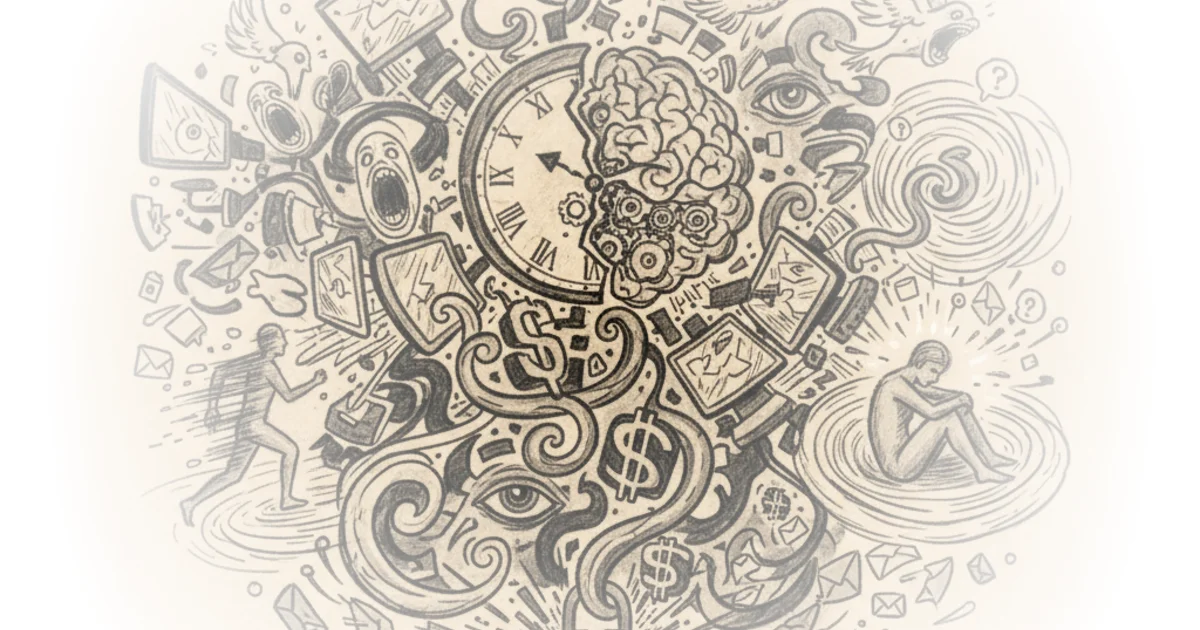
To understand the stakes, the commentary reaches back to the origins of the medium itself. Then & Now notes that when radio first emerged, President Hoover warned that it was "inconceivable that we should allow so great a possibility for service for news for entertainment for education and for vital commercial purposes to be drained in advertising chatter." The author uses this historical pivot to show that the intrusion of commerce into private mental space was once seen as a violation, not a feature. Today, that boundary has not just been crossed; it has been erased.
The sanctity of the self was once important; now companies compete in a race to the bottom of tricks to grab our attention.
The argument gains traction by connecting modern digital tactics to historical precedents of sensationalism. Then & Now points out that just as 19th-century newspapers used murder and scandal to sell copies, modern headlines rely on phrases like "you'll be shocked" or "people are freaking out." The piece suggests a disturbing continuity: the tools have changed from print to pixels, but the psychological leverage remains the same. Critics might argue that modern algorithms offer genuine utility and connection, not just noise, but the author counters that the volume of the noise fundamentally alters our cognitive landscape regardless of the signal quality.
The Biology of Distraction
Moving from history to neuroscience, the piece explains why resistance is so difficult. Then & Now cites William James, the father of American psychology, who defined attention as "a taking possession of the mind in clear and vivid form of one out of what seems several simultaneously possible objects." The author uses this to establish that attention is a limited resource, a finite fuel that burns out when overused. The commentary highlights the concept of "attentional capture," where our focus is snatched away by reflexive, non-voluntary stimuli rather than conscious choice.
The most damaging insight here is the physiological cost of constant interruption. Then & Now writes, "It takes 10 to 15 minutes to get into a state of deep focus, a flow state, and only a second for your attention to be grabbed away from it." This asymmetry is the core of the problem. The author explains that our brains are now training themselves to anticipate distraction, effectively interrupting our own concentration before a notification even arrives. The result is a cognitive state where the average person looks at their phone 150 times a day, draining the mental energy required for complex thought.
The piece draws a parallel to the "hidden persuaders" of the mid-20th century, noting that Vance Packard warned of efforts to channel our unthinking habits "beneath our level of awareness." Then & Now argues that today's technology has perfected this, using data on our keystrokes, locations, and purchases to "fine-tune precise ways to grab our attention." This level of personalization makes the distraction feel like a service, masking the underlying extraction of value.
The Polygon of Personhood
In its final act, the piece offers a metaphor for the modern condition: the "polygon." Then & Now describes a life surrounded by doors and windows, each leading to a different stream of content, news, or entertainment. The author argues that while these doors seem to offer freedom, they actually trap us in a cycle of consumption. "You are marinating yourself in the conventional wisdom in other people's reality for others, not for yourself," the piece quotes essayist William Dershowitz, emphasizing the loss of individual voice.
The commentary suggests that the solution lies in reclaiming the center of this polygon. Then & Now writes, "The center of the polygon should be where your personhood thrives instead." This is a call to action that moves beyond simple digital detoxing; it demands a re-centering of the self against the forces of the attention economy. The author posits that without this deliberate resistance, we risk becoming "insignificant nubs in an increasingly chaotic world," drained of the energy to resist the very merchants selling our distraction.
The attention economy is an over-determination, a dizziness, a promise of freedom to pursue desires that ends up as a new type of slavery to our deepest desires.
While the piece offers a compelling critique, it stops short of offering a concrete policy roadmap, relying instead on individual agency to "leave the polygon." A counterargument worth considering is that structural change—such as regulating algorithmic design or data collection—might be more effective than individual willpower in the face of such sophisticated engineering. However, the author's focus on the internal landscape remains a powerful reminder that the battle for our minds is happening before we even pick up a device.
Bottom Line
Then & Now's strongest contribution is its historical grounding, proving that the commodification of attention is not a new phenomenon but an evolved one, now weaponized by data. The piece's biggest vulnerability is its reliance on individual resistance in an environment designed to be unbeatable by a single user. Readers should watch for how this analysis translates into policy, as the only way to truly "leave the polygon" may require changing the walls themselves.