Most video essays on geometry start with shapes you'll find in a textbook. Derek Muller starts somewhere more interesting: with a 400-year-old scientist who believed the universe had hidden geometric harmony, and whose guesses led to one of the most surprising discoveries in modern physics.
The Kepler Connection
Muller begins by visiting Prague's Kepler Museum, but the real story isn't tourist history — it's what Kepler guessed about the solar system that turned out to be wrong in all the right ways. "Kepler is most famous for figuring out that the shapes of planetary orbits are ellipses," Muller writes, "but before he came to this realization he invented a model of the solar system in which the planets were on nested spheres separated by the platonic solids."
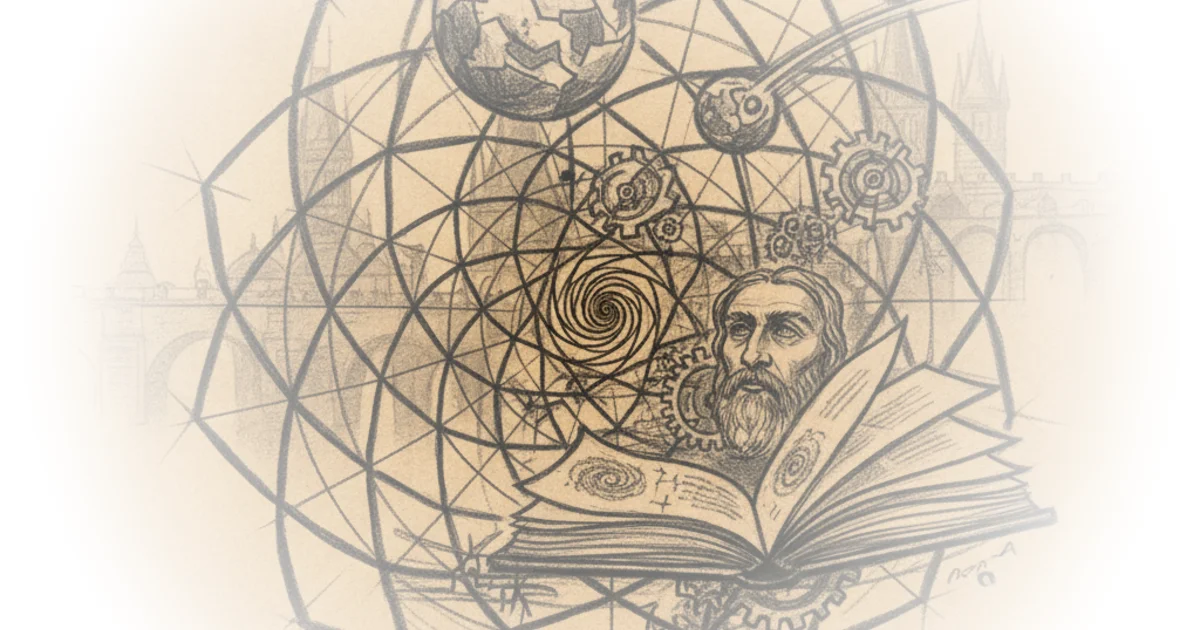
This matters because it shows how scientific intuition sometimes works. Kepler was wrong about the specific mechanism — the Platonic solids don't actually determine planetary distances — but he was right that geometry hides inside nature's most complex structures. Muller uses this to set up his real target: a pattern that never repeats, and what it means for physics.
The Tiling Problem Gets Weird
The core of the piece turns to one of mathematics' most counterintuitive results: there are shapes that can only tile the plane non-periodically. "There are an infinite number of shapes that can tile the plane periodically or non-periodically," Muller observes, then immediately complicates the claim by noting that some arrangements work locally but fail globally.
This is where the story gets strange. Muller explains Wang's conjecture — which held that if tiles could tile the plane, they must do so periodically — was "false." His student Robert Berger found a set of 20,426 tiles that "could tile the plane but only non-periodically." The number itself is almost comical: twenty thousand tiles, and none of them can ever form a repeating pattern. Muller frames this as a puzzle, which it is, but it's also a revelation about how pattern works in mathematics.
A finite set of tiles can tile all the way out to infinity without ever repeating the same pattern.
The Penrose Revelation
The real breakthrough came when mathematicians stopped asking what shapes could tile and started asking what shapes must — and found that just two pieces could fill an entire plane non-periodically. "Just two tiles go all the way out to infinity without ever repeating," Muller writes, and this lands because it sounds impossible until you see the diagrams.
Muller then does something visually powerful: he prints up two copies of the same Penrose pattern on transparency, overlays them, and shows that "the resulting interference you get is called a moire pattern where it is dark the patterns are not aligned." The light spots move as he rotates the layers. It's one of those moments where geometry becomes visible — and Muller clearly loves it.
The Golden Ratio Appears (And It Shouldn't)
What happens next is the part that feels like magic. When Muller counts up all the kites and darts in a particular pattern, "I get 440 kites and 272 darts. Does that ratio ring any bells? Well if you divide one by the other you get 1.618 that is the golden ratio."
This is the piece's most stunning claim: an irrational number — the most irrational of constants, actually — appearing in a tiling pattern that never repeats. "The fact that the ratio of kites to darts approaches the golden ratio an irrational number provides evidence that the pattern can't possibly be periodic," Muller writes. If it were periodic, the ratio could be expressed as two whole numbers. But here it's forever stuck in the middle of the Fibonacci sequence: 13 shorts and 21 longs appear in any section you check.
Critics might note this requires some careful reading — the golden ratio appears because Penrose deliberately constructed pieces from pentagons, which carry five-fold symmetry naturally. It's not magic; it's geometry built into the tiles. But Muller doesn't oversell it, and that restraint makes the reveal hit harder.
The Quasi-Crystal Question
The final turn is where Muller connects pure math to physical reality. "Crystals are built by putting atoms and molecules together locally," he writes, "whereas Penrose tilings well they seem to require some sort of long range coordination." This is the tension: how could nature produce something that seems to need global coordination when crystals form from local rules?
The answer comes from two places at once — Paul Steinhardt's computational simulations in the early 1980s and Dan Shechtman's actual material made of aluminum and manganese. "When he scattered electrons off his material this is the picture he got it almost perfectly matches the one made by steinhardt." The pattern with rings of 10 points reflecting the five-fold symmetry appeared independently in both work. Quasi-crystals exist, and Penrose tilings describe their structure.
Bottom Line
Muller's strongest move is showing that patterns which seem purely abstract — aperiodic tilings, irrational ratios, five-fold symmetry — have physical consequences we didn't expect. The piece's vulnerability is its pacing: the jump from Kepler's historical guesses to quasi-crystals happens fast, and some viewers will need time to breathe between these ideas. But that's also where the excitement lives. What comes next is wondering whether there are other patterns hidden in nature that we've never looked for.