Wesley Yang delivers a provocative, high-stakes critique of the modern gender movement, arguing that the institutional machinery built to secure gay marriage has been repurposed to drive a controversial agenda of medical intervention for children. This piece is notable not for its historical timeline, which Yang admits is complex, but for its sharp focus on the tactical continuity between two seemingly distinct social movements. For a busy reader, the value lies in Yang's specific claim that the "weaponization" of suicide and the prioritization of symbolic desires over material realities are the true bridges connecting the LGB and T communities today.
The Institutional Shift
Yang begins by challenging the assumption that the LGBTQ+ movement is a monolithic block with a single, unbroken trajectory. He observes that the institutional juggernaut built for "marriage equality" was "indeed quickly repurposed to propagate the chemical castration and surgical modification of a population of mostly autistic, gay, mentally-ill, and gender nonconforming youth." This framing is aggressive, designed to shock the reader into questioning the current direction of the movement. Yang suggests that the expansion of the acronym has created friction, noting that "organized LGB splinter groups" have emerged, recognizing a threat to their own gains when classed with "adult fetishists seeking to induct confused children into a cult of medicalized self-harm."
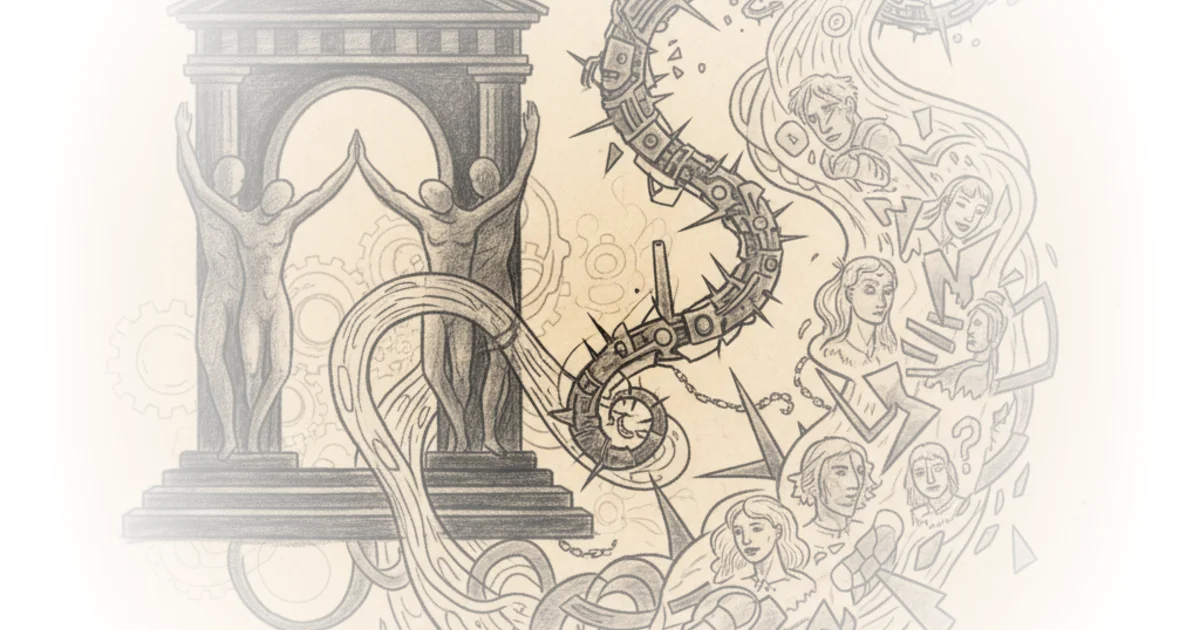
The author leans heavily on the idea of a "Successor Ideology" that cannibalizes previous reform movements. He writes, "the transgender movement's success has come from wielding with brutal efficiency the institutions, tropes, and tactics that were first developed by gay and lesbian activists before them." This is a powerful, if contentious, assertion. It shifts the debate from whether one group caused the other to how the methods of the past are being applied to the present. Critics might note that this framing risks oversimplifying the distinct origins of transgender activism, which Yang himself acknowledges in the section by his correspondent Moonlit Piglet, who argues that transgender activism has "always existed apart from, and in tension with, the gay rights movement." Yet, Yang's point remains that the strategic overlap is what matters most in the current political landscape.
"The very major organization that developed to fight for gay and lesbian equality in the last fifty years — GLAAD, the HRC, and the ACLU, to name a few — immediately shifted to transgender activism after Obergefell."
Weaponizing Tragedy
The commentary then pivots to a more somber analysis of how suicide narratives are used in political discourse. Yang traces a line from the Tyler Clementi era to the present, arguing that the gay rights movement "helped desensitize progressives to the dangers of politicizing suicide." He recalls how figures like Dan Savage pinned Clementi's death on "hate groups" and how Ellen DeGeneres blamed the Mormon Church for suicide rates, creating a precedent where "any trans person's suicide can be linked to any person's disapproval at any time."
Yang's critique here is that these tactics, once used to garner sympathy for gay rights, have evolved into a form of "emotional blackmail" in the gender debate. He writes that the fixation on suicide "bordered on obsessive" and that the narrative of the "martyr" was used to silence dissent. This is a difficult argument to navigate; while the politicization of tragedy is a valid concern, Yang's suggestion that the gay rights movement's approach was "ghoulish" may alienate readers who view those campaigns as necessary responses to a genuine crisis of youth mental health. However, his observation that these tactics laid the groundwork for current demands is a crucial point for understanding the intensity of modern cultural conflicts.
The Priority of Symbolism
Perhaps the most distinct argument Yang makes concerns the shift from material rights to symbolic validation. He contrasts the tangible discrimination faced by gay Americans—housing, employment, healthcare—with the focus on the word "marriage." He notes that activists argued that "even if civil unions could be entirely equal... the division would still be entirely unjust." Yang sees a direct lineage from this to the current demand for gender-affirming spaces, stating, "It's no wonder, then, that I don't want to use the gender-neutral shower, I want the one that validates my gender makes so much sense to so many liberals today."
The core of this argument is that the movement has moved away from concrete protections toward a worldview where "depriving someone of something they really, really want to be an injustice in and of itself." This is a sharp critique of the philosophical underpinnings of the current movement. Yang argues that the gay rights movement was "tremendously reckless with the feel-good moral principles they casually relied on," prioritizing the "transcendent moral and spiritual beauty" of the institution over the practical benefits. While this overlooks the very real legal and social barriers that marriage equality removed, it effectively highlights a shift in activist priorities that many observers find jarring.
"Rather than laying out arguments for why the specific institution of marriage ought to be extended to the specific group of gays and lesbians on the basis of specific material concerns, the gay rights movement pushed a dangerously broad worldview that saw depriving someone of something they really, really want to be an injustice in and of itself."
Bottom Line
Wesley Yang's strongest contribution is his detailed dissection of the tactical and rhetorical continuity between the gay rights movement and the current gender activism, particularly regarding the use of suicide narratives and the prioritization of symbolic validation. The argument's biggest vulnerability lies in its stark characterization of transgender youth as a "cult" of "self-harm," a framing that may obscure the genuine distress and complex identities of the individuals involved. Readers should watch for how this critique of institutional tactics influences the broader debate on gender-affirming care for minors, as the tension between material rights and symbolic recognition continues to define the political landscape.
"The gay rights movement of the 2000's and the transgender movement of the present day are obviously linked — if not in terms of ultimate ideals, then surely in terms of strategy and tactics, as well as concrete institutions."
The Biological Question
Finally, Yang addresses the contentious issue of biology, distinguishing his view from conservative appeals to "nature." He argues that early gay liberation movements grounded themselves in the reality of biological sex, but the modern movement has moved to "decenter biological sex" entirely. He writes that the movement pushed to "collapse both heterosexuality and homosexuality" into a framework where identity is detached from physical reality. This section serves as the philosophical capstone to his argument: that the movement has moved from seeking rights for a specific biological reality to seeking validation for an identity that transcends it. While this is a profound philosophical claim, it remains a point of deep contention, with critics arguing that gender identity is a valid aspect of human experience that does not require the denial of biology. Yang's framing, however, forces the reader to confront the fundamental shift in how the movement defines the self.