Kevin Xu arrives in the United Arab Emirates not as a tourist, but as a forensic auditor of the world's most audacious geopolitical gamble. While global narratives often relegate the Gulf states to the sidelines of the US-China AI rivalry, Xu's on-the-ground reporting reveals a deliberate, high-stakes pivot: the UAE is not a neutral Switzerland, but a committed ally to the American camp, betting its entire economic future on becoming the physical engine of the next computing era.
The End of Neutrality
The most striking revelation in Xu's account is the dismantling of the "Switzerland" myth. For years, the UAE has been viewed as a neutral broker, a place where East and West meet without friction. Xu argues this perception is not just outdated, but actively harmful to the UAE's strategic goals. "The UAE does not want to be a 'Switzerland'... A neutral party does not vote; it abstains. The UAE does vote, and has voted with its labor force, seemingly unlimited capital, and a point of view," Xu writes. This is a crucial distinction. By explicitly choosing a side, the UAE is attempting to secure a seat at the table of the most critical industrial competition of the 21st century.
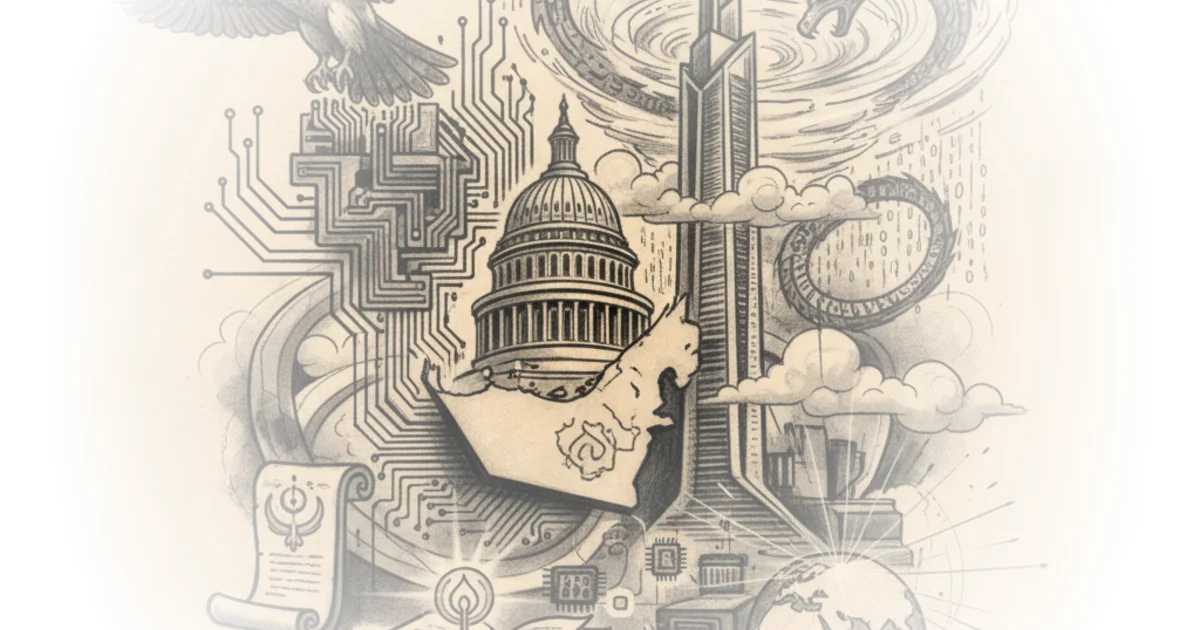
This choice is being materialized through massive infrastructure projects, specifically the Stargate initiative. Xu notes that the project is a "physical manifestation of how the UAE... has voted this time: Team USA." The scale is difficult to comprehend: a 5-gigawatt mega data center project, with the first phase alone designed to house the most advanced GPUs for both local and American companies. The sheer velocity of this build-out is staggering. Xu points out that 1.5 million construction workers—15% of the total population—are currently building something every day. "The pace of building is literally fast and furious," he observes, drawing a parallel to the action movie imagery of skyscrapers being breached, but here, the destruction is replaced by relentless construction.
Critics might argue that such a rapid, state-directed build-out risks creating white elephants or infrastructure that outpaces actual demand. However, Xu suggests the UAE's unique advantages—abundant energy and a flexible, massive foreign workforce—solve the bottlenecks that are currently crippling data center construction in the United States. While the US grapples with labor shortages and energy grid constraints, the UAE offers a "token factory" with latency to India and Pakistan of less than 30 milliseconds. This pragmatic calculation suggests the move is less about ideology and more about solving the immediate physics of AI scaling.
The UAE has voted in favor of the US when it comes to AI, it does not want to be seen as Switzerland, and it needs to make this big bet work!
The Singapore Model and the Pragmatism of Survival
Xu frames the UAE's strategy not as techno-idealism, but as a desperate and necessary form of pragmatism. With a population of only 10 million, the country cannot rely on organic growth. Instead, it is leveraging AI as a force multiplier. "For a country of merely 10 million people... if this AI thing boosts productivity or drives efficiency by 40% or 50%, it would be as if the UAE all of a sudden has 4 or 5 million extra people!" Xu argues. This logic mirrors the development trajectory of Singapore, a small nation that punched above its weight by becoming a dense node of global commerce and compute.
The parallels are intentional. Xu notes that both Sheikh Mohamed bin Zayed Al Nahyan and Sheikh Mohammed bin Rashid Al Maktoum have publicly acknowledged Singapore's development journey as a "distinguished model." In a classic display of this pragmatic gene, the UAE became the first country to appoint a Chief AI Minister in 2017, a move Singapore followed in 2023. The goal is to create a "digital embassy" concept where other nations can run sovereign workloads in UAE data centers. However, Xu is skeptical of this specific offering, calling it a "temporary stopgap" rather than a sustainable model for nations truly serious about sovereignty. "If a country is not AGI-pilled, then such a 'digital embassy' offering would not be attractive," he writes, suggesting that true sovereign AI requires physical infrastructure within one's own borders.
Yet, the pragmatism extends to the UAE's relationship with China, its largest trading partner. Despite voting with the US on AI, the UAE is not engaging in a total decoupling. Xu observes that while critical infrastructure is being purged of Chinese technology to satisfy American partners, less strategic elements, like surveillance cameras, remain. "Ripping out Chinese technologies in critical infrastructure... will also continue. Pragmatism demands it," he notes. This dual-track approach allows the UAE to maintain leverage with both superpowers, a balancing act that requires constant, high-wire agility.
Inclusivity by Chopsticks
Beyond the macro-geopolitics, Xu turns his attention to the human element required to sustain this machine. The UAE's model relies on an "inclusive representative tribal system," a phrase that sounds like corporate boilerplate until one examines the ground truth. Xu describes a society where an investment manager from London and an Uber driver from Pakistan coexist, bound by Emirati traditions but united by economic necessity. He finds a poignant symbol of this in a modest noodle restaurant in Dubai, where the chopsticks box contained five different types of chopsticks to accommodate various preferences. "The world's most inclusive chopsticks offering, found in Dubai," he quips, using the detail to illustrate a broader point about the country's ability to absorb diverse talent.
This inclusivity, however, is conditional. It exists within the boundaries of the state's cultural and political framework. Xu acknowledges the tension here: the country needs massive talent density to build its AI future, but must do so without destabilizing its social fabric. The "inclusive representative tribal system" is the UAE's answer to the Western concept of diversity, tailored to a context where the host nation remains the absolute authority. It is a unique social contract that allows for rapid modernization without the friction of Western-style political polarization.
Bottom Line
Kevin Xu's reporting succeeds in stripping away the mystique of the UAE's AI ambitions, revealing a cold, hard calculation of survival and dominance. The strongest part of his argument is the reframing of the UAE from a neutral observer to an active, voting participant in the US-China tech war, driven by the existential need to multiply its tiny population through technology. The biggest vulnerability remains the execution: can a state-directed, hyper-accelerated build-out truly deliver the complex, multi-tenant cloud services required by global hyperscalers without the friction of a mature, organic market? As the Stargate project breaks ground, the world will be watching to see if the UAE's "fast and furious" pace can outlast the inevitable growing pains of the AI industrial complex.
The UAE does not want to be a 'Switzerland'... A neutral party does not vote; it abstains. The UAE does vote, and has voted with its labor force, seemingly unlimited capital, and a point of view.