Most people assume the global economy runs on the Federal Reserve printing money and shipping it overseas. Joeri Schasfoort, hosting a deep-dive conversation with monetary expert Jeff Snyder, dismantles that intuition by revealing that the true engine of global finance operates entirely outside U.S. borders, in a shadow system of private bank liabilities that functions as the world's actual reserve currency.
The Invisible Ledger
Schasfoort introduces Snyder, an educator who stumbled upon this hidden architecture while analyzing corporate balance sheets in the 1990s, only to find that standard economics textbooks had no explanation for the massive volume of "Eurodollars" and repurchase agreements flooding the system. "I started looking at these things... what really bothered me the most was as a young man in this profession was nobody wanted to know it," Schasfoort quotes Snyder recalling the industry's reluctance to discuss the mechanics of offshore banking.
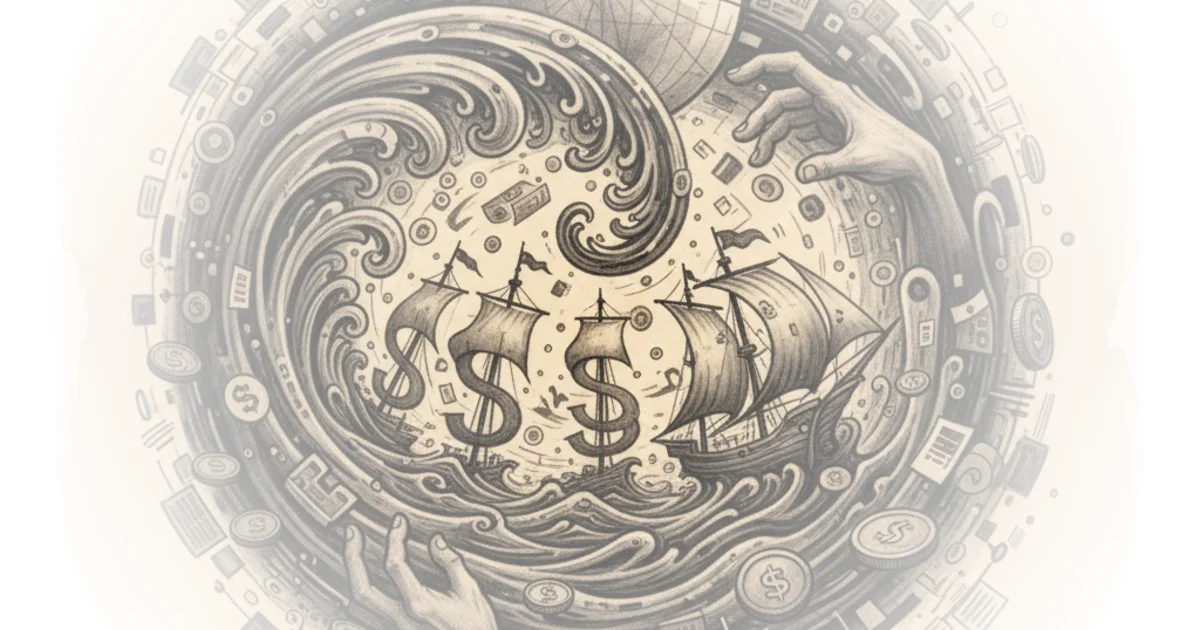
The core of the argument is that the term "Eurodollar" is a historical misnomer that has nothing to do with the European Union currency; rather, "Euro" simply means "offshore." Snyder explains that this system emerged in the 1950s as a way to bypass the inefficiencies of moving physical cash, evolving into a ledger-based network where banks trade claims on dollars without ever moving the actual currency. "The real Eurodollar secret which was to move outside of physical currency and just trade Bank liability so it's actually a ledger money system Bank centered outside the U.S transacting in US dollar denominations," Snyder asserts.
This framing is crucial because it shifts the narrative from a government-controlled monetary policy to a private, decentralized plumbing system that the executive branch cannot easily regulate. The system allows for frictionless global commerce by letting a bank in London, a client in Malaysia, and a supplier in Pakistan transact in dollar claims without a single Federal Reserve note changing hands. "Once you've removed your remove the need to transact in physical hand-to-hand cash cash or even Bank Reserves from the Federal Reserve you've given Banks essentially free reign to come up with all different kinds of transactions," Snyder notes.
The Eurodollar system is the real Reserve currency and the way it operates actually means how much money is floating around the world.
Critics might argue that this distinction is merely semantic and that the Federal Reserve's tools, such as swap lines, effectively control this offshore market. However, Snyder's point is structural: the sheer volume of these private liabilities creates a layer of money supply that exists independently of the central bank's direct balance sheet, making the system more fragile and prone to liquidity crunches that official policy struggles to predict.
The Global Vehicle Currency
Schasfoort guides the conversation toward the practical implications, noting how even non-U.S. entities and digital creators often default to dollar-denominated payments because the infrastructure demands it. Snyder confirms this observation, arguing that the dollar's dominance isn't just about pricing oil, but about its role as a "vehicle currency" that intermediates trade between nations that do not use the same currency. "A lot of people especially in the United States tend to think of a reserve currency as oh we get to price oil in US Dollars that's not it at all Reserve currency is as I said this uh what was used to be called a vehicle currency," Snyder clarifies.
The commentary here is effective because it moves beyond abstract macroeconomics to the ground-level reality of global commerce. Whether it is a factory in Malaysia or a freelancer in Pakistan, the ability to participate in the global economy hinges on access to this offshore dollar network. "If you're over there in Europe and you want to invest make you want to build a factory and say Malaysia you got to have access to the euro dollar system because in Malaysia while they might take Euros um certainly in the early early part of the euro dollar era you're you're the dollar denomination," Snyder explains.
This highlights a critical vulnerability: the entire global trading system relies on a private, offshore network that is not directly overseen by the U.S. government or any single central bank. When this system tightens, as it did during the 2008 financial crisis and the 2020 pandemic shock, the resulting liquidity freeze can paralyze international trade regardless of domestic economic conditions. The administration may control the onshore dollar, but the offshore system dictates the flow of global capital.
Bottom Line
Schasfoort and Snyder successfully reframe the global monetary system, proving that the true power of the dollar lies not in the Federal Reserve's vaults but in a vast, private network of offshore bank liabilities. The argument's greatest strength is its ability to explain why global liquidity crises occur despite aggressive central bank intervention, though it leaves the reader wondering how much longer this unregulated parallel system can remain stable in an era of rising geopolitical fragmentation.