This piece from More Perfect Union exposes a quiet economic theft: the transformation of owned machinery into leased software, stripping farmers of their property rights and inflating costs by billions. It moves beyond simple consumer frustration to reveal a systemic legal maneuver where companies like John Deere argue that a $300,000 tractor is not actually owned by the buyer, but merely licensed. This is not just about broken tractors; it is about the erosion of the First Sale Doctrine in the digital age, with implications that stretch from your car to your medical equipment.
The Monopoly on Repair
More Perfect Union begins by grounding the abstract in the visceral reality of a Montana farmer named Walter, whose hay crop was imperiled by a tractor that shut down for no apparent reason. The narrative quickly reveals the bottleneck: "John Deere is costing farmers and ranchers Like Walter billions of dollars and lost income." The author highlights a critical dependency where modern diagnostics require proprietary software that independent mechanics cannot access. As More Perfect Union writes, "When a modern John Deere tractor malfunctions, you can't diagnose the problem without John Deere's software but John Deere won't let Farmers or independent mechanics use it."
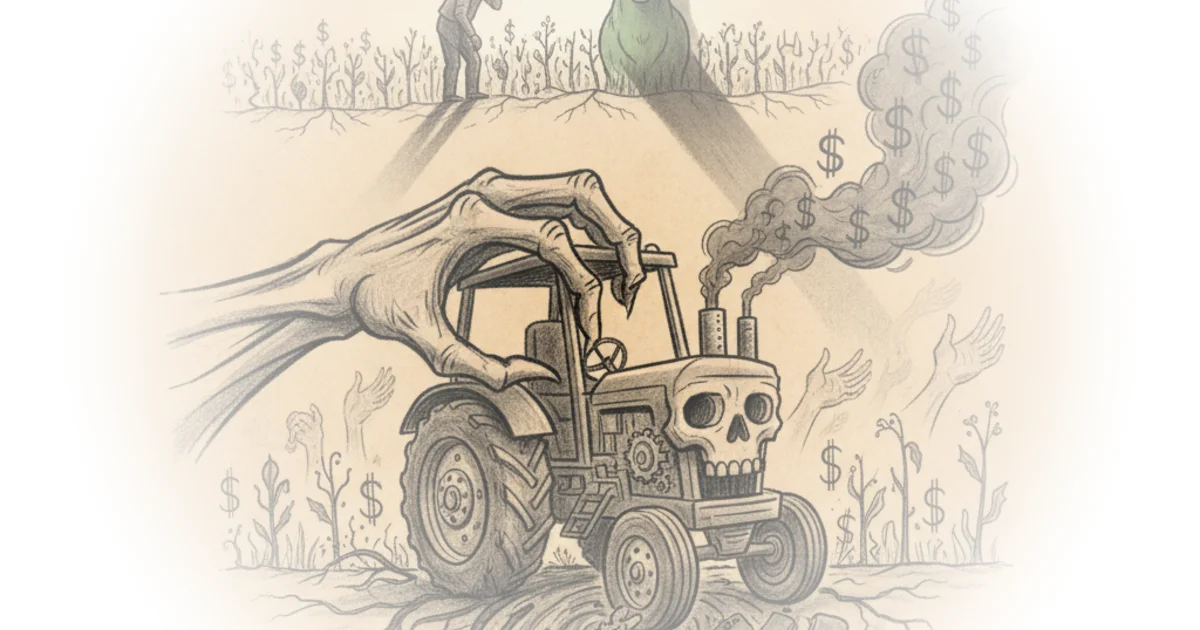
The commentary effectively illustrates the absurdity of the situation: a $150 part and $300 of labor ballooning into a $5,000 bill simply because the manufacturer controls the digital keys. The piece argues that this is a deliberate business model, noting that "service and repair work can yield John Deere five times more profit than new equipment sales." This framing is powerful because it shifts the blame from inevitable technological complexity to a calculated strategy of profit extraction. Critics might argue that proprietary software is necessary for safety and security, but the evidence presented—such as a faulty sensor causing a shutdown—suggests the restrictions are often disproportionate to the risk.
"We're not leasing it, we're buying that... the gadgets that are in it are part of that equipment and the technology that runs that gadgets is part of that equipment."
The Legal Loophole: Licensing vs. Owning
The article's most sophisticated argument lies in its legal analysis of how companies circumvent traditional property rights. More Perfect Union explains that manufacturers are redefining the transaction from a sale to a license, effectively nullifying the First Sale Doctrine. This doctrine, which allows owners to resell or lend physical goods, is being bypassed by Digital Rights Management (DRM). The author notes, "According to the contract I agreed to when I bought this book I can only read this ebook using an Amazon approved device... it's like renting a book with an invisible string that ties it to the seller."
This logic is then applied to heavy machinery and automobiles. The piece points out that General Motors has told the Copyright Office that they, not the consumer, own the vehicle through its entire life because of the software license. This is a stunning claim that, if unchallenged, would fundamentally alter the concept of ownership in America. The commentary rightly identifies this as a "twisted legal logic" that allows companies to lock out third-party repair shops. The stakes are raised significantly when the piece connects these repair monopolies to human safety, citing electric wheelchair users who wait months for repairs and hospitals without critical equipment.
Critics might suggest that without these strict controls, manufacturers would be liable for unsafe modifications, but the article counters that independent mechanics are capable and that the current system creates dangerous delays. The argument holds weight because it highlights that the data restrictions are often a pretext for maintaining a monopoly rather than a genuine safety concern.
The Battle for the Future of Repair
The final section of the coverage shifts to solutions, outlining a three-pronged approach: enforcing antitrust laws, updating copyright exemptions, and passing Right to Repair legislation. More Perfect Union details how the Federal Trade Commission has already intervened in similar monopolies, from Harley-Davidson to ice cream machines. The author emphasizes the urgency of the "Freedom to Repair Act," which would permanently amend the Digital Millennium Copyright Act to allow circumvention for repair purposes.
The piece does not shy away from the political reality, noting that companies worth over $10 trillion are fighting back with aggressive lobbying. It exposes the fear-mongering tactics used by automakers, who have claimed that sharing repair data would give criminals access to vehicle information. The author dismantles this by pointing out that data breaches are already occurring due to manufacturer negligence, not independent repair. "Car companies also lock out local repair shops by aggressively getting design patents for the parts of a car that are most likely to be damaged in a collision," the text explains, showing how intellectual property is weaponized to force consumers into expensive dealership channels.
The emotional core of the argument is the stress placed on farmers, who face the highest suicide rate in the nation. The inability to fix essential equipment during critical planting or harvesting windows adds a layer of existential dread to an already high-pressure profession. As More Perfect Union puts it, "Equipment breaking down and you are not able to fix it, you can't do anything—that's a whole new level of stress."
"I bought it but I'm kind of a slave to your operation."
Bottom Line
More Perfect Union delivers a compelling indictment of the "right to repair" crisis, successfully framing it not as a niche consumer complaint but as a fundamental threat to property rights and economic competition. The strongest element of the argument is the clear demonstration of how licensing models are being used to dismantle the First Sale Doctrine, turning owned assets into rented services. The piece's biggest vulnerability is the sheer scale of the corporate opposition, which has proven effective at stalling federal legislation, but the growing momentum in state houses suggests the tide may be turning. Readers should watch for the upcoming legislative battles in state capitals, as the outcome will determine whether we retain the right to fix what we own.