Derek Muller has found something remarkable at what appears to be the Naval Warfare Center — an indoor ocean facility that isn't just a pool but a controlled laboratory for replicating the open sea. What makes this piece compelling isn't the spectacle of giant wave machines (though that's certainly visually arresting). It's the precision with which they can reproduce exact wave conditions, and what that means for understanding how ships will behave in the real world.
The facility is massive — 360 feet long, 240 feet wide, and 20 feet deep. Muller describes it as "the biggest wave pool in the world" and notes "it's just it's insane cuz they say indoor ocean but like it's exactly what it is." But size isn't the real story here.
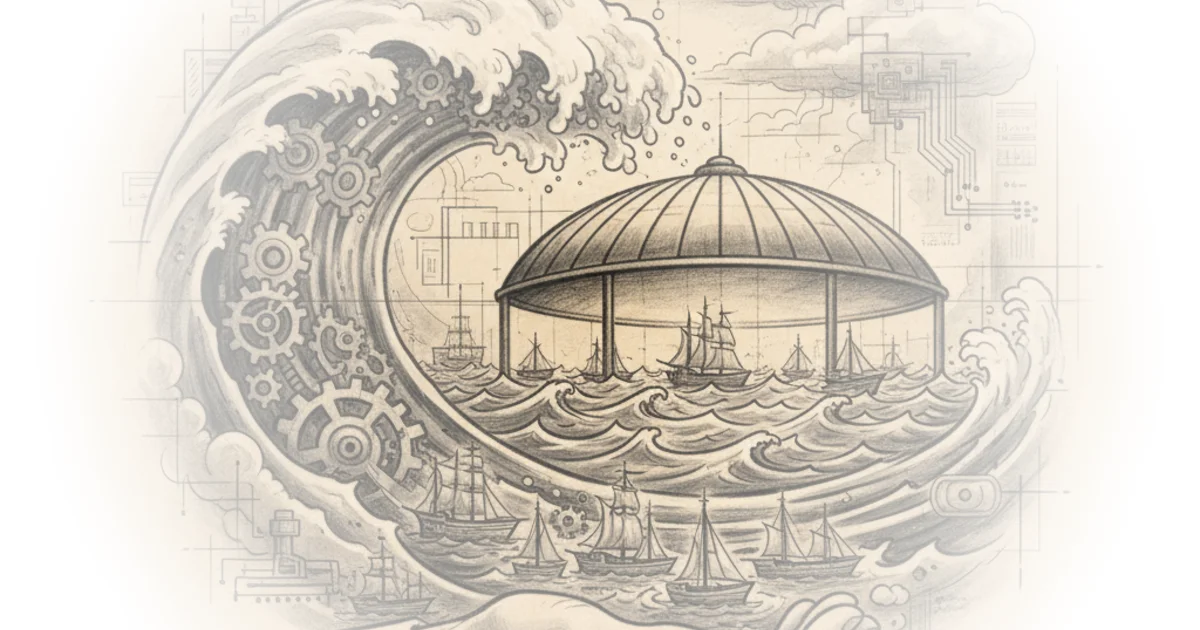
The Control Problem
What makes this one different is control. Muller writes, "they can create waves of a specific amplitude and frequency and do so repeatedly should we try our 1 Hertz yeah" — and that repetition is precisely what sets this facility apart from any ocean. In the actual sea, you never see waves this regular.
The engineering behind this is staggering: 216 individual wave makers programmed to move in "incredibly well choreographed ways" so they can produce reproducible perfect size perfect frequency waves that go across the entire pool. This isn't just showmanship — it's the foundation for rigorous ship testing.
They have a really cool demo that takes advantage of the different speeds of different frequency waves you can see it starting here they send out high frequency waves first followed by lower and lower frequency waves and because the high frequency waves travel slower the lower frequency waves gradually catch up wow and they've timed it so that all the waves meet up at exactly the same time and place in the pool.
This demonstration of wave superposition — where waves "meet up" and create breaking conditions — isn't just a parlor trick. It's the precise mechanism engineers use to understand how ships will hold up in real storms.
The Real Purpose
The facility's actual purpose is straightforward: replicate on a small scale the types of waves Navy ships will encounter in the oceans of the world. Muller writes, "research Engineers Place ships modeled after billion dollar vessels in the water to see how different designs actually behave in real world conditions."
But here's where the science gets nuanced. They don't just scale down — they scale with specific ratios based on the Froude number, a measure of inertial to gravitational forces. The model ship's hole is 46 times smaller than the real thing, which means "to get accurate data it should be traveling at 1 over the square root of 46 time its real world speed." This mathematical precision is what makes the facility valuable: the physics are identical to a real ship out on the open ocean — just slowed down.
The Geography of Waves
One of the most compelling segments involves Muller's conversation about how different oceans produce different wave conditions. "For most people I think an ocean is an ocean but you're saying that there's sort of like different conditions depending on where you are," Muller notes — and then gets a surprising answer.
The North Sea has what experts call a "peier spectrum" due to limited fetch, while the Atlantic produces broader spectra from steady winds across open ocean. This matters practically: when testing engineers first have to figure out where the ship will be deployed and which Spectra best match these locations before creating them in the pool.
A former destroyer commander provides vivid context: "My bed was actually in the middle of a room and the seas were so bad that one night I woke up in the middle of the night and my whole mattress with me on it was sliding off of my bed frame" — conditions far rougher than anything seen in this controlled environment.
Counterpoints
Critics might note that wave pool testing, however precise, still lacks the full chaos of real ocean conditions. Even controlled superposition can't replicate every variable factor — the wind's exact turbulence, the interaction with other ships, the specific physics of breaking waves in open water. There's also the question of whether scale models fully capture how billion-dollar vessels will perform under stress.
Bottom Line
The strongest part of this piece is its demonstration that wave control isn't just about making big splashes — it's about precise replication for engineering purposes. The facility's 216 wave makers and superposition capabilities represent decades of refinement in understanding ocean conditions. Its vulnerability? Even with perfect control over frequency, amplitude, and direction, the ocean remains fundamentally unpredictable. You can recreate every spectrum you know, but you can't test against what you didn't anticipate.
The indoor ocean is remarkable precisely because it shows how much we understand about wave mechanics — and how much we'll never fully control.