Jesse Singal delivers a surreal, hallucinogenic short story that masquerades as memoir, using the absurdity of religious ritual to explore profound grief and the desperate human need for connection. Rather than a standard report on Jewish outreach, the piece constructs a fever dream where the boundaries between sacred text, drug-induced euphoria, and physical trauma dissolve, forcing the reader to confront the fragility of the self.
The Architecture of Grief
Singal frames the narrative around the tension between the rigid, physical reality of the body and the elusive nature of spiritual solace. He introduces a character, Dovid, who serves as an impossible guide through the narrator's recent losses. Singal writes, "Living in a city was supposed to sustain and vivify you — that was why it was worth it — but lately it felt like there was a fine mesh sieve between everyone else and me, that whatever actually got through it was thin and watery and nutritionally worthless." This metaphor of the city as a filter that strips away meaning resonates deeply with anyone feeling isolated in a crowd. The author uses the specific Jewish practice of seeking out non-observant men to wear tefillin—the black leather boxes containing Torah verses—as the catalyst for this breakdown of reality.
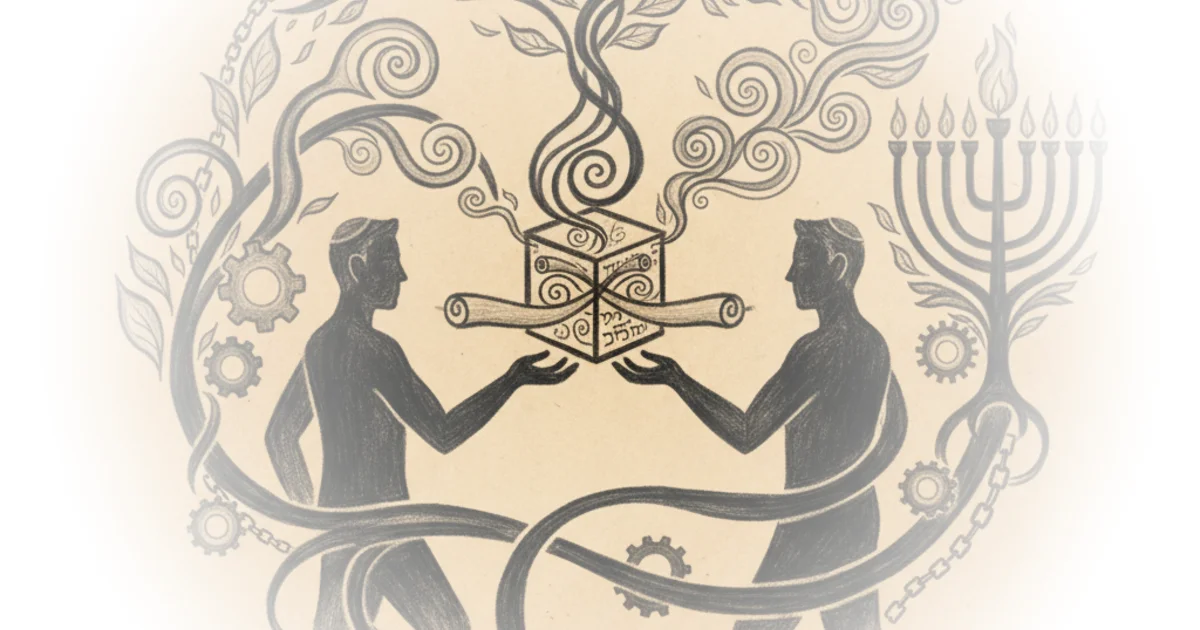
The story leans heavily on the concept of the genizah, a storeroom where worn-out sacred texts are kept before burial, a tradition rooted in the belief that God's name cannot be destroyed. Singal twists this historical reverence into a bizarre ritual. He describes a scene where Dovid explains, "We dry them out in specialized chambers in water towers that we retrofit. When they get brittle enough we bring in old men. The old men say a few blessings, and then they shred the Torahs by hand while singing songs of praise and apology." By transforming the solemn act of preserving holy words into a method for creating a drug, Singal creates a jarring dissonance. The narrator's decision to inhale these fragments—"shredded-up bits of Torah"—becomes a desperate attempt to ingest meaning directly. As Singal puts it, "Maybe that was why I was here — to stop being so afraid. Maybe Dovi, who had already so amazed and invigorated me, could reconfigure me into someone better and braver."
The narrator's decision to inhale these fragments becomes a desperate attempt to ingest meaning directly, turning a sacred burial rite into a drug-fueled epiphany.
Critics might argue that this conflation of religious ritual with recreational drug use risks trivializing the very real devotion of the Chabad-Lubavitch movement, which the story satirizes through the character of Dovid. However, Singal's intent appears less to mock the faith itself and more to highlight the narrator's own disorientation and the lengths to which a grieving person will go to feel something real.
The Physics of Connection
The narrative shifts from the bedroom to a surreal road trip to Water Country, a water park that serves as a liminal space between the narrator's past and a potential future. Singal uses the setting to explore the idea of a "two-body solution" to the problem of infinity, suggesting that connection between two people can create a stable universe against the chaos of loss. The absurdity peaks when the narrator, under the influence of the Torah smoke, claims to have suddenly mastered Hebrew, translating a scroll that describes the human condition as a digestive failure: "The past is like a thick, chunky stew... You have no choice in this matter." This grotesque imagery underscores the inescapable weight of history and memory that the narrator is trying to shed.
The climax occurs at the "Geronimo" slide, a metaphor for the terrifying leap of faith required to move forward. Singal writes, "The moment you splashed to a stop at the bottom that first time, that integer value altered your destiny." The physical danger of the slide mirrors the emotional risk of vulnerability. When Dovid attempts to kiss the narrator, the reaction is visceral: "a current of atavistic rage surged through me and I pushed him away, hard." This rejection leads to Dovid's fatal fall, a moment where the story's magical realism collides with brutal physical consequence. The narrator's subsequent flight toward the bulldozer—a grotesque image of disposal—highlights the horror of realizing that the attempt to fix oneself has destroyed the very thing that offered comfort.
The Illusion of Control
The story concludes with a jarring return to a clinical setting, where the narrator wakes to find a surgeon, Dr. Schwarzstern, taking measurements of his face. The revelation that the entire journey was a drug-induced hallucination, recorded and played back to the narrator, reframes the narrative as a study in consent and delusion. Singal notes, "Dovid had been recording my trip and he played the recording. It proved, beyond any semblance of a doubt, that while I was under the influence of Torah I had started screaming get this thing off me, get this thing off me, scratching at my nose." The narrator's claim of enthusiastic consent—swearing to "God, to Adonai, to Allah, to Jah"—is revealed as a fabrication of the altered state. This ending forces the reader to question the reliability of the narrator's perception of reality and the ethics of Dovid's intervention.
Singal's choice to end on this ambiguous, slightly sinister note leaves the reader unsettled. The "forever mitzvah" of the title suggests an endless cycle of seeking and failing to find redemption. The story suggests that while the desire to be "reconfigured" is powerful, the methods we choose to achieve it can be as destructive as the grief we are trying to escape.
Bottom Line
Singal's piece is a masterclass in using the surreal to articulate the unspeakable pain of loss, though its reliance on hallucinogenic tropes may alienate readers seeking a more grounded exploration of faith. The strongest element is the subversion of the genizah tradition, turning a rite of preservation into a vehicle for self-destruction, which effectively mirrors the narrator's internal state. The biggest vulnerability lies in the final twist, which risks reducing the emotional journey to a mere trick of the mind, potentially undermining the genuine connection the narrator felt with Dovid before the fall.