The Yugoslav Playbook, Scaled Up
Good Times Bad Times, a geopolitics-focused YouTube channel, concludes its three-part series on a hypothetical Russian collapse with an examination of what would follow. The analysis draws heavily on Janusz Bugajski's book "Failed State: A Guide to Russia's Rupture" and lands on a central tension that runs through every serious discussion of Russian dissolution: the short-term dangers are terrifying, but the long-term prospects for the people currently living under Moscow's imperial project could be dramatically better.
The Yugoslav comparison is the analytical backbone of the piece, and it is well chosen. The breakup of Yugoslavia produced wildly different outcomes in different places -- a brief skirmish in Slovenia, genocide in Bosnia, a NATO bombing campaign in Serbia, nothing at all in Montenegro. The authors argue that a Russian collapse would follow a similar pattern of uneven violence, but at a continental scale and with nuclear weapons in play.
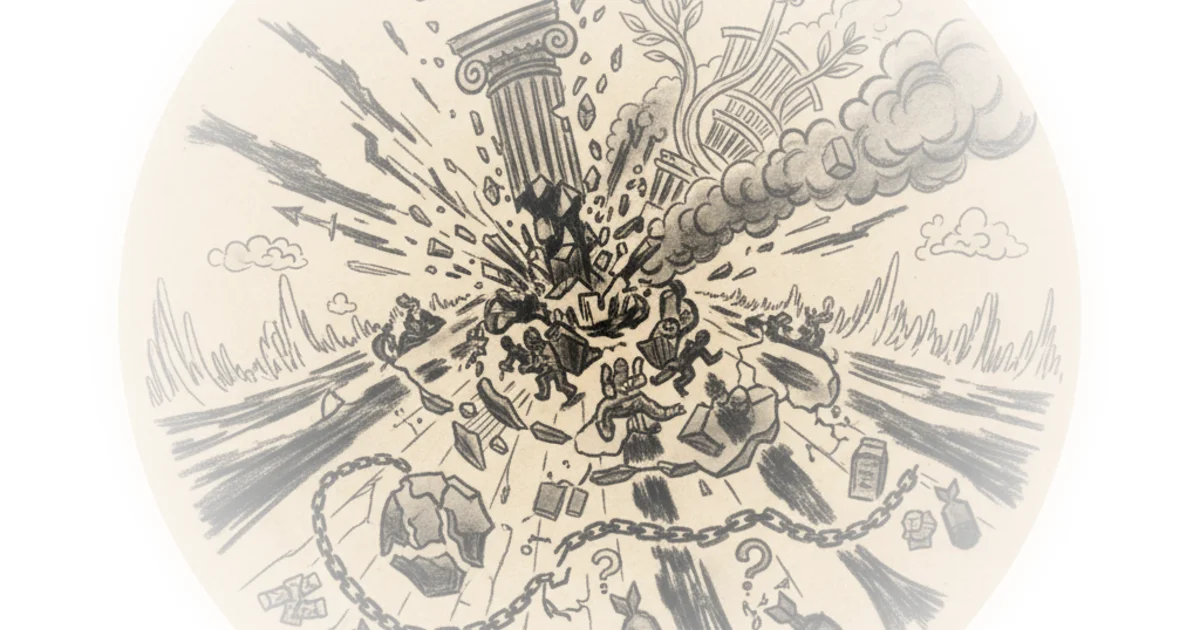
The fall of Moscow will be one of the most important events defining the 21st century comparable in its impact to the two world wars or the fall of the USSR in the 20th century.
That is a bold claim, but not an unreasonable one. A state spanning eleven time zones, possessing the world's largest nuclear arsenal, and sitting atop enormous energy reserves does not disintegrate quietly. The question is not whether it would be consequential, but whether the consequences can be managed.
The Nuclear Problem Has No Clean Solution
The most sobering section of the analysis concerns nuclear weapons. The authors propose a framework where new successor states trade their inherited warheads for international recognition, trade agreements, and security guarantees -- essentially a replay of the Budapest Memorandum process that denuclearized Ukraine, Belarus, and Kazakhstan after 1991.
But here the analysis runs into its own counterargument, and to the authors' credit, they confront it directly. The Budapest Memorandum promised Ukraine sovereignty and territorial integrity in exchange for surrendering its nuclear arsenal. Russia, a signatory to that memorandum, invaded Ukraine. First in 2014, then in full force in 2022.
This bargaining chip has been made significantly weaker by this event. There is little to no incentive for the various actors to relinquish their warheads to any new Moscow-run state as had been done 30 years earlier by Ukraine.
This is the central paradox of post-Russian nuclear diplomacy. The international community's best tool for denuclearization -- security guarantees in exchange for disarmament -- was discredited by the very power whose collapse would make it necessary again. Any new successor state leader who agreed to give up nuclear weapons in exchange for paper promises would be making a decision that recent history has shown to be catastrophically naive.
The authors acknowledge that full denuclearization would be impossible and that Moscow would likely retain its nuclear status even in a diminished form. What they do not fully reckon with is the possibility that several successor states might rationally choose to keep their warheads precisely because the Budapest precedent demonstrated that disarmament invites aggression. A world with five or six new nuclear states carved from Russian territory is a fundamentally different strategic environment than anything humanity has navigated before.
The Great Power Chess Match
The analysis of how major powers would respond to Russian dissolution is where the piece does its strongest work. The argument that nobody actually wants Russia to collapse is counterintuitive but well-supported. Beijing loses an ally and an energy supplier. Washington inherits a nuclear proliferation nightmare. Europe faces a migration crisis. Even the countries most threatened by Russian imperialism -- Poland, the Baltics, Finland -- would face enormous instability on their borders.
Geopolitically the potential collapse of the Russian Federation is arguably undesirable for most major international actors since it presents a host of dangerous uncertainties.
The parallel to the Soviet collapse is instructive here. George H.W. Bush famously discouraged Ukrainian independence in his 1991 "Chicken Kiev" speech, not out of sympathy for Moscow but out of fear of exactly the kind of uncontrolled nuclear proliferation that followed. The authors suggest that similar logic may partially explain Washington's calibrated approach to military aid for Ukraine -- not just avoiding escalation, but avoiding a blow so devastating to Russian state structures that they buckle entirely.
A counterpoint worth raising: the assumption that the United States and China would cooperate on managing a Russian collapse may be overly optimistic. The two powers have fundamentally incompatible visions for successor states. The authors note that the EU and the US would push democratic institution-building while China would prefer autocratic client states. But they then suggest both sides would support "cross-regional initiatives" and confederations for stability. In practice, the competition to shape successor states could become a proxy contest that makes the situation worse, not better -- much as Cold War proxy competition in Africa and Southeast Asia produced decades of instability rather than the stability both sides claimed to seek.
The Overlooked Geography
One of the piece's most interesting observations concerns the counterintuitive geography of a post-Russian world. Standard map projections make Siberia appear to be a natural extension of Chinese territory. But on a globe, the northern and eastern reaches of Russia -- Kamchatka, Yakutia, the Arctic coast -- are closer to Alaska, Canada, and the Pacific Northwest than to Beijing.
Geographically much of the Siberian regions are closer to the US and Canada than to China. This is counter-intuitive given the traditional map projection but this would be the new reality.
This geographic reality could reshape the strategic calculus entirely. A hypothetical Far Eastern Republic or Siberian Republic with access to the Northern Sea Route and vast natural resources might find its natural trading partners in North America and East Asia simultaneously, rather than defaulting to Chinese dominance. The Arctic, already a zone of intensifying competition, would become the most strategically significant maritime corridor on the planet.
The Case for Optimism Deserves Scrutiny
The long-term optimism in the piece rests on the post-Soviet precedent: countries that escaped Moscow's orbit and oriented toward Western Europe -- the Baltics, Poland, the Czech Republic -- experienced extraordinary economic growth over the past three decades. The authors argue that successor states like a Ural Republic or a Siberian Republic could replicate that trajectory, pointing to their natural resource endowments and human capital.
The comparison of Estonia and Belarus is deployed to illustrate the point. Both emerged from Soviet collapse. Estonia, despite being farther from Western Europe, embraced democratic reforms and integration with European institutions. Belarus stayed in Moscow's orbit. The economic and quality-of-life gap between the two is enormous.
But this optimism deserves tempering. The Baltic states had populations of one to three million people, strong cultural ties to Scandinavia and Western Europe, and the gravitational pull of EU membership to anchor their reforms. A hypothetical Siberian Republic with tens of millions of people, no EU membership on offer, minimal institutional infrastructure, and thousands of miles of border to secure would face challenges of an entirely different order. The post-Soviet success stories are real, but they may not be the right template for territories that lack the geographic and institutional advantages that made Baltic integration possible.
Bottom Line
Good Times Bad Times presents a thoughtful framework for thinking about an event that most analysts treat as either impossible or unthinkable. The piece is strongest when it grapples with the nuclear dilemma and the paradox of great powers preferring a hostile but stable Russia to the chaos of its dissolution. It is weakest when it slides into optimism about long-term outcomes without fully accounting for the structural differences between post-Soviet European states and the vast, resource-rich, institution-poor territories that would emerge from a Russian collapse. The core argument -- that preparation is essential even for unlikely scenarios -- is sound. The harder question, which the series gestures at but cannot answer, is whether any amount of preparation would be sufficient for the simultaneous management of nuclear proliferation, ethnic conflict, great power competition, and state-building across the largest landmass on Earth.