This piece cuts through the noise of standard economic forecasting to present a high-stakes debate on the very nature of national power. Senior establishment economist Xia Bin argues that China's financial system is not merely a support structure for industry, but a strategic asset that must be carefully contained to survive great-power competition. His opponent, Alicia García-Herrero, counters that this caution is a trap, insisting that true sovereignty requires the aggressive internationalization of the currency that Xia Bin fears.
The Core Tension: Caution vs. Ambition
The essay is framed as a clash between two distinct visions of how a rising power navigates a volatile world. Xia Bin, a former director at the People's Bank of China, anchors his argument in the belief that finance is inherently unstable and must remain subordinate to the real economy. He writes, "In the face of an uncertain future external environment, policy competition among governments, especially between major powers, will determine the course of history." This sets the stage for his central thesis: that China cannot afford the risks of full financial openness.
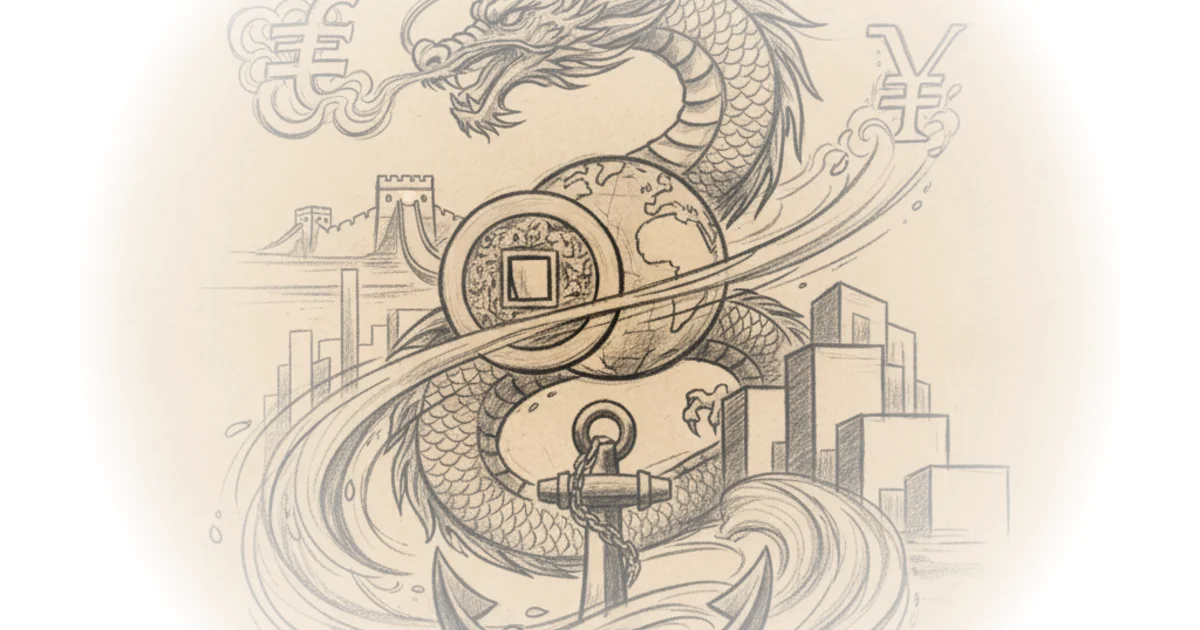
García-Herrero, a chief economist at Natixis, challenges this premise directly. She argues that viewing finance as a secondary servant to the real economy is a fatal strategic error. "A developed financial system is not just supportive infrastructure; it is a core instrument of national power, sovereignty, and self-reliance," she asserts. Her critique is sharp: by prioritizing safety over scale, China risks remaining a "lame giant"—economically massive but financially weak.
The historical context here is crucial. García-Herrero points out that Britain's 19th-century dominance and America's post-1945 "exorbitant privilege" were not built on insulation, but on bold monetary internationalization. This reference to the concept of "exorbitant privilege"—the unique advantage the US enjoys by issuing the world's primary reserve currency—highlights what China is missing. Xia Bin's strategy of "full domestic marketisation paired with limited cross-border globalisation" may feel prudent, but García-Herrero warns it perpetuates dependency on the dollar.
"True self-reliance requires the opposite: decisive opening that transforms the RMB into a genuine reserve currency, allowing China to finance its growth on its own terms, recycle surpluses globally, and insulate domestic policy from U.S. Federal Reserve decisions."
The "Weak Financial Power" Diagnosis
Xia Bin's analysis is particularly candid about China's structural vulnerabilities. He identifies a "currency mismatch" and the inability to freely convert the Renminbi as defining features of a "weak financial power." He notes that despite China's manufacturing might, it remains a "lame giant" regarding pricing power over bulk commodities and energy.
His proposed solution is a "harmonious" financial strategy that advances Chinese interests without disrupting global growth. He argues for a managed floating exchange rate and a gradual, controlled opening of the capital account. "Capital account opening must be proactive, gradual and controlled—coordinated with domestic reform, RMB regionalisation and stronger macroprudential regulation," Xia Bin writes. He views the current state of financial weakness not as a failure, but as a shield. In a striking metaphor drawn from Traditional Chinese Medicine, he suggests that "using deficiency to ward off harm" protects the economy from external shocks.
Critics might note that this "defensive necessity" approach assumes the global financial order will remain stable enough to allow for gradualism. If the dollar system fractures or if geopolitical tensions escalate, the buffers Xia Bin relies on could evaporate, leaving China exposed without the leverage of a fully internationalized currency.
García-Herrero finds this logic flawed. She argues that "limited globalisation, by design, caps these benefits" and risks locking China into a perpetual state of vulnerability. She contends that deep, liquid capital markets are essential for attracting global savings and lowering borrowing costs for strategic industries. "The real economy thrives when finance leads, not follows," she writes, challenging the very hierarchy Xia Bin seeks to preserve.
"Cautious incrementalism may feel safe, but it delays the very financial superpower status Xia Bin himself endorses."
The Limits of the "Real Bills" Mindset
The debate touches on the "real bills doctrine"—the idea that money should only be created to finance real economic transactions. Xia Bin's insistence that finance must serve the "root" (the real economy) reflects this traditional view. He warns that mainstream Western textbooks miss the systemic, dynamic, and structurally unequal nature of the real financial world.
However, García-Herrero argues that this view underestimates the autonomous strategic value of finance. She suggests that by treating finance merely as a tool to avoid external shocks, China misses the opportunity to reshape the global monetary order. The tension here is between the "Impossible Trinity"—the economic principle that a country cannot simultaneously maintain a fixed exchange rate, free capital movement, and an independent monetary policy—and the desire for full sovereignty. Xia Bin seems to accept a compromise on the first two to protect the third, while García-Herrero argues that China must eventually embrace the risks of the first two to secure the third.
The stakes are high. As Xia Bin puts it, "What is urgently required is not merely the mainstream theories of modern economics, but also a guiding theoretical framework that is capable of adapting to changes in the distribution of global economic power." He calls for a political economy framework that reflects the dynamics of the rise and decline of major powers.
"In Traditional Chinese Medicine terms, China's financial weakness is itself a strategic asset: 'using deficiency to ward off harm' shields against external shocks while strengthening the real economy."
Bottom Line
Xia Bin offers a sobering, realistic assessment of China's financial fragility, correctly identifying that the path to a global reserve currency is fraught with peril. However, García-Herrero's counter-argument is the more compelling strategic vision: true independence cannot be achieved through insulation, but only through the hard power of a dominant currency. The reader should watch for how the administration balances these competing pressures in the coming decade, as the choice between "lame giant" status and financial superpowerhood will define the next era of global economics.