The Pentagon Picks a Public Fight with Anthropic
Anthropic Chief Executive Officer Dario Amodei met with Secretary of War Pete Hegseth at the Pentagon this week. What followed was not a quiet policy disagreement but a full-blown public confrontation between the Department of Defense and one of America's leading artificial intelligence companies.
Hegseth accused Anthropic of arrogance and betrayal, claiming the company seeks veto power over military decisions.
Amodei refused to remove certain safety guardrails, issuing a statement that the company "cannot in good conscience remove safeguards" it considers unreliable or ethically risky with current technology. Hegseth responded by designating Anthropic a supply-chain risk to national security, a classification typically reserved for adversarial foreign entities, not domestic AI labs. President Donald Trump then directed all federal agencies to cease using Anthropic technology entirely.
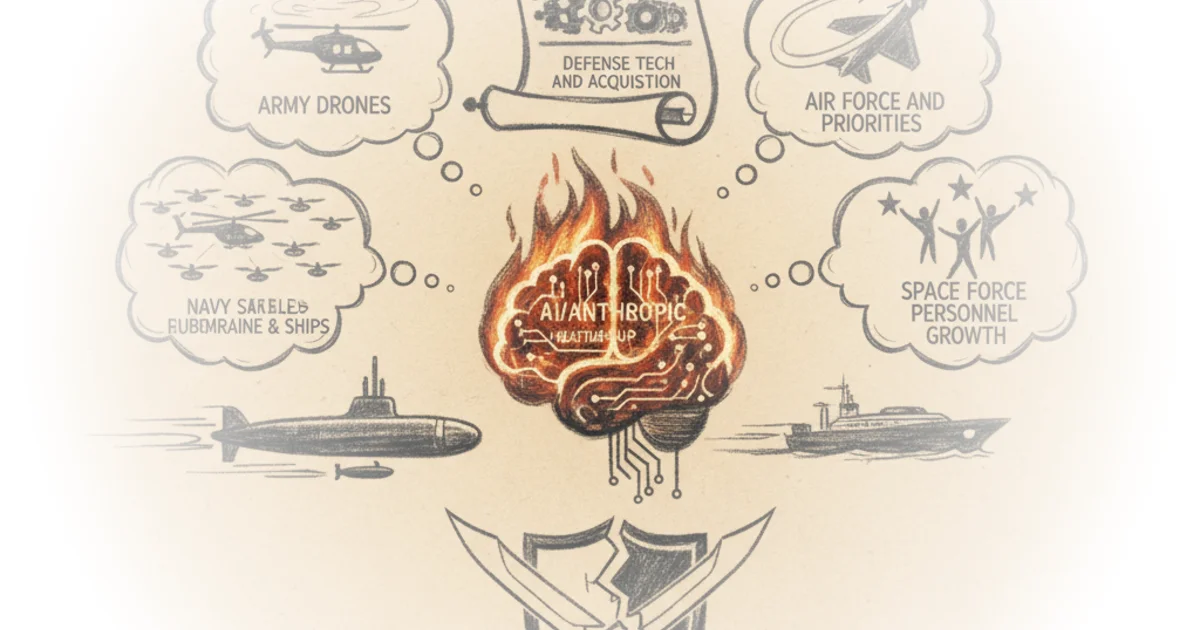
The escalation was breathtaking in its speed. And yet the substance of the dispute remains murky.
DoD CTO Emil Michael accused Anthropic of lying about DoD intentions, stating the department does not engage in mass surveillance and needs unrestricted access for scenarios like defending against enemy drone swarms — without needing to call Dario for permission.
There is a genuine tension here. Elected civilian leadership should control military decision-making, not technology executives. Palmer Luckey of Anduril made this point directly. But the Pentagon's response — threatening to invoke the Defense Production Act against a domestic company — risks chilling the very private-sector innovation the defense establishment desperately needs. If the goal is to attract commercial technology companies into defense work, publicly branding one of the most capable as a national security threat sends a contradictory signal.
Retired Vice Admiral Jack Shanahan offered perhaps the most measured assessment.
Despite the hype, frontier models are not ready for prime time in national security settings. Over-reliance on them at this stage is a recipe for catastrophe. This should never have become such a public spat.
AI Models Fail the Warfighter Test
Beneath the Anthropic drama lies a more fundamental problem. EdgeRunner, a defense-focused AI firm, tested 24 leading frontier large language models on legitimate military-use queries authored by Army and special operations subject matter experts. The results were damning.
The models refused — meaning they stated that they could not provide a response for reasons of safety or policy — up to 98% of the operationally relevant military questions.
Even after abliteration, a process that modifies a model's internal functions, refusal rates barely budged. Tyler Saltsman, EdgeRunner's chief executive, put it bluntly: the models are "completely unfit for combat operations at the tactical edge or major modernization projects." This finding undercuts both sides of the Anthropic argument. The Pentagon is fighting to remove guardrails from models that cannot perform military tasks even without them. Anthropic is defending safeguards on systems that already refuse military queries at extraordinary rates.
The real question is whether the Department of Defense should be investing in general-purpose frontier models at all, or purpose-built systems designed from the ground up for warfighter needs.
AI in Military Planning: Faster Does Not Mean Better
Christopher Denzel's analysis of AI in military planning staffs provides a useful counterweight to the breathless enthusiasm. AI compresses routine cognitive labor. It absorbs guidance, reorganizes material, and produces clear strategic language at speed. But Denzel argues this creates a dangerous illusion.
Failure rarely stems from insufficient information but instead from the failure to impose priority where competing objectives cannot all be satisfied.
The core problem is what Denzel calls the "planning optimizer" trap. AI generates plans that are structurally sound and defensible but avoid hard choices.
By smoothing differences and averaging the focus of effort, optimization suppresses priority.
In other words, AI raises the floor of planning quality while collapsing the median. More competent plans come cheaper, but real insight — the kind that wins wars — becomes relatively more scarce. Operational art remains bounded by judgment, not information.
The $152 Billion Reconciliation Sprint
The Department of Defense plans to spend the full $152 billion reconciliation budget in fiscal year 2026, despite having authorization to stretch it through 2029. The allocations reveal clear priorities: $29.2 billion for shipbuilding and the maritime industrial base, $24.8 billion for munitions and supply chain, $24.4 billion for Golden Dome missile defense, and $11 billion for nuclear modernization.
The shipbuilding numbers are notable. A second Virginia-class submarine at $4.6 billion, two additional guided-missile destroyers at $5.4 billion, and three T-AO oilers at $2.7 billion represent a direct injection into an industrial base that currently cannot produce even two Virginia-class boats per year. Whether the shipyards can absorb this funding at the pace intended is an open question.
On the munitions side, $1 billion is earmarked for one-way attack drones managed by the Defense Autonomous Warfare Group, commonly known as DAWG. Another $490 million goes toward 245 additional Joint Air-to-Surface Standoff Missiles-Extended Range, and $400 million toward 90 Long Range Anti-Ship Missiles. These are the weapons that would be expended in the opening days of any Pacific conflict.
Small Business Innovation Research Gets a New Lease
The Senate reached agreement on reauthorizing the Small Business Innovation Research (SBIR) and Small Business Technology Transfer (STTR) programs through September 30, 2031. The compromise includes several meaningful changes.
A new "strategic breakthrough award" allows agencies to make post-Phase II awards up to $30 million under certain circumstances. Enhanced training for acquisition workforces on Phase III awarding addresses one of the program's chronic weaknesses: the failure to transition successful prototypes into production contracts. Standardized model contracts for Phases I, II, and III should reduce the legal overhead that small companies face.
The legislation also imposes a cap on the number of proposals a small business can submit per fiscal year, per solicitation, or per topic. This is a double-edged reform. It may reduce gaming by firms that submit high volumes of speculative proposals, but it could also penalize legitimately innovative small businesses that work across multiple technology domains.
The Services Modernize at Different Speeds
Across the military branches, the picture is one of uneven urgency. The Army is moving aggressively on drones, with Secretary Dan Driscoll aiming to buy one million drones within 18 to 24 months. The Army's Pathway for Innovation and Technology office operates on three principles worth noting.
Speed takes priority over perfection. Early end user feedback is critical. Significant demand signal must be proven before substantial funding.
The Navy, meanwhile, is caught between present necessity and future aspiration. The next-generation SSN(X) attack submarine promises the speed, quieting, and advanced sonar needed for the 2040s threat environment, but shipyards are struggling to produce enough Virginia-class boats right now. The pragmatic course is to maximize Virginia builds while methodically developing SSN(X) — but that requires patience the strategic environment may not permit.
The Air Force is restructuring acquisition offices and investing $3.1 billion in F-15EX fighters and $750 million toward the F/A-XX next-generation fighter milestone decision. The Space Force is pushing for personnel growth to support new missions, though the details remain thin.
Defense Innovation: Same Barriers, New Vocabulary
Austin DeLorme, reflecting on nearly a decade since the AFWERX standup, offers a sobering assessment. In 2016, nearly 1,000 people across government, technology, and the investment community identified three barriers to scaling defense innovation: access to people, problems, and data; long contracting timelines; and requirements specificity. Those same barriers persist today.
Here we are, almost ten years later still talking about the same things. This has been cause for reflection. Did AFWERX matter?
DeLorme argues that AFWERX did catalyze capital and connect a generation of defense technology founders to the mission. But the returns may not come fast enough. If companies cannot transition and scale, capital will move elsewhere. The one hopeful sign DeLorme identifies is that requirements reform is finally being discussed alongside acquisition reform, rather than as separate problems.
Ben Van Roo pushes this further with an analysis of outcomes-based contracting. The sharpest insight: AI does not just change what gets built, it changes where value lands. For two decades, defense software vendors sold platforms — nouns. AI modularizes the verb. Companies like Waymo do not sell driving platforms; they drive. This restructuring threatens systems integrators whose economic model depends on headcount, a model that collapses when AI agents deliver outcomes with an order of magnitude fewer people.
Bottom Line
This edition of Defense Tech and Acquisition captures the defense establishment at an inflection point. The Anthropic confrontation is the most visible symptom of a deeper confusion: the Pentagon simultaneously demands commercial AI capability and punishes companies that set conditions on its use. The EdgeRunner data showing 98% refusal rates on military queries suggests the entire debate may be about technology that is not yet fit for purpose.
The reconciliation spending is real money aimed at real gaps, particularly in shipbuilding, munitions, and missile defense. Whether the industrial base can absorb $152 billion in a single fiscal year remains to be seen. The SBIR reauthorization through 2031 provides small businesses with needed certainty, even as the same structural barriers to technology transition persist after a decade of reform efforts.
The most important thread running through every section is speed. The Army wants drones now. The Navy wants ships faster. Acquisition offices are reorganizing around velocity. But as Christopher Denzel's planning analysis warns, speed without judgment is not an advantage. It is a liability.