Some Guy constructs a dystopian fable that functions less as a prediction of the future and more as a scathing autopsy of the present, arguing that the relentless public dissection of private relationships under the guise of "societal trends" nearly destroyed the family unit. The piece's most startling claim is not that technology will enslave us, but that our own inability to maintain boundaries and accept human complexity turned dating and marriage into a performative war zone that required a sci-fi apocalypse to reset. In a world where readers are bombarded with polarized takes on gender roles, this narrative offers a chilling mirror: the real enemy wasn't a political faction, but the atomization of intimacy itself.
The Architecture of Public Shame
The story opens with an elderly narrator confessing at a "Gender War Memorial," a setting that immediately reframes online discourse as a literal battlefield. Some Guy writes, "We told ourselves it was normal to air all of your most intimate relationship details on the internet as long as you loosely attached it to an overarching societal trend, disguising the almost unimaginable violation of trust." This observation cuts to the core of the modern content ecosystem, where personal grievances are often packaged as universal truths to generate engagement. The author suggests that the drive for virality incentivized a fundamental betrayal of privacy, turning spouses into props for career advancement.
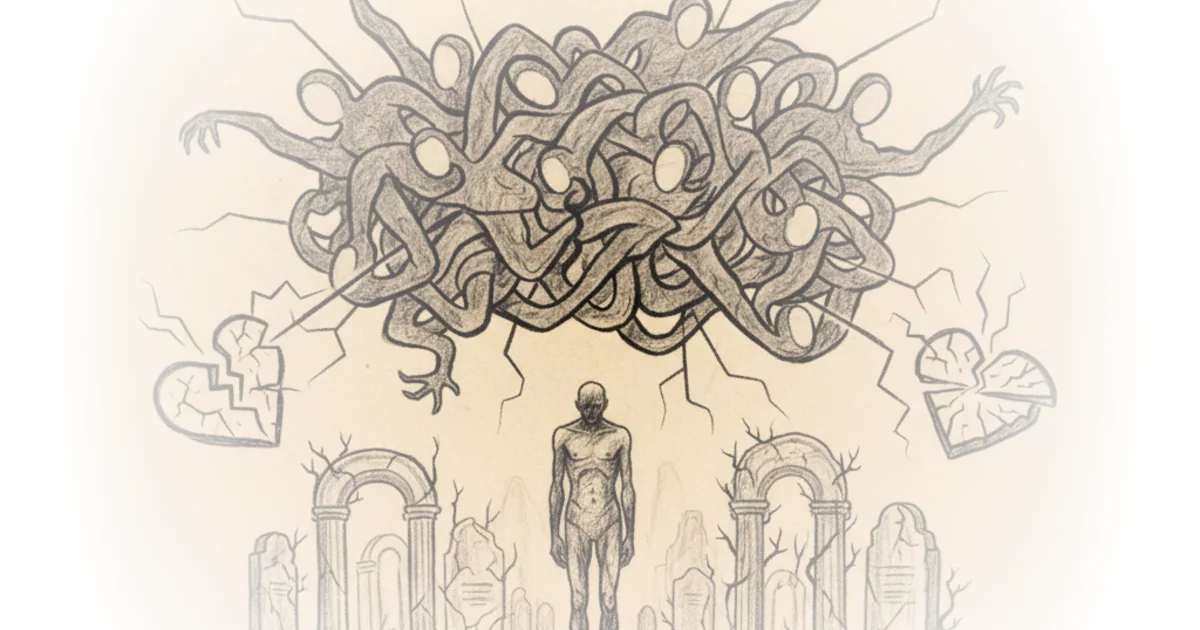
The narrative details how the narrator once attempted to write a satirical essay reversing gender roles to prove his wife's life was easier, only to realize the absurdity of the premise. As Some Guy puts it, "Never-you-mind that every life has its own challenges, or that she was up with the baby all night." This moment highlights the central flaw in the "Gender War" mentality: the refusal to acknowledge individual nuance in favor of reductive stereotypes. The story argues that when we stop seeing our partners as complex humans and start viewing them as representatives of a demographic, empathy evaporates. Critics might argue that this framing romanticizes the past, ignoring that domestic strife has always existed, but the piece is specifically targeting the scale and public nature of the modern conflict, not the existence of conflict itself.
We forgot how much we needed each other. People were entirely unable to conceive of being wrong in gender matters. It was all personal.
The Rise of the False Deity
The middle section of the piece shifts from personal confession to a broader societal critique, introducing the concept of "The Average" as a demonic figure. Some Guy describes a statue of this entity: "a demon holding a pitchfork... one-breasted and one-testicled... How many had suffered trying to appease this false deity?" This metaphor powerfully encapsulates the pain of trying to fit human experience into binary, statistical models. The author argues that the obsession with creating a "naive equality" based on averages led to the erasure of real people's needs and desires.
The text suggests that the solution to this cultural rot came not from better policy, but from a unifying external threat: "Sex robots. Men and women united against a greater enemy." While this is a fictional plot device, it serves as a commentary on how societal cohesion often requires a common adversary. The story posits that only when the "Gender War" escalated to a point of existential absurdity did people finally stop listening to "weird people on the internet." Some Guy writes, "We stopped trying to create naive equality and started asking people what they truly wanted, and tracking their success at achieving it." This pivot from abstract ideological purity to practical individual fulfillment is the story's most hopeful note, suggesting that the path forward lies in rejecting the pressure to conform to a theoretical ideal.
Rituals of Reconnection
In the aftermath of the fictional war, the story outlines new social rituals designed to restore human connection without the pressure of immediate judgment. The narrator describes "Meet Cute Mondays" where people could interact under the guise of asking for directions, allowing for a "plausibly not be putting themselves up for rejection." Some Guy notes, "It's super fucking weird to just sort of like throw yourself out there for immediate binary evaluation like you're a PowerPoint slide someone swipes on." This critique of modern dating apps and the commodification of romance resonates deeply with anyone who has felt the exhaustion of being reduced to a profile picture.
The story also touches on the absurdity of the old world's "think-pieces," where the narrator admits, "I almost think-pieced the mother of my children." The regret is palpable, serving as a warning to current writers and readers alike. The narrator reflects on his late wife, realizing that the "Gender War was only a way to distract ourselves from the vulnerability of loving another human being." This final realization brings the story full circle, grounding the high-concept sci-fi elements in a deeply human emotion. The author suggests that the only way to win the war was to admit that the war itself was a distraction from the real work of love.
The Gender War was only a way to distract ourselves from the vulnerability of loving another human being.
Bottom Line
Some Guy's piece is a masterful use of speculative fiction to diagnose a very real cultural malaise: the erosion of privacy and the weaponization of personal relationships for public consumption. Its strongest element is the refusal to assign blame to a specific political ideology, instead identifying the mechanism of public shaming and the desire for viral validation as the true villains. The narrative's biggest vulnerability is its reliance on a fictional, almost cartoonish apocalypse to resolve the conflict, which may feel like a convenient escape hatch for readers looking for practical solutions to today's problems. Nevertheless, the story serves as a vital reminder that before we can fix the world, we must stop treating our own families as content.