In an era where political discourse often fractures into isolated silos, Compact Magazine offers a startling diagnosis: the very ideologies that claim to oppose each other are secretly bound together by a shared hostility toward Jewish existence. The piece argues that this isn't a new anomaly but a recurring historical pattern, one that demands we look past surface-level partisan battles to the deeper, darker logic uniting the extremes. For the busy reader, this is a crucial intervention—it suggests that the current political climate is not just polarized, but structurally converging on a single, dangerous point of failure.
The Superglue of Extremes
The article opens with a chilling observation about the current geopolitical moment. Compact Magazine reports, "Across the ideological spectrum, we are witnessing the resurgence of a political logic that casts Jewish collective existence as an obstacle to human emancipation." This framing immediately disrupts the comfortable assumption that antisemitism is solely a right-wing pathology. The editors note that on the far right, this manifests as conspiratorial views of Israel, while on the far left, it appears as a desire for the state's total erasure. The piece cites a disturbing declaration by Manolo De Los Santos, who told an audience that destroying Israel would be "the single most important blow that we can give to global capital and to imperialism in our lifetime."
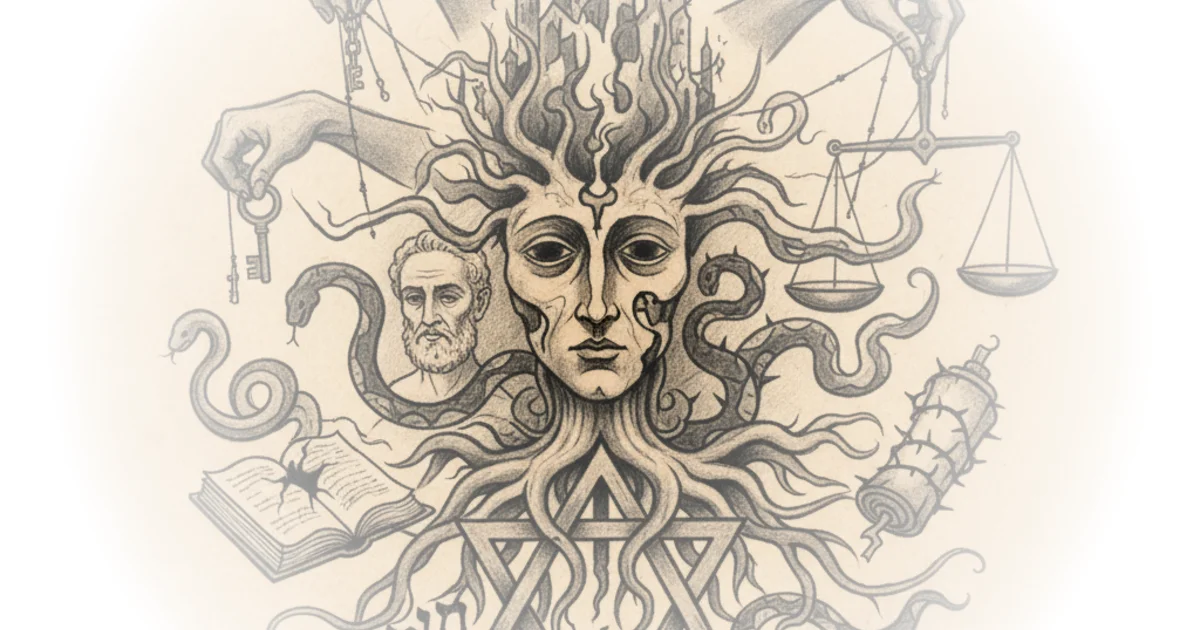
This convergence is the article's most provocative claim. It suggests that anti-Jewish sentiment acts as a "political superglue," binding together factions that otherwise disagree on everything else. The editors point out that figures like Cenk Uygur and Tucker Carlson, despite their ideological chasms, find common ground in wanting to "break down the barriers" that separate them, with anti-Jewish tropes serving as the bridge. This analysis forces a re-evaluation of current political alliances. If the enemy of my enemy is my friend, and both enemies are united by a desire to eliminate Jewish sovereignty, then the distinction between "left" and "right" begins to dissolve into something more ominous.
Anti-Jewish tropes thus construct a bridge across ideological extremes.
Critics might argue that equating the far-left's anti-Zionism with the far-right's antisemitism risks flattening distinct motivations into a single category. However, the piece counters this by tracing a long historical lineage where both sides have historically viewed Jewish existence as an impediment to their utopian visions.
The Historical Blind Spot
To understand the present, the article reaches back to the 19th century, challenging the modern belief that the left has always been the guardian of Jewish rights. Compact Magazine reminds readers that the communist philosopher Alain Badiou once declared that "there could be no such thing as a far-left antisemitism—an absurd oxymoron." The editors dismantle this view by highlighting the deep anti-Jewish roots in French and German socialism. They note that figures like Pierre-Joseph Proudhon, a key influence on later socialist thought, "nimbly combined left-wing concerns—social justice, anti-capitalism, equality—with more traditionally right-wing elements such as nationalism... all while demonizing Jews."
This historical context is vital. It reveals that the "Jewish question" was never truly resolved; it was merely reframed. In the 19th century, the disagreement was not about whether a "Jewish question" existed, but "on how it should be resolved: through subjugation, expulsion, and extermination, or through absorption and digestion." The piece argues that the left's failure to recognize its own complicity in this logic has left it ill-equipped to understand the current resurgence of hatred. By ignoring the historical precedent where socialist movements targeted Jews as agents of capital or obstacles to national unity, modern progressives repeat the same errors.
Heine's Prophetic Warning
The centerpiece of the commentary is the figure of Heinrich Heine, a poet whose insights into the dangers of secular radicalism were tragically prescient. The article details how Heine, having converted to Christianity only to be rejected by both communities, saw the coming storm long before it broke. Compact Magazine highlights his 1835 warning that when "German thunder has finally reached its goal," a play will be enacted in Germany that will make the French Revolution look like a "harmless idyll." More specifically, Heine predicted in 1838 that "a storm of persecution will gather over the heads of the poor Jews, one that will far surpass all their previous sufferings."
What makes Heine's perspective unique, according to the piece, is his refusal to abandon his Jewish identity for the sake of political purity. While his contemporary Karl Marx and others cast off Judaism as an "ugly and disagreeable" garment, Heine saw it as a necessary check on human arrogance. The editors quote Heine's critique of the "godless self-deifiers" of his time, urging them to remember that humanity is not divine. Heine argued that the Jewish belief in a God beyond humanity serves as an "essential restraint on cruelty and a check on inhumanity." This is a powerful counter-narrative to the idea that secularism is inherently more humane than religious tradition.
Heine saw in it a sign of civilizational advance. Europe, he argued, was rising toward principles long embedded in Jewish tradition.
The article also touches on Heine's nuanced view of economics, presenting Mosaic law not as a barrier to progress but as a "realistic form of socialism." Heine wrote, "Moses did not wish to abolish property; rather, he wanted everyone to possess it, so that no one, through poverty, might become a servant with a servile disposition." This reframes the debate: the goal is not the destruction of the Jewish people or their state, but the creation of a society where freedom is universal. Heine's defense of the Rothschilds against populist attacks further illustrates his belief that industry and trade were forces of liberation, not tools of oppression.
The Eschatological Trap
The piece concludes by returning to the present, arguing that the current political climate is once again driven by an "eschatological project" where the Jew or the Jewish state is cast as the primary obstacle to a perfect world. Compact Magazine observes that "on the left, Jews are once again cast as a force of reaction," while the right revives old conspiracies about hidden manipulators. The editors warn that this pattern is not new, but a recurrence of the same dynamic Heine identified centuries ago.
The argument here is that both extremes are trapped in a fantasy of redemption through elimination. Whether it is the right's desire to cleanse the nation or the left's vision of redemption through the annihilation of Israel, the underlying logic is the same: the removal of the Jewish element is the key to unlocking a utopia. This is a devastating critique of modern political idealism. It suggests that any movement that promises a perfect future by scapegoating a specific group is not just flawed, but dangerous.
Bottom Line
Compact Magazine's argument is at its strongest when it connects the dots between 19th-century socialist antisemitism and today's political fractures, offering a historical lens that makes the current crisis feel less like an anomaly and more like a predictable recurrence. Its biggest vulnerability lies in the difficulty of translating this deep historical analysis into actionable political strategy; knowing the pattern doesn't necessarily tell us how to break it. The reader should watch for how this convergence of extremes manifests in upcoming policy debates, particularly regarding civil liberties and the definition of legitimate political dissent.
The truly radical move against the Bruno Bauers of the world was not that of Marx, who accepted their premises only to tinker with their application, but Heine's willingness to challenge the anathemas of his age.