Ben Thompson's interview with Rivian CEO RJ Scaringe cuts through the noise of electric vehicle hype to reveal a startling truth: the most critical asset in building a car company isn't a factory or a battery, but the strategic patience to iterate before you have a single dollar of revenue. While the industry obsesses over quarterly delivery numbers, Scaringe admits his first twelve years were spent in a "squiggly path" of zero capital, refining a brand identity that could survive the chaos of a global pandemic and a fractured supply chain.
The Credibility Play
Thompson frames the conversation around the counterintuitive decision Scaringe made to pursue a PhD before launching his company. In a tech landscape that glorifies the dropout narrative, Scaringe argues that deep academic rigor was the fastest route to investor trust. "I knew that to start a car company, I was intellectually honest with myself that it would take a lot of money and I knew that I didn't have any money," Scaringe explains. He posits that without a track record, the only way to secure capital was to manufacture credibility through a doctorate from MIT.
This framing is compelling because it exposes the hidden mechanics of hardware startups. Unlike software, where a crude prototype can attract funding, building a car requires massive upfront capital that investors rarely risk on unproven founders. Scaringe's hypothesis that a PhD would serve as a signal of competence proved correct, connecting him to early backers through university networks. However, one might argue that this path is a luxury few can afford, potentially skewing the industry toward elite academic circles rather than diverse innovators.
"If I get a PhD from a top school... I thought that would be some earned credibility that would make it more likely that investors would want to get into the business."
Thompson highlights the irony that the specific technical work Scaringe did—researching homogeneous charge compression ignition engines—has zero relevance to his current electric vehicle empire. This detail adds a layer of historical depth, reminding us that the process of problem-solving matters more than the specific subject matter. Scaringe notes, "The things I was working on 20 years ago have nothing to do with Rivian whatsoever," yet the discipline of solving complex, funded problems was the true transferable skill.
The Strategic Value of Delay
The interview's most provocative insight concerns the eighteen-year gap between Scaringe's initial concept and the first vehicle launch. Thompson guides Scaringe to admit that this delay was not a failure, but a feature. Had Rivian raised capital immediately, they likely would have been locked into the wrong product strategy. "In the beginning you have no capital... you're just working on demos and proof of concepts," Scaringe says. "It's very helpful that in those years we didn't have capital, because we could have started building the wrong thing."
This argument challenges the modern startup imperative of "move fast and break things." In hardware, moving too fast without a defined strategy is catastrophic. The lack of funding forced the team to iterate on their brand and product vision without the pressure of scaling production. As Thompson notes, this period allowed them to pivot from a sports car concept to the adventure-focused R1T and R1S lineup that defines the brand today. "The whole team could fit in one little room... it just gave us the freedom to be very iterative," Scaringe reflects.
Critics might note that this "squiggly path" is a dangerous model for the average entrepreneur; the risk of running out of runway before finding product-market fit is real. Yet, for a capital-intensive industry like automotive, the alternative—rushing a flawed product to market—is often fatal. The interview suggests that the "slow" years were actually the most productive phase of the company's lifecycle.
"We recognized that in order for us to earn the right to exist, we needed to do something that was unique and could stand on its own."
Autonomy and the Tesla Shadow
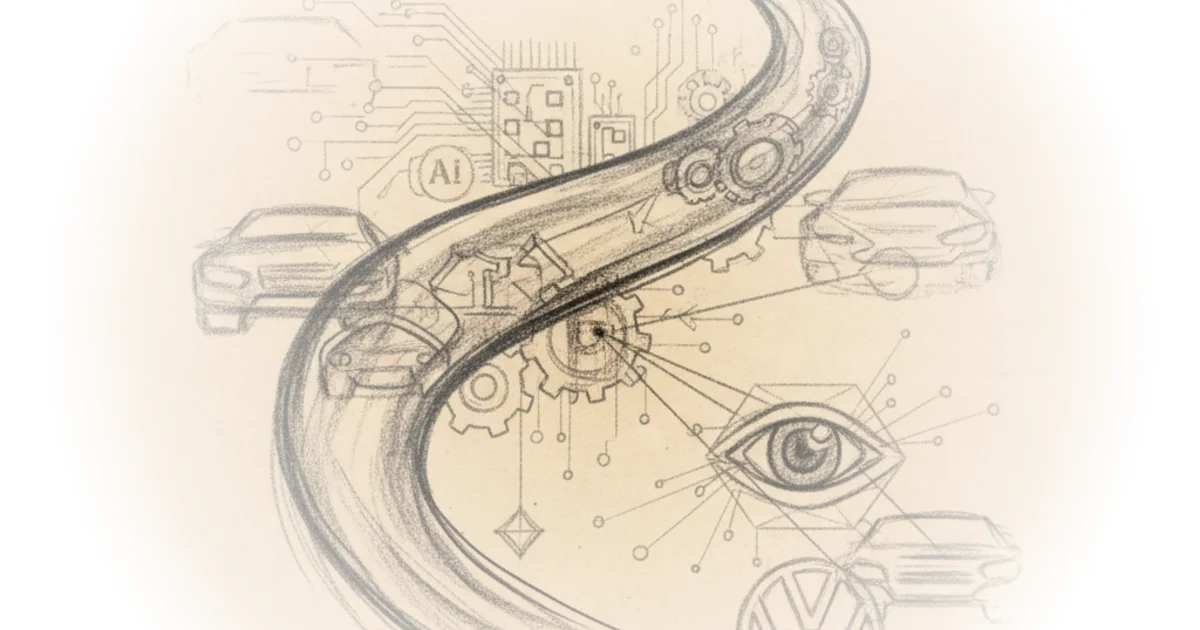
Thompson steers the conversation toward the critical divergence between Rivian and Tesla, particularly regarding autonomy. While Tesla pursues a camera-only, vision-based approach, Rivian is betting on a sensor-rich stack including LiDAR and radar. Scaringe emphasizes that their strategy is not just about the car, but about building a technology platform that can be licensed to others, including Volkswagen. "Rivian is building everything from its own chips to its own sensors... and if all goes well, the company will supply a multitude of companies," Thompson summarizes.
This distinction is vital for understanding the future of the auto industry. Scaringe acknowledges Tesla's role in changing the perception of electric vehicles, noting that the Roadster "shifted mindset" from golf carts to performance machines. However, he implies that Tesla's path is not the only viable one. By integrating their own chips and sensors, Rivian aims to create a more robust safety system, a choice that aligns with their "adventure" brand which demands reliability in unpredictable environments. The decision to exclude Apple CarPlay further underscores this philosophy; the vehicle's software ecosystem is a core product, not a peripheral feature.
"Tesla showed that electric cars could be cool... it just shifted mindset, and that was important."
Bottom Line
Thompson's interview succeeds by stripping away the glamour of the launch to reveal the grueling, non-linear reality of hardware innovation. The strongest argument here is that strategic patience and the freedom to iterate without capital were the true drivers of Rivian's survival, a lesson that contradicts the Silicon Valley dogma of speed. The piece's vulnerability lies in its reliance on Scaringe's unique background; his PhD-fueled credibility and ability to refinance his home are not replicable strategies for most founders. As the industry moves toward full autonomy, the real test will be whether Rivian's sensor-heavy, integrated approach can scale profitably against Tesla's software-first dominance.
"The things I was working on 20 years ago have nothing to do with Rivian whatsoever, but the confidence and skillsets around problem solving were everything."