Separation as Sacred Music
Ryan A. Davis, a hispanist at Illinois State University, opens his essay in Wayfare magazine not with doctrine but with Hollywood. The 1997 film Contact provides his launching point: the alien being who tells Dr. Ellie Arroway that humans feel "so lost, so cut off, so alone" but reassures her they are not. Davis maps this cinematic moment onto Latter-day Saint theology, specifically the Doctrine and Covenants vision of heaven as what he calls "an elevated mode of relationality." It is a bold opening move, yoking Carl Sagan's secular cosmos to Restoration scripture, and it signals the essay's ambition to find theological meaning in the mundane ache of friendships fading across distance.
For a few formative years, though, we walked side-by-side, sharing in the joys and struggles common to young families getting an education: dinners and game nights, the birth of new babies, and service in the kingdom when time was scarce. For most of us, we were each other's family away from family. Until one day when we weren't.
That final sentence lands hard. Davis is writing about a group of friends from his years in Atlanta, Georgia, all transplants who formed an intense bond before scattering to Washington state, Utah, New Jersey, and Illinois. The essay's emotional engine is a video call between his wife and these old friends, a call that leaves both husband and wife wrestling with grief that has no obvious remedy.
The Theology of a Weeping God
Davis anchors his theological argument in Moses chapter 7 from the Pearl of Great Price, where the prophet Enoch witnesses God weeping over humanity. This is the doctrine of divine passibility, the idea that God is not a remote, impassive deity but one who suffers alongside creation. Davis finds this theologically generative rather than troubling.
There is something spiritually sobering about the fact that God's divine nature does not spare him suffering, that part of what makes him divine is his capacity for suffering.
He pushes further, arguing that suffering in the Restoration framework is not arbitrary punishment but something closer to compassion. He traces the Latin etymology of the word, from compati, meaning to bear or suffer with, and links it to the covenant community described in Mosiah 18, where believers commit to bearing one another's burdens.
Suffering in this sense has nothing to do with pain for pain's sake. It is rather more akin to compassion (from the Latin compati, to bear or suffer with).
The distinction matters. Davis is not romanticizing pain. He is arguing that the specific ache of loving people you cannot be near is itself a form of spiritual development, a kind of growing pain that expands the soul's capacity.
Agency, Absence, and the Price of Choosing
The essay's most vulnerable passages describe Davis's wife declining yet another reunion with her Georgia friends. Financial constraints, the accumulated weight of past decisions, make discretionary travel impossible.
Still, each new "No, thank you, not this time" that my wife proffers comes with a sense of loneliness that has become familiar. The fact that she has grown accustomed to being the odd one out doesn't make the pain of her self-exclusion any less poignant.
Davis draws a tight connection between moral agency and suffering, calling them "a package deal." This is where the essay finds its sharpest edge. He is not describing suffering imposed from outside but suffering that flows directly from choices made freely and even wisely. The implication is unsettling: doing the right thing does not guarantee comfort.
Critics might note that Davis never quite addresses whether this framework risks sanctifying avoidable suffering. If the pain of separation is always spiritually productive, at what point does one stop trying to close the distance? The essay's logic could too easily become a justification for resignation when practical solutions exist.
Poetry in the Voice of God
The essay takes an unexpected turn when Davis examines Moses chapter 1 and discovers what he believes is poetic meter in God's speech to Moses. He rearranges the text and counts syllables: eight, six, eight, six, six.
I counted the syllables: eight, six, eight, six, six. Yes, it's there; I can feel it. Suddenly skeptical that I am overzealous to see in the scriptures what isn't really there, I tried some different arrangements and got different results.
Davis is honest about the subjectivity of the exercise. Nothing compelled him to read the text that way, he admits, but nothing prevented it either. He leans on Iain McGilchrist's concept of poetry as "speaking silence," truths that cannot be rendered explicit but that poetry bears witness to nonetheless. The tears that followed were, for Davis, confirmation enough.
A counterargument is that finding meter in prose depends heavily on how one arranges the line breaks. Davis concedes as much, yet his emotional response overrides the analytical doubt. Readers sympathetic to mystical reading will find this compelling; those with more empirical instincts may find it circular.
The Conductor of Creation
Korean artist Yongsung Kim's painting Calm and Stars becomes the essay's central visual metaphor. Davis describes Christ standing in a boat with outstretched arms, joined by a single oarsman rather than the full complement of bewildered apostles from the Gospel accounts. The image triggers a synthesis.
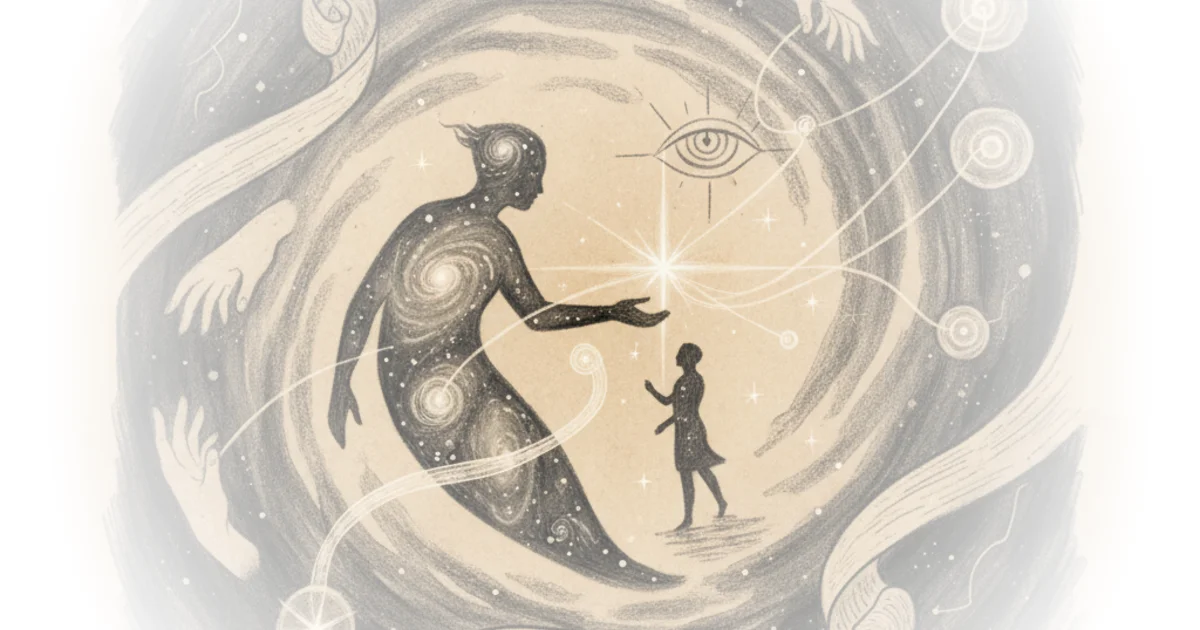
For me, his outstretched hands are like those of a conductor, the conductor of the musica universalis of creation. Notes and gaps, bodies and space, presence and absence, proximity and separation — all have a part to play in the grand orchestral score.
This is the essay's thesis compressed into a single image. Separation is not the absence of music but part of the music itself. The rests between notes are as essential as the notes. Davis applies this to friendship: the long silences between reunions, the years of distance, the occasional flickers of rekindled connection are all part of a divine composition.
He extends the metaphor through the visions of both Enoch and Moses, both of whom were physically overwhelmed by encounters with the divine. Moses falls to the earth, sapped of natural strength for hours, after seeing a single world. Joseph Smith once observed that five minutes of gazing into heaven would teach more about creation than a lifetime of reading on the subject.
Reconnection and the Promise of Zion
The essay circles back to the personal when a friend of twenty years suggests a monthly virtual reading group. Davis and these friends go back to their undergraduate days studying Spanish literature at Brigham Young University. The first gathering is free of pretense.
The intermittent points of contact that punctuate the silent periods of life; the bodies that orbit, now near, now far; the friendships that burn, sometimes like a fire, others like an ember — these are the notes and gaps of the music of relationship, the music of mortality, the soundtrack of lives lived in pursuit of that society we call Zion.
Davis closes with Ellie Arroway sitting alone at Canyon de Chelly, gathering dirt that sparkles in the evening sun, and with William Blake's "Auguries of Innocence." The final movement is quiet. He admits he does not know when God will answer his questions about lost relationships. He knows only that pondering them draws him closer to God.
Faith leads me to hope that in the eternities, that which is lost shall be recovered, and the love that we have for our friends, redeemed.
Bottom Line
Davis has written a genuinely moving meditation that finds theological weight in an experience most adults know intimately: the slow erosion of friendships by geography and time. His greatest strength is honesty. He does not pretend to have answers, and his willingness to sit with discomfort gives the essay an authenticity that more polished theological writing often lacks. The interweaving of Contact, Yongsung Kim, Moses, and Enoch is ambitious and largely successful, creating a layered argument that separation itself can be sacred.
The essay's vulnerabilities are structural. The leap from personal anecdote to cosmic theology sometimes moves too quickly, leaving the reader to bridge gaps that Davis might have explored more carefully. His discovery of poetic meter in Moses 1, while emotionally powerful to him, rests on a methodology he himself acknowledges is inconclusive. And the framework risks becoming too comfortable with suffering, potentially discouraging practical efforts to maintain the very relationships Davis mourns. Still, as a piece of devotional writing that refuses to flatten grief into easy answers, it succeeds.