Fabian Hoffmann delivers a sobering reality check that cuts through the optimism of Western defense planning: Europe's strategy of relying on missile shields is mathematically failing against Russia's industrial surge. While political leaders promise security through defense, the data suggests a terrifying asymmetry where offensive production is outpacing defensive capacity by a factor of three to one. This is not a theoretical gap; it is a countdown clock on Europe's ability to protect its own soil without a fundamental shift in strategy.
The Math of Asymmetry
Hoffmann begins by dismantling the assumption that Western production is keeping pace. He cites intelligence from Ukraine's Main Directorate of Intelligence (HUR) to establish the scale of the threat. "Russia currently produces a combined total of 840 to 1,020 ground-launched 9M723 and air-launched Kh-47M2 Kinzhal short- to medium-range ballistic missiles annually," Hoffmann writes. He notes that while these figures cannot be independently verified, the physical expansion of Russian factories and the rising volume of strikes lend them credibility. The author contrasts this with the West's response, which has been almost exclusively defensive. "Rather than closing the missile gap, Europe — by relying on a missile defense-centric strategy — is falling further behind," he argues.
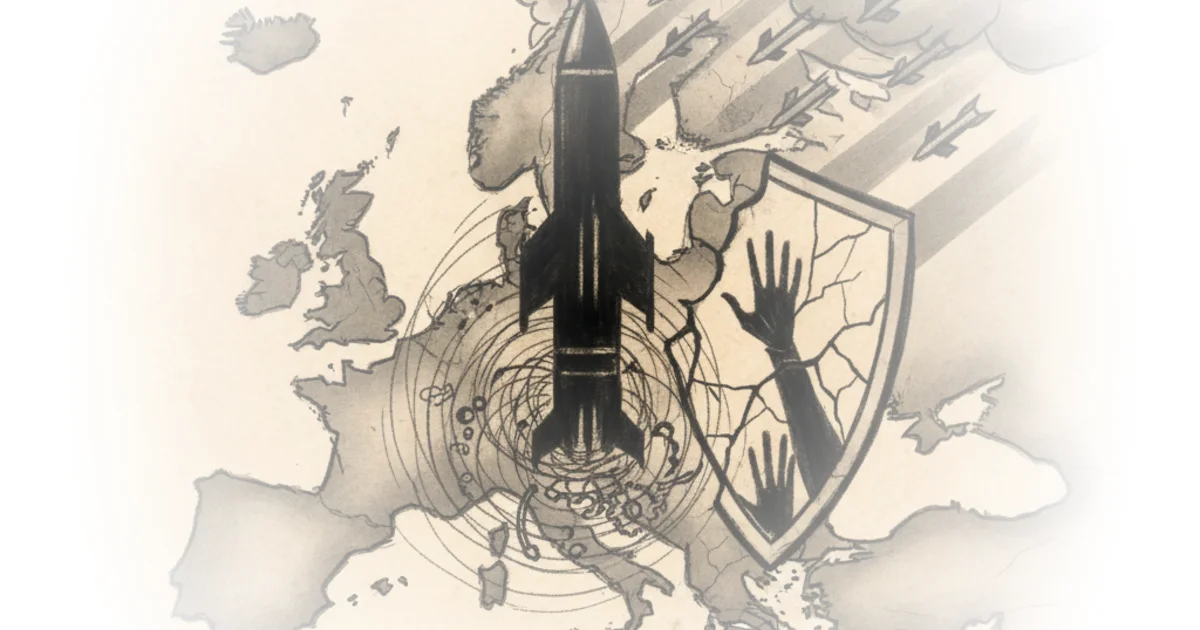
The core of Hoffmann's analysis lies in the production numbers for the two primary Western systems: the American Patriot and the European SAMP/T. He details how Lockheed Martin and Raytheon are ramping up output, yet the numbers remain insufficient. "Overall, this means that, at present, the global PAC-2 GEM-T and PAC-3 MSE interceptor supply likely stands at around 850 to 880 per year," Hoffmann notes. On paper, this barely matches the lower end of Russian production. But the situation is far more dire when one accounts for reality on the ground. "Europe will not receive all available Patriot interceptors," he warns, pointing out that the U.S. Army and allies in the Middle East and Asia have priority claims on the global supply. A reasonable estimate suggests Europe secures only 45 to 55 percent of these interceptors, drastically shrinking the ratio of defenders to attackers.
The math just doesn't add up. Even under 1-on-1 targeting assumptions, Europe would still fall short of covering the lower-end estimate of Russian production.
The Hidden Costs of Defense
Hoffmann then introduces a critical variable that often gets lost in procurement headlines: the inefficiency of interception. To achieve a high probability of stopping a missile, defenders often need to fire multiple interceptors at a single target. "To achieve very high intercept probabilities — above 90 percent — at least two, and in some cases three, interceptors may have to be allocated per target," he explains. This requirement effectively halves or thirds the number of threats Europe can actually neutralize. When applied to the French-Italian Aster 30 system, the numbers become even more stark. Even with a production ramp-up, the effective engagement capacity drops to "around 95 to 110" ballistic missiles annually.
Critics might argue that this analysis assumes a worst-case scenario of constant, high-volume saturation attacks that may not be sustainable for Russia over the long term. However, Hoffmann counters this by highlighting the cost imbalance. "Aster 30 and Patriot interceptors cost between $2–4 million USD each, significantly more than what Russia pays for its conventional ballistic missiles," he writes. "Any strategy that relies entirely on missile defense to counter large missile arsenals is therefore inherently cost-inefficient." This economic reality means that even if the West could technically intercept every missile, the financial drain would be unsustainable compared to Russia's ability to simply keep firing.
A Strategic Pivot
The piece concludes by challenging the political will to admit defeat in the current paradigm. Hoffmann asserts that pretending otherwise is dangerous. "Pretending otherwise, as several European political decision-makers seem to do, is not only disingenuous toward their populations but also weakens Europe's deterrence posture," he states. The author argues that since Europe cannot credibly promise to stop every missile, it must change the calculus of the conflict. "If European NATO states cannot credibly deter Russia by signaling they will successfully defend against an attack, they must deter by signaling that any attack will come at an unacceptable cost."
This proposed shift to a "punishment posture" is not a call for indiscriminate violence. Hoffmann is careful to distinguish between military necessity and moral boundaries. "The clearest way to do this is by fielding a counterstrike capability capable of rapid and equivalent response," he writes, emphasizing that the priority must be to "destroy economic and industrial value, not lives." He explicitly rejects the targeting of population centers, noting that such tactics are a hallmark of Russian aggression that Europe must not emulate. The human cost of the current strategy is implicit in the numbers: if the shield fails, the people behind it pay the price.
Bottom Line
Hoffmann's most compelling contribution is his refusal to let the narrative of "increasing production" mask the reality of a widening gap; the numbers prove that defense alone cannot solve an industrial asymmetry. The argument's greatest vulnerability lies in the political feasibility of a punishment posture, which requires a level of escalation and industrial mobilization that European democracies have historically resisted. Readers must watch whether leaders will acknowledge this mathematical reality or continue to bet on a defense strategy that the data says is doomed to fail.