Dylan Patel doesn't just observe a shift in construction; he identifies a structural pivot where the very definition of a datacenter is being rewritten to bypass a human bottleneck that money alone cannot fix. The most striking claim here isn't that buildings are getting faster, but that the industry is effectively abandoning the traditional "cast-in-place" model entirely, treating massive infrastructure projects like the assembly of a complex, 50,000-pound LEGO set. For investors and policymakers watching the AI boom, this is the missing link: the race isn't just for chips anymore, it's for the factory floor that builds the rooms to hold them.
The Labor Ceiling
Patel anchors his entire thesis in a harsh economic reality: the shortage of skilled trade workers is a hard constraint that cannot be solved by wage inflation alone. He writes, "Trade labor is an exception here, as you cannot quickly solve for a shortage of electricians and pipefitters." This framing is crucial because it moves the conversation away from simple capital expenditure and toward a fundamental supply chain crisis. The data supports this; Patel notes that operators like Crusoe had to pump wages by 30% just to attract talent to remote sites like Abilene, yet the gap remains.
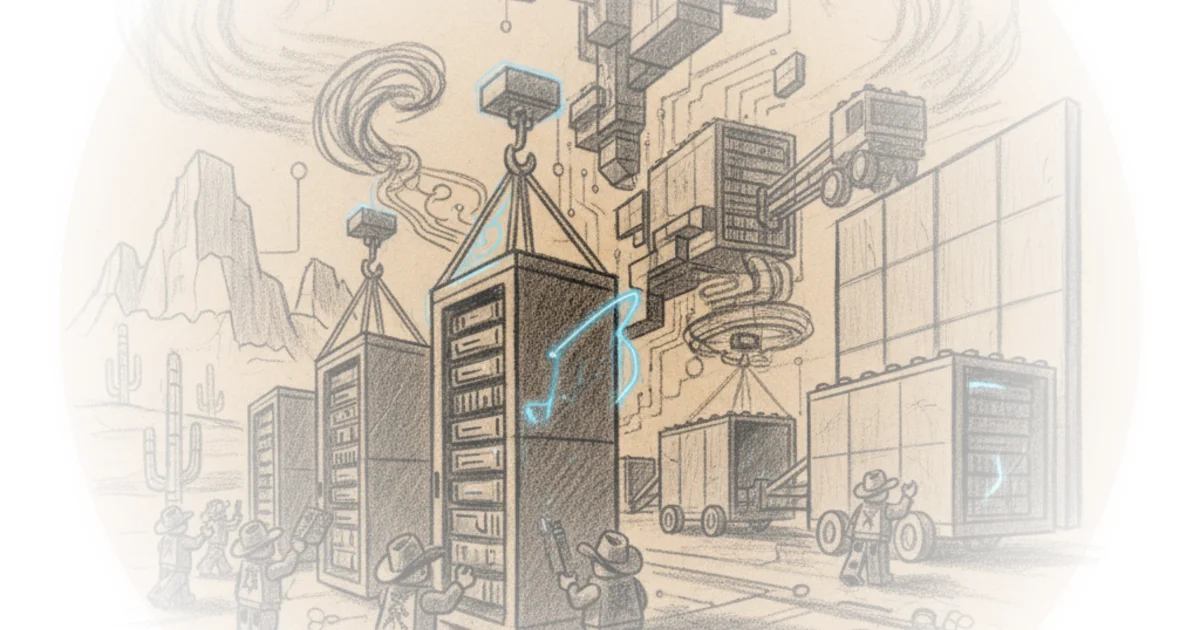
The argument gains depth when Patel breaks down the labor demand by trade, revealing that electricians alone represent "30-40% of the total construction man hours in a datacenter project." He projects a severe shortage emerging in 2027, particularly in buildout hotspots like Texas and Ohio. This isn't a theoretical risk; it's a timeline collision. The industry's response, as Patel details, is to move the work off-site. By pulling repeatable tasks into factories, operators can build wall panels and power rooms in parallel with site preparation. "The race for that talent became a true constraint long ago," he observes, and modularization is the only viable exit ramp.
Critics might argue that shifting to factory production simply displaces the labor shortage to the manufacturing sector, potentially creating a new bottleneck for skilled factory workers. However, Patel's model suggests that factory environments allow for better training retention and efficiency, effectively decoupling the construction timeline from the volatility of local on-site labor markets.
"The response is that every operator and vendor are now racing toward modularization, which essentially means pulling repeatable work off-site and into factories, where everything from wall panels to power rooms and cooling skids are built in parallel with the site and delivered as finished units."
From Concrete to Canvas
Patel meticulously dissects the evolution of the datacenter shell, moving from the familiar to the radical. He distinguishes between "prefabrication," which is just making parts off-site, and true "modularization," where self-contained units are bolted together. This distinction is the spine of his analysis, preventing the reader from conflating standard precast concrete with the new wave of rapid-deployment structures.
He traces a clear trajectory through three phases. First, precast concrete, which Northern Virginia has used for years but still required 18 to 20 months for delivery. Second, the simplification of the building itself into single-story steel halls, exemplified by QTS's Cedar Rapids campus, which moved from groundbreaking to topping out in just five months. But the most provocative section is the third phase: purpose-built rapid-deployment shells. Here, Patel highlights Meta's use of "fabric-clad 'Tent'-like halls" and AWS's "SAMDC" design. These aren't just faster; they are fundamentally different architectures designed around speed rather than permanence.
The historical context of prefabrication adds weight to this shift. Just as the post-WWII era saw a boom in modular housing and the 1970s introduced modular nuclear components to reduce on-site radiation exposure, the current drive is about compressing time-to-revenue. Patel notes that Meta's tents can be erected in months, with satellite tracking showing eight structures standing by April 2026 after an announcement in July 2025. "The tents accelerate the enclosure, not utility interconnection, power, cooling, or commissioning," he clarifies, adding necessary nuance to the speed claims.
The trade-off is significant. These structures sacrifice the durability and long-term flexibility of concrete for the sake of immediate capacity. "They also trade away some of the durability and long-term flexibility of a permanent concrete or steel building," Patel writes. This raises a strategic question: are we building for the next decade or just the next quarter? The answer seems to be the latter, driven by the intense pressure to deploy AI infrastructure before competitors.
The Economics of Speed
The financial implications are as dramatic as the architectural ones. Patel's bottom-up analysis challenges vendor marketing, finding that modular construction can "compress the construction window by ~ 36%, or 7-9 months, and is ~ 8% cheaper on a Capex/MW basis." This isn't just a marginal improvement; it's a game-changer for return on investment. When time is revenue, shaving nearly a year off a build cycle transforms the economics of the entire asset class.
Furthermore, Patel points out a shift in value capture for vendors. Companies like Vertiv are expanding their content per project from historical averages of $3.5 million per megawatt to roughly $7 million per megawatt by offering full-stack modular solutions. This creates a new moat for suppliers who can integrate the entire system, leaving traditional engineering, procurement, and construction (EPC) firms scrambling to adapt.
"And today, speed is revenue."
This simple sentence encapsulates the entire industry's pivot. The "wild west" of modular datacenters Patel describes is a chaotic but necessary evolution. With over 61 gigawatts of modular capacity tracked and a projection that modular penetration will reach over 30% of total live capacity by 2028, the industry is betting its future on the ability to assemble infrastructure as quickly as software is written.
Bottom Line
Patel's analysis is a masterclass in connecting physical constraints to financial outcomes, proving that the bottleneck for AI is no longer just silicon, but the human capacity to build the boxes that hold it. The strongest part of the argument is the rigorous distinction between simple prefabrication and true modularization, which clarifies why some solutions offer genuine speed while others are merely cosmetic. The biggest vulnerability lies in the long-term viability of these "tent" structures and the potential for a new supply chain bottleneck in the factories themselves. Watch for the next 18 months: if the promised 36% time compression holds up at scale, the traditional datacenter developer will become obsolete overnight.