This piece cuts through the fog of daily war reporting to reveal a chilling symmetry: as Ukraine's lights go out, Russia's economy is flickering toward its own blackout. Good Times Bad Times doesn't just tally missile counts; they connect the dots between a freezing February night in Kyiv and a collapsing banking sector in Moscow, arguing that the war has entered a phase where both sides are bleeding out their most vital resources.
The Asymmetry of Attrition
The author opens by painting a stark picture of the February 3rd assault, where over 500 missiles and drones targeted Ukraine's grid during a rare pause in strikes. "Russia chose a freezing February night to launch yet another massive attack on Kyiv," writes Good Times Bad Times, highlighting the tactical cruelty of striking when temperatures hit -20° C. The evidence is grim: rolling blackouts, injured civilians, and the shattering of a brief energy ceasefire. Yet, the commentary pivots quickly to the Russian side, suggesting that this aggression is a desperate gamble born of internal weakness rather than pure strength.
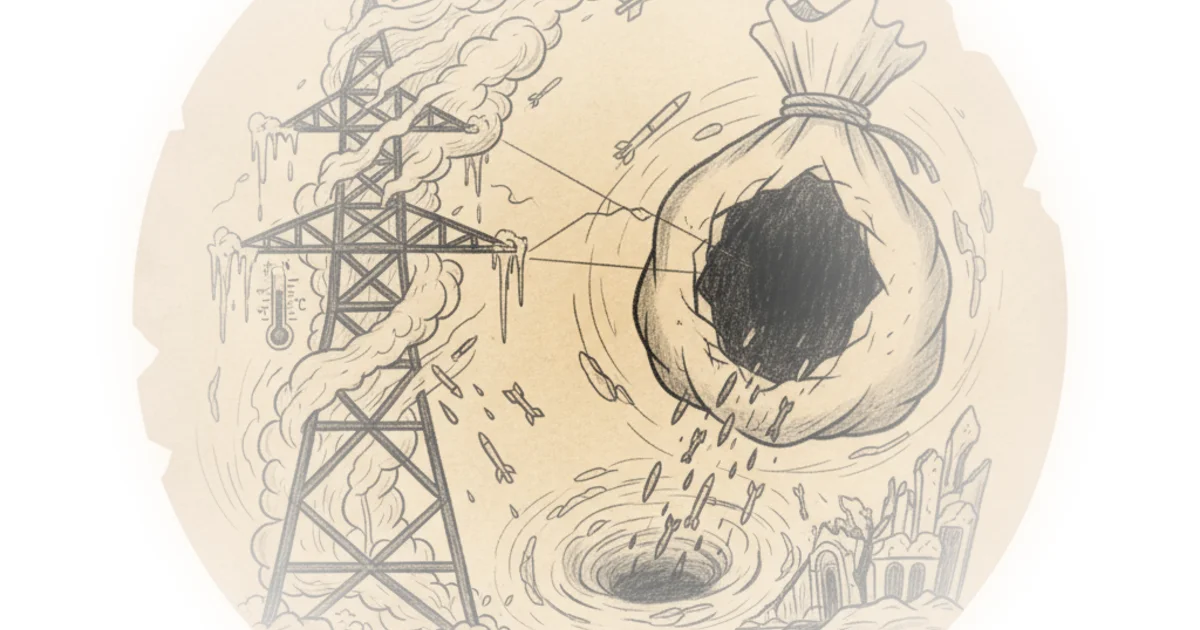
The core of the argument is that Russia's ability to sustain this offensive is crumbling under its own economic weight. Good Times Bad Times notes, "Russia's oil and gas revenues fell by 50% year-on-year in January 2026, hitting their lowest level since June 2020." This is a massive claim, placing the current crisis in the context of the pandemic's peak. The author argues that the combination of sanctions, a steep discount on Russian crude, and the loss of India as a major buyer has created a demand-side crisis that Moscow cannot easily solve.
Critics might note that Russia has historically shown resilience to sanctions, often finding new markets or adapting its logistics. However, the piece provides specific evidence that the "shadow fleet" is finally being cornered. Good Times Bad Times details how 14 European countries issued a warning to tankers that change flags or switch off transponders, calling them "stateless vessels" that can be detained without legal risk. The interception of the tanker Grinch off Spain is cited as the first concrete step in this new, aggressive enforcement.
"The enemy doesn't just have problems at the front. The enemy has a catastrophe. The entire military command structure has collapsed."
The Financial and Technological Crack-Up
Moving beyond energy, the author exposes the fragility of Russia's domestic economy. The piece highlights a formal acknowledgment from Moscow's Center for Macroeconomic Analysis that the banking sector is in crisis, driven by non-performing assets and mass withdrawals. The author points to the plight of Samolet, Russia's largest real estate developer, which is teetering on bankruptcy. The government's response, according to the author, is brutal pragmatism: "Whoever dies dies. It's their own fault," quotes Good Times Bad Times, citing a deputy chair of the state Duma. This indifference signals that the state is so consumed by military spending—estimated at 66% higher than official reports—that it cannot bail out its own strategic industries.
The commentary then shifts to a fascinating technological twist: the deactivation of Starlink terminals used by Russian forces. Good Times Bad Times explains that after Ukraine's defense leadership coordinated with Elon Musk, Russian drones equipped with these terminals were rendered useless. "Now by default, we'll be losing out on decision-making speed and situational awareness. This is called technological lag," the author quotes Russian military blogger Pavel Gubarev. This section is particularly compelling because it illustrates a direct link between American private sector power and battlefield outcomes, a dynamic rarely seen in conventional warfare.
However, the author tempers this victory with a dose of realism. Ukrainian analyst Tatarigami is cited to suggest that while the disruption is severe, it is not total. Russia is implementing inferior alternatives, but they still function. This nuance prevents the piece from veering into triumphalism, grounding the narrative in the messy reality of war.
The End of Nuclear Restraint
The final major point addresses the expiration of the New START treaty on February 5th. Good Times Bad Times frames this as a historic shift, noting that for the first time since 1972, the US and Russia are operating without formal limits on their nuclear arsenals. The author suggests that Washington was the less enthusiastic party regarding the treaty's extension, with Donald Trump previously calling it "badly negotiated." The expiration removes a critical safety valve, adding a layer of existential risk to an already volatile conflict.
Critics might argue that the expiration of New START is a diplomatic formality that won't immediately change on-the-ground tactics, as both sides still have incentives to avoid escalation. Yet, the author's framing of this as a removal of the "last formal limits" serves as a sobering reminder of the long-term trajectory of the conflict.
Bottom Line
Good Times Bad Times delivers a powerful, data-rich argument that the war has reached a critical inflection point where Russia's internal economic and technological failures are becoming as dangerous to the Kremlin as Ukrainian missiles are to Kyiv. The piece's greatest strength is its synthesis of disparate data points—from oil prices to Starlink deactivations—into a coherent narrative of systemic collapse. Its biggest vulnerability lies in the difficulty of verifying the full extent of Russia's banking crisis, which remains opaque. Readers should watch closely for whether Russia's "shadow fleet" crackdown holds and if the expiration of New START leads to a new, more dangerous phase of nuclear posturing.