N.S. Lyons argues that the current political upheaval is not merely a policy shift but the violent end of a seventy-year historical epoch defined by the post-war obsession with preventing fascism. This piece stands out for its willingness to name the intellectual architects of the modern managerial state and to frame the dismantling of that state as a necessary, albeit chaotic, restoration of human agency rather than a regression into tyranny.
The Architecture of the Open Society
Lyons begins by contextualizing the current moment as the conclusion of the "Long Twentieth Century," a period he defines not by calendar dates but by a specific spiritual and political orientation. He writes, "Our Long Twentieth Century had a late start, fully solidifying in 1945, but in the 80 years since its spirit has dominated our civilization's whole understanding of how the world is and should be." The author's central thesis is that the post-war elite, terrified by the horrors of World War II, constructed a global order dedicated to the negation of any strong collective identity. This "open society" consensus, driven by thinkers like Karl Popper and Theodor Adorno, viewed strong national bonds, religious traditions, and moral hierarchies as the precursors to fascism.
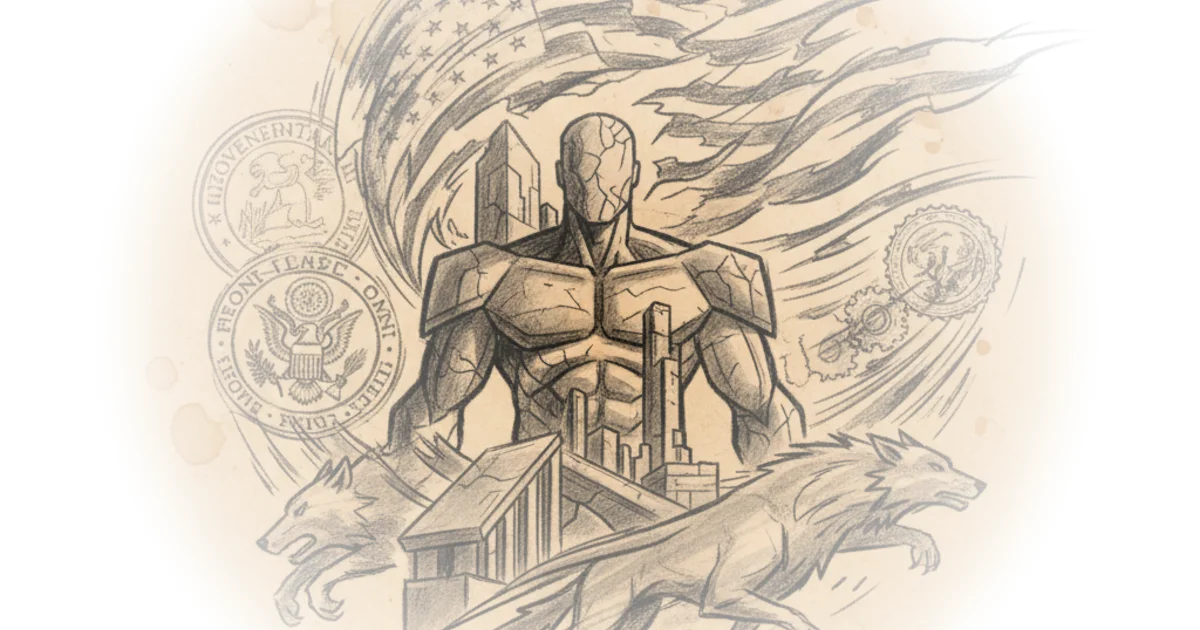
The argument posits that this fear led to a paradoxical outcome: a crusade against the "closed society" that became its own form of dogmatic intolerance. Lyons notes, "By making 'never again' its ultimate priority, the ideology of the open society put a summum malum (greatest evil) at its core rather than any summum bonum (highest good)." This framing is compelling because it explains the intensity of modern cultural conflicts as a reaction to a foundational anxiety rather than simple political disagreement. The author suggests that the establishment's primary goal became the prevention of a "resurrection of the undead Führer," leading to a system where any deviation from the path of total openness was treated as a moral catastrophe.
Critics might argue that this interpretation romanticizes the very "closed societies" that the post-war order sought to dismantle, potentially minimizing the genuine atrocities committed in the name of nationalism and religious absolutism in the 20th century. However, Lyons is careful to distinguish between the fear of fascism and the reality of the open society's failures.
The Rise of the Managerial State
The commentary then pivots to the structural consequences of this ideology: the creation of a permanent, unaccountable managerial state. Lyons draws on the political theorist Carl Schmitt to argue that liberalism's "elemental impulse" is the "neutralization" and "depoliticization" of the political sphere. The goal was to replace democratic contention with "scientific management" and "social engineering" run by a cadre of technocrats. Lyons writes, "The great expansion of our modern managerial regimes, including the American 'deep state' that the Trump administration and Elon Musk are now trying to dismantle," was a direct result of this desire to remove fundamental questions from public debate.
This section is particularly sharp in its diagnosis of how foreign policy and domestic governance became tools for enforcing the "open society" consensus. The author points to specific examples, such as USAID funding initiatives to "expand atheism" in Nepal or catechize journalists in Sri Lanka on gender language, as evidence of a global mission to deconstruct national identities. "They believed they were fighting the good fight against the closed society in order to stop zombie Hitler," Lyons observes, noting the irony that this mission often involved significant financial self-enrichment for the institutions involved. The argument here is that the administrative state grew not to serve the public, but to insulate the "open society" from the messy realities of democratic will.
The post-war establishment dreamed of achieving governance via scientific management, transforming the political sphere into a social technology whose results can be tested by social engineering.
The Return of the Strong Gods
In the final analysis, Lyons frames the current political disruption as a "restoration of the gods." He suggests that the attempt to banish strong beliefs and loyalties failed because human beings are driven by "thumotic vitalism"—a desire for heroism, community, and meaning that cannot be suppressed by technocratic management. Citing Mary Harrington, Lyons describes the current movement as an archetypal battle against a "miasmic foe whose aim is the destruction of masculine heroism as such." The author argues that the "open society" produced not peace, but "civilizational dissolution and despair," leaving a vacuum that is now being filled by a return to the very "strong gods" the post-war order tried to extinguish.
The piece concludes that the "blitzkrieg" against the permanent state is not an attack on democracy, but a desperate attempt to reclaim it from the technocrats who had hijacked it. Lyons writes, "Trump 2.0 seems to be the first administration serious about delivering on democratic demands for real change in American governance since FDR." This is a provocative claim that reframes the current political chaos as a necessary correction to decades of depoliticized governance.
Bottom Line
Lyons offers a powerful, if controversial, historical narrative that connects the intellectual history of the post-war era to the current political realignment. The strongest part of the argument is its explanation of why the "open society" consensus became so rigid and intolerant, rooting it in a genuine, albeit misdirected, trauma. Its biggest vulnerability is the tendency to treat the "strong gods" of the past as a monolithic force for good, potentially glossing over the very real dangers of the authoritarianism that the post-war order was designed to prevent. Readers should watch to see if this restoration of strong collective identities leads to a more vibrant democracy or a new form of exclusionary nationalism.