Derek Muller tackles one of physics' most counterintuitive questions: can a vehicle travel directly downwind faster than the wind pushing it? Most people — including many physicists — say no. The reasoning feels intuitive. When a sailboat matches the wind's speed, there's no relative air motion over the sails; the air and boat move together at equal speeds. But Muller argues this conventional wisdom is wrong.
The Setup
Muller frames the stakes immediately: "this propeller craft was built to settle a physics debate because what its creators claim it can do is so counter-intuitive that it seems to violate the law of conservation of energy." He's not exaggerating. This is genuinely controversial. Physics professors have argued with each other about whether a treadmill experiment properly represents real-world conditions. "I am not a stupid person but i cannot understand ultimately we said okay if we build a little model," Muller recalls. The doubters weren't convinced by the lab setup — they wanted to see the real thing.
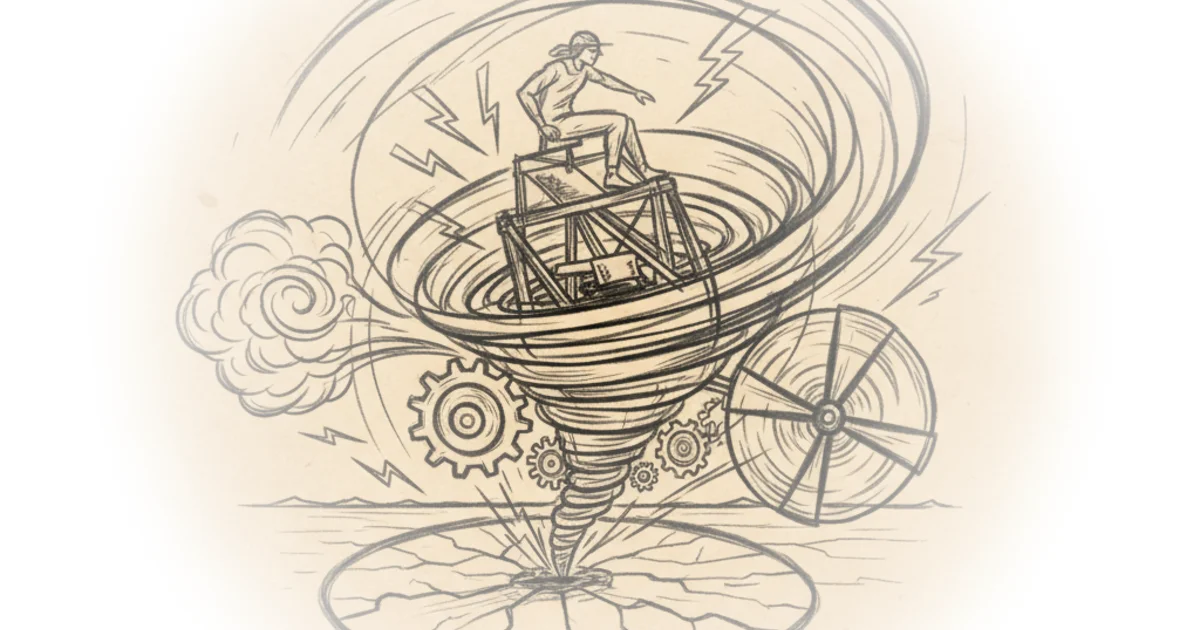
The vehicle, called Blackbird, is a bizarre contraption. It looks like something held together with duct tape and hope. "it's just been shoddily put together but i'm excited to try it and i'm excited to survive," Muller admits before climbing in. The safety concerns from his team are palpable — they're worried the whole thing might shake apart under high wind speeds.
The Physics Explained
What follows is a masterclass in making complex aerodynamics accessible. "sailboats can do it as long as they're traveling at some angle to the wind," Muller explains. The key is that sails act like wings: air flows faster over the curved outer surface than the inner side, generating lift. This produces forward motion perpendicular to the apparent wind.
But straight downwind? That's where most people draw the line. "if you reach wind speed what powers it past that" — Muller captures the core skepticism. The answer lies in how Blackbird actually works.
"it's not what it looks like what you imagine i bet is that when the wind blows on that propeller it spins the way the wind is pushing it and that drives the wheels but that's actually not how this works"
The trick: the wind pushes the vehicle forward, causing the wheels to turn. These wheels are geared to spin the propeller opposite the wind direction. Rather than operating like a windmill requiring airflow, it operates like a fan — "it spins like a fan pushing air backwards and that's what drives the craft forwards." Even in still air, a fan would move the vehicle forward because it's pushing air molecules backward rather than relying on external wind to turn blades.
The Test
The actual run is tense. Muller waits hours for wind conditions at El Mirage, a dry lake bed outside Los Angeles. When he finally gets his chance, the telltale — a piece of string showing wind direction — flips to point straight back at him: "indicating that i have an apparent headwind even though the true wind standing on the ground is coming from behind." He's going faster than the wind. The moment is visceral: "god damn that got my heart rate up" he says after the run.
Why This Works As Content
Muller excels here because he treats a physics puzzle as genuinely unresolved rather than lecturing viewers about an answer. He documents real uncertainty — hours of waiting, mechanical failures, arguments between experts about whether it's fake or real. "i love brain teasers i just love doing brain tumors" he admits with disarming honesty.
The explanation is cleanest when he describes the energy transfer: behind the propeller, wind moves slower than the true wind ahead. The propeller has taken energy from the wind and converted it into forward motion. "so the energy from this wind behind the propeller has gone into the cart into accelerating it forwards" — this is what makes the whole thing work without violating conservation laws.
Counterpoints
Critics might reasonably ask whether a desert test on one vehicle validates the broader physics claim. The conditions were marginal, the data was imprecise, and one success doesn't necessarily prove a universal principle. Some physicists would argue that the apparent wind measurement could be read differently — still air versus moving air creates ambiguity.
Bottom Line
The strongest part of this piece is Muller's willingness to test something most people call impossible rather than simply explaining why it's wrong. His biggest vulnerability is that he never quite settles whether Blackbird genuinely demonstrates a new principle or just exploits existing understanding cleverly. The excitement — the hours of waiting, the near-fear before the run, the heart rate spike — makes this piece compelling because it captures what science actually looks like in the field: messy, uncertain, and genuinely alive.