Devin Stone cuts through the noise of late-night television drama to expose a far more dangerous precedent: the executive branch weaponizing regulatory leverage to silence political opposition. While the surface story involves a comedian and a canceled interview, Stone's analysis reveals how the Federal Communications Commission (FCC) is being used to bypass First Amendment protections through indirect coercion of local broadcasters. This is not merely about who gets on air; it is about the structural integrity of American media when a federal agency treats its licensing power as a cudgel for political conformity.
The Illusion of Content Regulation
Stone immediately dismantles the administration's premise that the FCC has the authority to police political speech. He notes that Section 326 of the Communications Act explicitly forbids the commission from exercising "the power of censorship over the broadcast communications or signals transmitted by any broadcast station." This statutory barrier is absolute, yet the current FCC chair, Brendan Carr, appears to be operating in a gray zone of intimidation rather than direct rule-making.
As Devin Stone puts it, "The FCC has spent decades allowing consolidation of ownership in media distribution networks, resulting in less competition, fewer choices for consumers, and a much higher cost." This observation is crucial because it highlights the agency's historical failure to protect the very market diversity it claims to champion. Instead of enforcing competition, the agency has facilitated a landscape where a handful of conglomerates control the flow of information, making them uniquely vulnerable to political pressure.
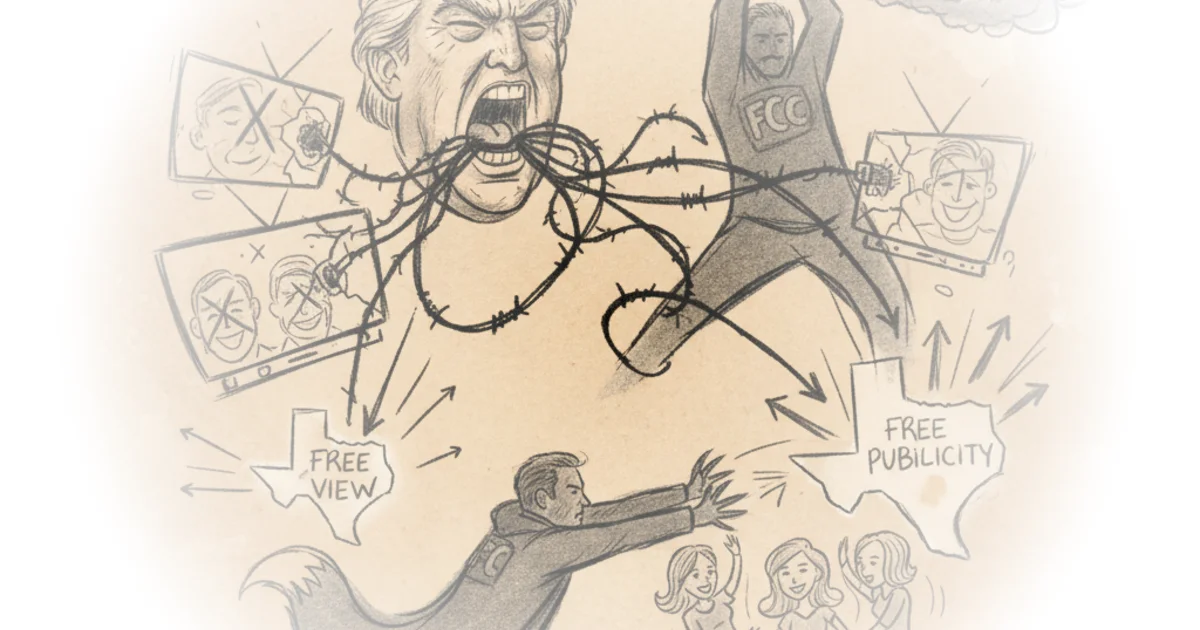
The author argues that the FCC's strategy relies on a bifurcated regulatory reality: while it cannot dictate content to national networks like CBS or ABC, it holds the keys to the local affiliates that actually transmit the signal. Stone explains that Carr is leveraging the threat of license revocation or the denial of merger approvals to force these local stations to preempt specific programming. This is a subtle but potent form of censorship that avoids the legal pitfalls of direct content regulation.
"Carr can't directly regulate content on the networks, but he does have two serious pain points which he can poke to shape broadcast content."
This framing is effective because it shifts the blame from a hypothetical conspiracy to a documented bureaucratic tactic. However, critics might note that the legal precedent for revoking a broadcast license due to political disagreement is virtually non-existent, suggesting that the threat itself may be the primary tool rather than a genuine legal strategy. The administration is betting on the fear of the unknown rather than the certainty of the law.
The Mechanics of the Backfire
The article's most compelling section details how this pressure campaign backfired spectacularly in the case of Texas State Representative James Talerico. When network lawyers blocked Talerico's appearance on a late-night show, the host, Steven Colbert, turned the censorship into a headline, drawing massive attention to a candidate who would otherwise have struggled for visibility. Stone connects this to the "Streisand effect," a phenomenon where attempts to hide information only serve to publicize it more widely.
Devin Stone writes, "Carr took a big swing and a miss at Steven Colbert, managed to net a Texas Democratic senator a massive slug of free publicity, but he's still menacing the ladies over at The View." This irony underscores the futility of the administration's approach. By trying to suppress a candidate's access to earned media, the FCC inadvertently guaranteed that candidate a platform they could not afford to buy.
The author further contextualizes this within the 2026 United States Senate election in Texas, noting that candidates like Talerico rely on "earned media" to compete against incumbents who can generate news through lawsuits or congressional hearings. Stone points out that "airtime in Texas is not cheap," making the ability to appear on national talk shows a critical resource for challengers. By threatening to cut off this resource, the FCC is effectively altering the electoral playing field, a move that raises serious questions about the neutrality of federal agencies.
"Framing this mega merger as striking a blow for local control and increased competition is truly chef's kiss, really."
This sarcasm is well-placed. The article highlights how NextStar Media Group, which needed FCC approval for a $6 billion merger, immediately complied with Carr's demands to preempt a show, only to receive the waiver shortly after. The transactional nature of this exchange suggests that regulatory approvals are being held hostage to political compliance. While the administration frames this as protecting local control, the reality is a consolidation of power where media owners must align with the executive branch to secure their business interests.
The Ghost of the Fairness Doctrine
Stone also addresses the administration's invocation of the "equal time rule," a relic of the Fairness Doctrine era that requires broadcasters to provide equal opportunities to all legally qualified candidates. The author clarifies a critical legal distinction: this rule applies to local station licenses, not the national networks that produce the content. As Stone explains, "The equal time rule doesn't apply to ABC or CNN, only to the local affiliates which air that nationally produced content."
This distinction is vital because it exposes the administration's misunderstanding—or deliberate misrepresentation—of the law. The Fairness Doctrine itself was repealed in 1987 by Reagan's appointees, and the Supreme Court has since moved away from the "scarcity rationale" that once justified such regulations. Stone notes that the equal time rule is a "tiny relic" that may not even pass modern First Amendment scrutiny, yet the FCC is using it as a pretext to pressure networks.
"The nine most terrifying words in the English language are, 'I'm from the government and I'm here to help.'"
By quoting this famous line, Stone underscores the danger of a government agency claiming to act in the public interest while engaging in political interference. The argument is that the FCC's actions are not about fairness or balance, but about ensuring that the airwaves reflect the administration's preferred narrative. This is a fundamental breach of the agency's mandate to manage the spectrum without censoring speech.
Critics might argue that the FCC has a duty to ensure that local stations serve their communities, and that preempting shows that distort the news cycle could be seen as fulfilling that duty. However, Stone's analysis suggests that the definition of "distortion" is being used as a political weapon, targeting specific voices rather than addressing genuine misinformation.
Bottom Line
Devin Stone's commentary is a masterclass in separating the political theater from the legal reality, revealing how the FCC is being repurposed as an instrument of political control. The strongest part of the argument is the detailed breakdown of how regulatory leverage is being applied to local affiliates to achieve what the agency cannot do directly to national networks. The biggest vulnerability, however, lies in the administration's reliance on fear; if the courts or the public push back hard enough, the legal precedents supporting these threats may crumble. Readers should watch closely as the FCC navigates the upcoming election cycle, as the outcome of these regulatory battles could redefine the relationship between government and media for a generation.