In this Veritasium piece, Derek Muller ventures into one of astronomy's most tantalizing open questions: does a ninth planet lurk beyond Neptune? The answer matters not just because we might discover another world, but because the Planet 9 hypothesis represents a rare modern case where mathematical prediction led to direct observation — a story with roots stretching back to Uranus and Neptune. What makes this piece distinctive is how it weaves historical precedent (the discovery of Uranus and Neptune through mathematical prediction) into contemporary research, showing readers that finding hidden planets has precedent.
The Historical Precedent
The piece opens by drawing on a remarkable historical parallel: when Uranus was discovered in 1781, astronomers immediately realized the star was moving across the sky in ways that couldn't be explained by existing gravitational calculations. As Batygin explains, "the star that was slowly moving across the sky had actually been imaged many many times before" and mathematicians of the time noticed a problem with its orbit. This isn't just historical trivia — it's the foundation for why scientists take the Planet 9 hypothesis seriously.
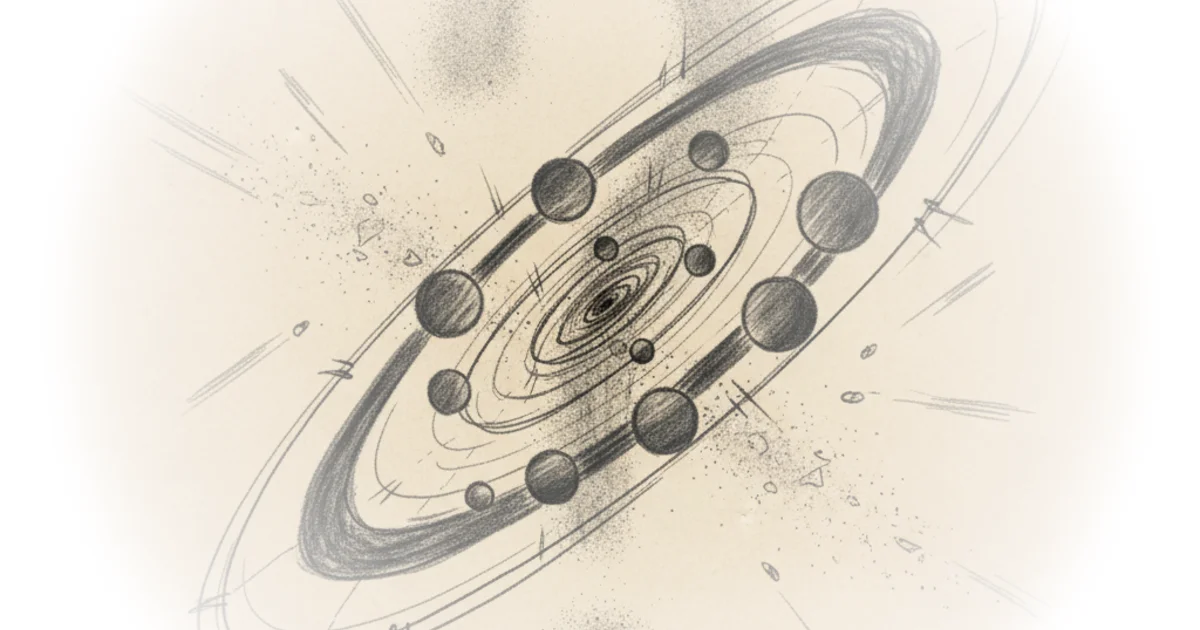
The story becomes even more compelling when Batygin describes how this precedent played out with Neptune. "They found Neptune in one night because they knew exactly where to look," he says, describing a mathematical prediction that led to direct discovery. The parallel is striking: just as mathematically predicting Neptune's position led to its discovery, calculating where Planet 9 should be might lead to finding it.
The Kuiper Belt Connection
The piece pivots to the Kuiper belt — the ring of icy debris beyond Neptune — and this is where the evidence for Planet 9 becomes most compelling. Batygin describes how "we started a survey to find stuff beyond Saturn" in 1985, searching for years and finding nothing until 1992 when they discovered the first identified Kuiper belt object. The puzzle was why the inner solar system was full of asteroids and comets while "the outer solar system be so empty." This emptiness, it turns out, may not reflect reality at all — it may reflect observational bias.
There is a chance that this is a false alarm, and that chance is one in 500.
This quote captures both the scientific humility required and the genuine excitement of the hypothesis. The clustering among Kuiper belt objects provides what Batygin calls "the best evidence for Planet 9," though he readily admits it's not enough to confirm the planet's existence.
The Evidence For A Hidden World
The most compelling evidence for Planet 9 comes from three mysteries it would explain, and the piece lays these out clearly. First, the clustering of Kuiper belt objects: "all of their orbits kind of point into the same direction." Second, highly inclined bodies that orbit perpendicular to the planets — something Batygin calls "you should not expect to find objects in the solar system that are flipped on their side." Third, objects orbiting "the wrong way" yet existing in the Kuiper belt.
These aren't just academic curiosities. As Batygin notes, these objects exist and "this has actually been a problem since before Planet 9 was even a thought." The hypothesis provides a mechanism: Planet 9 "instills upon distant orbits where it takes them and at the expense of kind of circularizing these distant objects by making their orbits less elliptical flips them upside down and then makes them more elliptical again."
Why This Matters
What elevates this piece beyond mere astronomical speculation is Batygin's explanation of why Planet 9's properties are actually consistent with what we find elsewhere. "We don't have anything in the solar system that's five Earth masses," he notes, but "five Earth masses as it turns out it's kind of standard outcome of planet formation" around other stars. The solar system's emptiness beyond Neptune is itself unusual — the fact that we lack a planet between five and seventeen times Earth's mass may be the real anomaly.
The search for Planet 9 has proven extremely difficult because the planet would be "just kind of dim enough at the outer parts of its orbit where he can be discovered with telescopes." The survey is about twenty percent complete, and at current rates, it might take a decade to fully rule out or confirm the hypothesis. The LSST telescope coming online in 2022-23 will help "by direct observation it'll rule out or it'll either find planet 9 or rule out a big chunk of its horbet."
Counterarguments
Critics might note that the two-point six sigma result doesn't meet the standard for scientific acceptance — five sigma is the threshold, and even three sigma results have a significant failure rate. Batygin himself acknowledges "half of all three Sigma results are wrong." Additionally, some scientists suspect confirmation bias: "a lot of people want to believe that there's a nice planet" and this creates psychological bias where you find evidence, real or not, that supports what you want to be true.
Bottom Line
The strongest part of this argument is the historical precedent — finding planets through mathematical prediction has worked before (Neptune) and might work again. The biggest vulnerability is that clustering in the Kuiper belt could also be explained by observational bias: we only find objects where we look, so their alignment might reflect where astronomers have searched rather than a hidden gravitational pull. What readers should watch for is whether LSST observations confirm or rule out the hypothesis within the next decade — and what happens when we finally give this potential planet a name (there's already an online petition to call it David Bowie).