What happens when two thinkers who respect each other disagree not about facts but about where to place the emphasis? A guest essay by David Pinsof takes on precisely that question in a back-and-forth with Dan Williams over a deceptively simple title: what kind of apes are we? The piece is less a debate than a calibration — two researchers peering at the same human animal and arguing over whether the glass is half-empty or half-full.
Pinsof's position is clear from the start. He argues that humans are strategic, rational creatures shaped by millions of years of natural selection, and that intellectuals systematically overstate how confused and maladapted ordinary people are — largely, he suggests, so intellectuals can cast themselves as humanity's saviors. Dan Williams takes the opposing view: that modern humans are stone-age creatures stumbling through a world they were never built for, and that they could use a little guidance from the educated class.
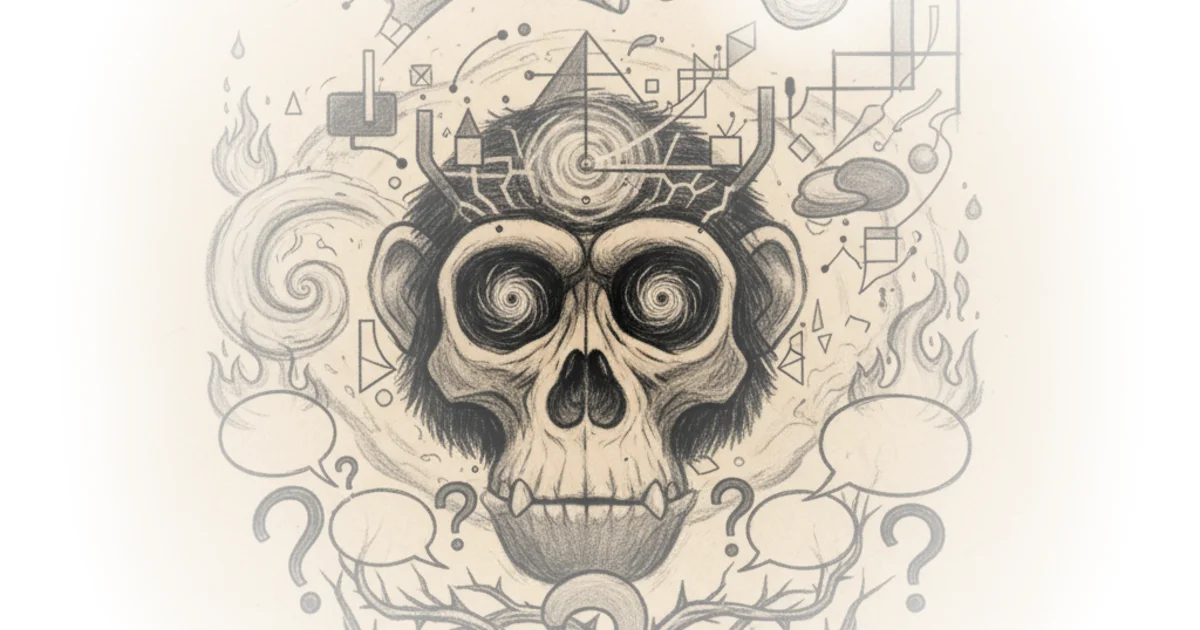
It's basically a disagreement over where to put the italics. But if it were only that, Pinsof wouldn't have written the essay.
The Mismatch Myth
A cornerstone of Williams's argument is evolutionary mismatch — the popular idea that human brains are adapted to an ancestral world of cave paintings and saber-toothed tigers and are therefore hopelessly confused by cellphones and skyscrapers. The policy implication Williams draws is predictable: if people are this lost, they need intellectuals to tell them to put down their phones and read some economics.
Pinsof pushes back hard. Mismatch is real, he concedes, but it is increasingly recognized within evolutionary psychology as an overrated explanation. The folk story about humans gorging on sugary foods because those calories were scarce in ancestral environments contains a grain of truth, Pinsof writes, but it is too simple. Our evolved food psychology is more well-designed than the caveman story suggests. Try eating nothing but Oreos for a few days and your body will punish you.
He goes further, citing research by Daniel Nettle suggesting that obesity correlates with early-life food insecurity. Bodies in poverty aren't malfunctioning — they are rationally stockpiling energy reserves because their environment is sending signals that food access is uncertain. The implication is uncomfortable for anyone who wants to blame the poor for their own weight. Critics might note that this hypothesis, while elegant, is difficult to test conclusively and risks rationalizing a public health crisis that has clear, measurable environmental drivers regardless of evolutionary backstory.
The hunter-gatherer narrative gets similar treatment. The popular image of small, egalitarian, peaceful ancestral bands is, Pinsof argues, a romantic oversimplification. Research by Manvir Singh and Luke Glowacki shows that forager societies were highly variable — some large, some deeply unequal. And the supposed egalitarianism of even the most idyllic groups masked brutal competition and hierarchy. Pinsof's broader point is that humans did not evolve in one simple, uniform past. We evolved across a bewildering variety of social and physical contexts. The human brain is not a caveman relic. It is a general-purpose problem-solving engine built for exactly the kind of bewildering variety we face.
Zero-Sum Is Not a Bug
Williams identifies zero-sum thinking as another major mismatch — a relic of subsistence life where one person's gain meant another's loss. The modern world, Williams argues, has unlocked positive-sum wealth creation through trade and innovation, and people who can't see this are stuck in an outdated mental frame.
Pinsof agrees that modern wealth creation is real. But he argues that zero-sum thinking is not a cognitive error — it is a rational response to the actual structure of modern political economy. Status is zero-sum. Political power is zero-sum. When governments intertwine themselves so deeply with capitalist wealth production that capitalism and politics become inseparable, viewing wealth through a zero-sum lens stops looking like a misunderstanding and starts looking like accurate perception.
David Pinsof writes, "Once we correctly see wealth as an instrument of power-grabbing and status-seeking, it no longer seems like such a misunderstanding to view wealth in zero-sum terms." In a system where political tribes cannot both win and where the victor enforces its will on the defeated, paranoid coalition-building and outgroup demonization are not signs of cognitive malfunction. They are functional strategies for mobilizing supporters, signaling loyalty, and capturing power. Political propaganda works on both sides of the spectrum because it serves real material purposes for the coalitions that deploy it. The masses are not being fooled by conspiracy theories — they are participating in them, and they benefit when their side wins.
Critics might counter that while political competition is indeed zero-sum in form, Pinsof's framing risks legitimizing every instance of zero-sum paranoia as rational, making it harder to distinguish between justified skepticism of power and destructive mythmaking that harms innocent people.
Progress Without Enlightenment
Williams points to improving trends in health, wealth, and safety over centuries as evidence that a kind of enlightenment has taken hold — a march of progress driven by reason and intellectual leadership. Pinsof agrees the trends are real. He just rejects the enlightenment narrative as the explanation.
As Pinsof puts it, "These trends must be explained in testable, mechanistic, incentive-based terms, like any other phenomenon in economics or social science." Attributing progress to conscious intellectual intent is, he argues, the same error of overattributed intentionality that Williams accuses the masses of making. Intellectuals anthropomorphize "the enlightenment" into a brainy homunculus striving for human betterment — which is either another form of cognitive mismatch or, more plausibly, simple self-aggrandizement.
The world got better because incentive structures changed. Expanding trade and global markets created wealth and broke down tribal barriers. People pursued cash in their pockets. Adam Smith's insights about markets emerged after wealth-creating trade was already underway — not before it. Smith did not produce the progress. He described it after the fact.
Pinsof extends the same logic to moral progress: markets pay enormous sums to people who cooperate across tribal boundaries. That financial incentive, not intellectual enlightenment, drove the expansion of moral consideration. The intellectual class simply wrote the post-hoc obituary for the old world and claimed credit for the new one.
"Given the enormous range of social and physical environments our species currently inhabits, and likely inhabited ancestrally, it is a mistake to think there is one simple, caveman past that is tragically out of sync with the present moment."
The Intellectuals' Blind Spot
What makes this essay worth reading is not its conclusion — reasonable people can disagree about how well-adapted humans are — but its method. Pinsof applies the same skeptical lens to the intellectuals that he applies to everyone else. If humans are prone to cognitive bias, so are intellectuals. If the masses are susceptible to junk food and misinformation, so is the educated class, just in higher-resolution forms. If people rationalize their self-interest and dress it up as universal wisdom, intellectuals are hardly exempt.
David Pinsof writes, "Is there any reason to expect intellectuals to be more 'matched' than the masses? The answer to this question is far from clear." It is a question that the entire project of intellectual self-justification depends on evading.
Critics might note that Pinsof's essay, while sharp, occasionally swings too far in the opposite direction — treating nearly every human behavior as the product of rational calculation responding to incentives. Cognitive bias research exists for a reason. People do make systematic, predictable errors in judgment that are not explained away by hidden rationality. Pinsof's framework is strongest as a corrective to intellectual condescension and weakest as a complete theory of human cognition.
Bottom Line
Pinsof's essay is a useful antidote to the intellectual habit of treating ordinary people as evolutionary misfits in need of expert guidance. Humans are not confused apes blundering through modernity — they are strategic organisms responding to the incentives their environments actually present, not the ones intellectuals wish they would. But the corrective risks its own blind spot: a world where every human behavior is post-hoc rationalized as adaptive is a theory that explains everything and predicts nothing.