Michael Huemer tackles a moral blind spot that plagues modern ethical consumption: the seductive idea that doing good can erase doing bad. In this provocative piece for Fake Nous, the author dismantles the logic of "moral offsetting"—the practice of neutralizing a wrongful act by performing a compensatory good deed—revealing why our intuition that "the ends justify the means" collapses under scrutiny. This isn't just abstract philosophy; it's the intellectual engine behind carbon credits and charitable tax write-offs, and Huemer exposes a fatal flaw in how we calculate the cost of our daily choices.
The Offsetting Trap
Huemer begins by laying out three distinct scenarios to test our moral compass: flying and planting trees, eating meat and donating to animal charities, and the extreme case of murder followed by massive philanthropy. He argues that if we accept the premise that doing nothing is permissible, and that combining a bad act with a good one results in a net positive, then logically, the bad act becomes permissible. "Moral offsetting is the practice of making up for a bad or prima facie wrongful action by doing something else that is good enough to outweigh the bad act," Huemer writes. The author then presents the logical skeleton of this argument, suggesting that if action A is okay, and action B is better than A, then action B must be okay.
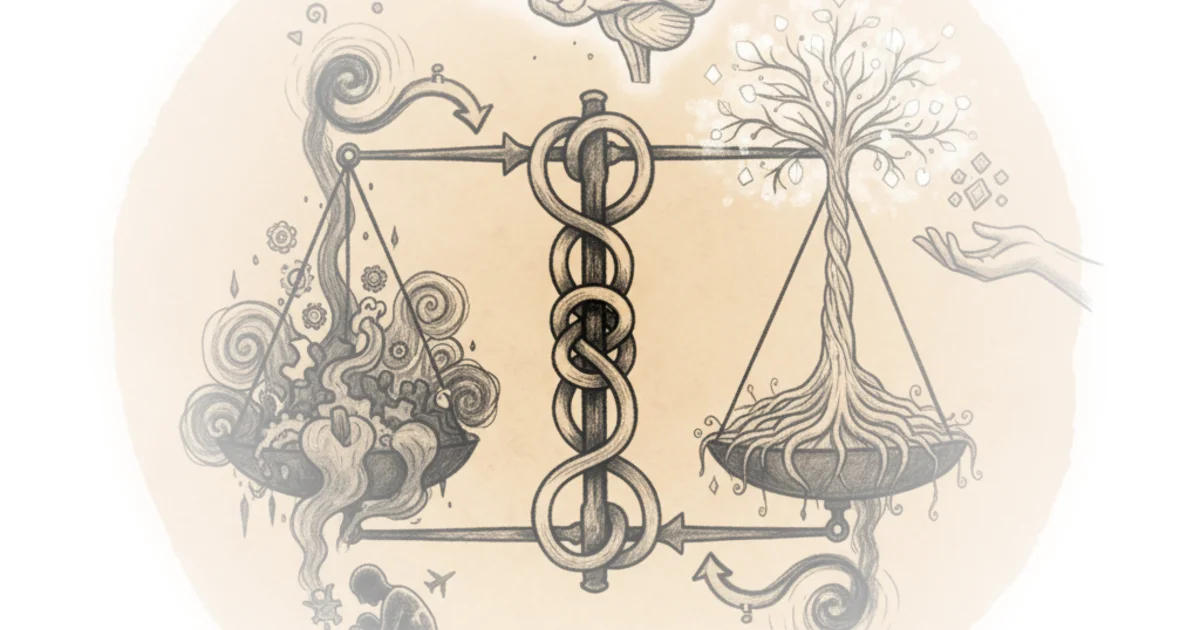
The strength of Huemer's framing lies in his refusal to shy away from the absurdity of the conclusion. He forces the reader to confront the "Murder case," where a wealthy individual kills a neighbor but donates billions to save a million lives. "Does this make the murder permissible?" he asks, highlighting the visceral rejection most people feel toward such a transaction. This intuition is the anchor of the piece. It suggests that some actions are wrong not because of their net outcome, but because of their nature. As Huemer notes, "The murder case just seems completely unacceptable. It won't be permissible to murder an innocent person, no matter how much you give to charity."
Critics might argue that this intuition is merely a cultural artifact of deontological ethics, which prioritizes rules over consequences. However, Huemer pushes back by showing that even within a framework that allows for sacrificing one to save many, the method of offsetting matters. He points out the strangeness of time ordering: "It's odd that the time ordering of the offsetting action would make such a crucial difference, such that it's horribly wrong if you donate then kill, but okay if you kill then donate." This inconsistency reveals that the problem isn't just the math of lives saved versus lives lost; it's the causal link between the harm and the good.
The most likely account of what goes wrong in the Murder case would be that the principle 'if x is permissible, and y is morally preferable to x, then y is permissible' is simply false.
Why Climate Feels Different
Having established that offsetting fails in the most extreme cases, Huemer pivots to the most common application: carbon offsets. Here, he offers a nuanced distinction that saves the concept from total collapse. He argues that climate offsetting works because the victims of the harm and the beneficiaries of the good are the same group: future generations. "This case differs from the other two because in the Climate case, the victims of the bad action (mainly future generations) are the same people as the beneficiaries of the offsetting action," he explains. Furthermore, the harm and the benefit exist on the same dimension—carbon emissions.
This is a crucial insight for anyone navigating the complex world of environmental policy. It suggests that the moral validity of an offset depends on whether the good deed directly repairs the specific harm caused. In the meat-eating scenario, Huemer points out that the animals saved by a donation to Vegan Outreach are distinct from the animals slaughtered for your burger. "Similarly, when Elon Musk donates $5 billion, the people he saves will be different from the person he kills," he writes, illustrating why the "identifiable downside" remains even if the net utility is positive. This distinction adds necessary depth to the debate, moving it beyond a simple "good vs. bad" tally.
The Problem of Action Counting
Huemer then addresses a technical objection that often plagues ethical theories: the "individuation of actions." Some philosophers argue that offsetting fails because "B+O" isn't a single action but two separate ones, and we shouldn't judge the permissibility of a bundle. Huemer rejects this as a semantic trick. "I think facts about moral permissibility are objective, not dependent on conventions or conceptual schemes," he asserts. He uses the mundane example of buying a kiwi to show that how we count actions is arbitrary. You could count buying a kiwi as one action, or as four distinct steps like walking to the store and paying. "None of these ways of counting actions is either correct or incorrect," he argues, noting that ethical theories shouldn't hinge on such arbitrary definitions.
This section is particularly effective because it strips away the jargon that often obscures moral reasoning. By grounding the argument in the physical reality of behavior, Huemer forces the reader to confront the behavior itself, regardless of how we label it. He concludes that if we cannot justify the murder in the "Murder case" even when treating the act and the donation as a single unit, then the offsetting argument is fundamentally flawed.
The Bottom Line
The strongest part of Huemer's argument is his rigorous dismantling of the "net positive" fallacy, proving that moral permissibility cannot be reduced to a simple equation of harms and benefits. His biggest vulnerability, however, lies in the practical application of his findings; if offsetting is largely invalid, it leaves individuals and corporations with few tools to mitigate the unavoidable harms of modern life. Readers should watch for how this philosophical critique might reshape the legitimacy of carbon credit markets and the ethics of "buying back" moral standing in the future.
It just sounds like nonsense to say that killing your neighbor and donating to charity is fine, but don't kill your neighbor.
Bottom Line
Huemer successfully exposes the logical incoherence of moral offsetting in cases involving rights violations, proving that some harms cannot be balanced by unrelated goods. While his defense of climate offsets offers a narrow path forward, the piece ultimately serves as a stark warning against the commodification of guilt. The real takeaway is that doing good does not grant a license to do evil.