The Revolutionary in London
Wes Cecil tells this story with the kind of detail that makes intellectual history actually gripping: Karl Marx wasn't just a philosopher getting thrown out of countries—he was essentially doing what we'd now call investigative journalism. "If you want to report about something you should just go there look at it and write it down," is how Cecil puts it, describing Marx's radical approach to understanding political upheaval. This isn't the sanitized Marx of later political mythology; it's the messy, desperate man who kept getting invited back to countries that had just kicked him out.
The World as a Material Place
The most important philosophical argument here involves what Marx saw as Hegel's fundamental flaw. Hegel believed history moved through abstract ideal categories—thesis, antithesis, synthesis—toward "the end of history" and the "perfect man." But Marx called this complete nonsense. As Cecil writes, "Marx is like what the hell are you talking about there's an idea in the world as no ideas in the world there aren't concepts in the world he says what's in the world is the world man is in the world you want to know what's going on the world go look at the world look at the statistics talk to people see what they say."
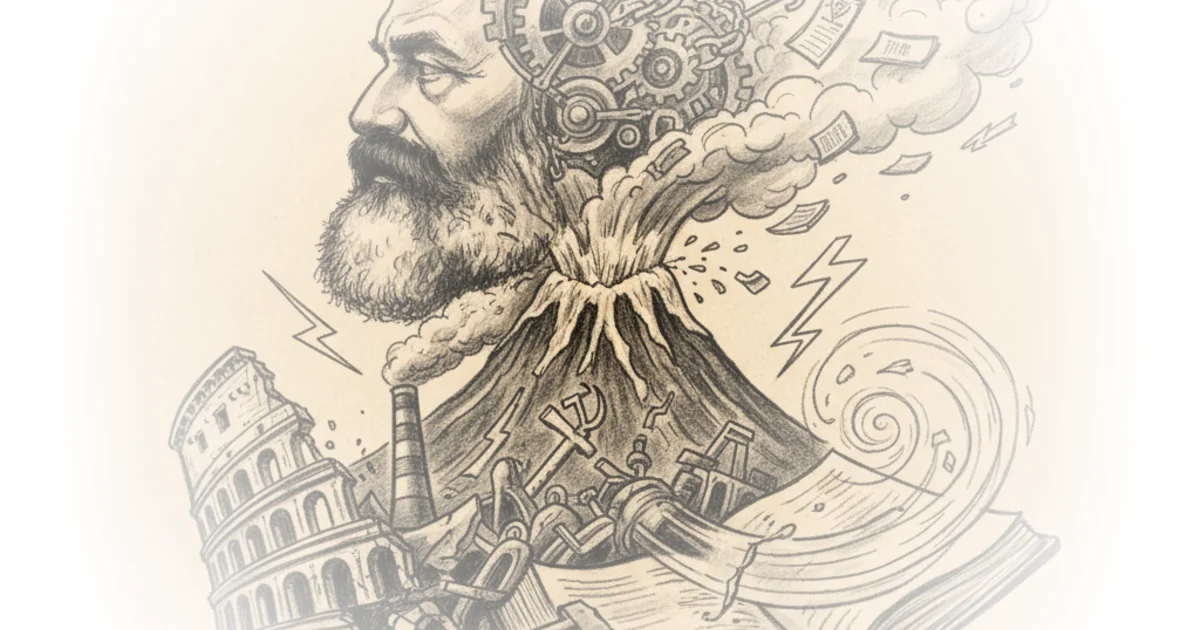
This is where Marx becomes genuinely interesting—not as a political icon but as someone who fundamentally changed how we understand knowledge. He replaced Hegel's idealism with what would become dialectical materialism: the structure of dialectic, but applied to actual lived human experience rather than abstract perfect forms. "What's in the world is the world man is in the world" isn't just clever phrasing—it represents a complete rejection of the way Western philosophy had operated for centuries.
The Economics That Changed Everything
Cecil walks through Marx's two major theories with appropriate care. First, the notion that property is theft: "he gets this in part from Adam Smith and the idea is we live in a perfect example of this right because we come in our ancestors arrived in America and they look here's a continent and nobody lives here so the land must be ours for free." The argument isn't original to Marx, but it's applied to show that converting common land into private property always involves forcing some people off it—and then protecting that new ownership through government rules. "This is necessarily so," Cecil writes. "my neighbor used to always say I'm not so upset that we stole the land from the Indians but since we didn't pay them for it why do I have to pay a mortgage."
He keeps the structure of Hegel but tries to get rid of the idealism by replacing it with materialism.
The second theory is the labor theory of value. This is where Marx's desperation actually becomes historically significant—he spent "hours and hours and hours at the British Museum doing research" on economic statistics, social history, how people really lived in 1700 versus 1800 versus now. The result was his argument that the value of objects is just accumulated labor: "What you end up paying for is congealed labor." If labor is cheap, prices decline—which explains why we"ve experienced a huge example of that over the last 15 years" with things getting cheaper due to vast pools of cheap labor.
The Man Behind the Myth
What makes this piece valuable isn't just the philosophy—it's the human details Cecil includes. Marx was "not good with money he was good with money in the abstract," living in conditions so severe that one of his children died because they couldn't afford medicine. He had pawned his only pair of pants at one point. And yet Engels gave up so much "that Engels diminished his quality of living a great deal" to support Marx's family for decades.
This isn't the heroic revolutionary figure of later mythology—it's someone who was constantly getting kicked out of countries, writing newspapers, organizing people around political ideas, and being generally disliked by other socialists "because he's not an idealist." He always wanted to talk about facts. "He's a political economist with heavy heavy philosophical leanings."
Counterarguments Worth Considering
Critics might note that Marx's labor theory of value has been largely rejected by mainstream economics—his claim that value is purely determined by accumulated labor doesn't hold up under modern marginal utility analysis. The historical record also shows his predictions about the inevitable collapse of capitalism were spectacularly wrong in their timeline. And his own economic data, gathered desperately in London poverty, was imprecise by any scientific standard.
But what Cecil captures effectively is how Marx's fundamental insight—that you should "go look at the world look at the statistics talk to people see what they say"—actually became foundational for empirical social science. The methodological revolution he started, looking at actual conditions rather than abstract philosophical categories, has never fully ended.
Bottom Line
Wes Cecil's strongest move is reframing Karl Marx from political icon to empirical researcher—a man who revolutionized how we study economics not through grand theoretical predictions but by actually talking to people and counting things. His biggest vulnerability is probably the one he acknowledges least: the romanticism of poverty as intellectual sacrifice. The child dying because medicine couldn't be afforded isn't a sign of noble commitment—it's a failure that Marx himself never quite resolved. But the core argument holds: the materialist method Marx introduced still shapes how we understand economics today, whether we call ourselves Marxists or not.