In a world where secular modernity often assumes human nature is inherently good and culture is merely a burden, Tove K offers a startling counter-narrative: civilization is not our default state, but a fragile, improbable accident. This piece challenges the comfortable belief that we are born enlightened, arguing instead that large-scale cooperation required us to override millions of years of biological programming. For the busy reader seeking to understand the deep roots of our current social order, this is a provocative reminder that our peace is not natural, but earned through rare and unlikely historical events.
The Social Bottleneck
K begins by dismantling the modern secular assumption that human nature is morally pure. "In Modern Western secular society, on the other hand, there are important currents that say the opposite of this: Human nature is in itself enlightened," K observes, immediately pivoting to the scientific reality that contradicts this view. The author argues that the true breakthrough of humanity was not the invention of the wheel or the spear, but the ability for unrelated males to live together without killing each other over reproductive access.
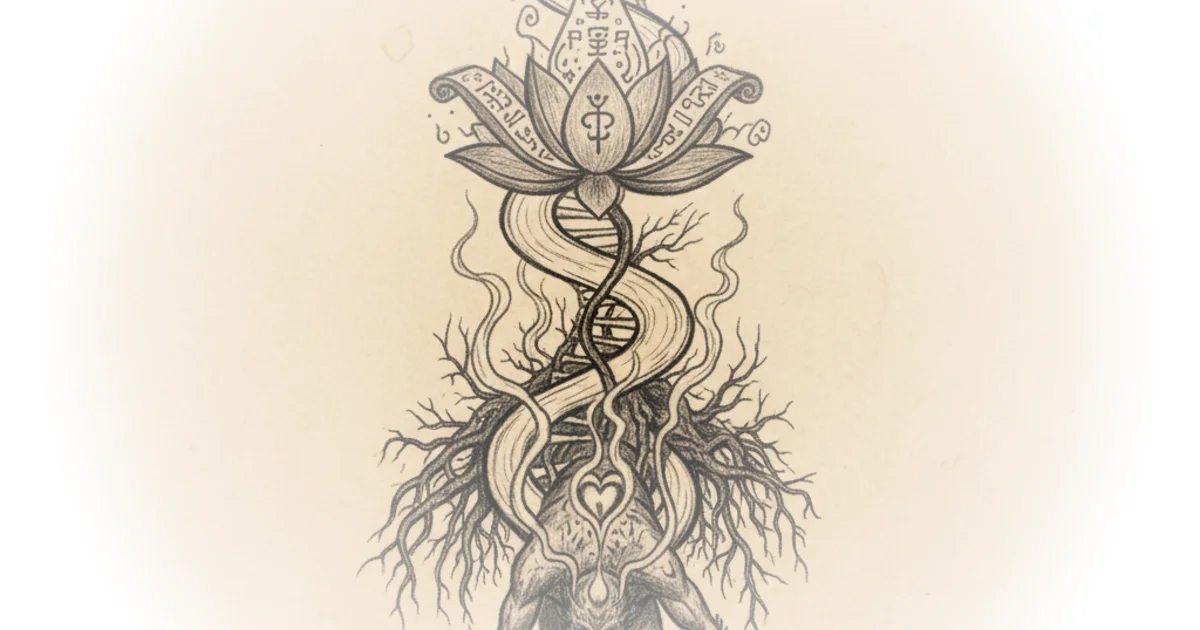
The core of the argument rests on evolutionary biology: in nature, males are typically reproductively greedy, and cooperation among unrelated males is an anomaly. K writes, "Overcoming this specific part of nature was as important as inventing technology. In fact, the latter was much of an effect of the former." This reframing is powerful because it shifts the focus from material progress to social psychology. The author suggests that without a mechanism to curb male aggression, the complex societies required to maintain advanced technology could never have formed.
Critics might note that this view risks oversimplifying the diversity of human social structures, as some hunter-gatherer societies have maintained large, peaceful networks without the specific "civilizing" mechanisms K describes. However, the piece effectively highlights a genuine tension in evolutionary theory regarding the origins of large-scale cooperation.
The Stalemate of Nature
To illustrate the difficulty of breaking out of this evolutionary trap, K turns to the example of the Dugum Dani people of Papua New Guinea. Despite living in a fertile, densely populated environment, they remained locked in a cycle of ritual warfare for centuries. K describes the grim reality: "A woman who walked thoughtlessly into her fields and was killed was considered to have committed suicide; the equivalent of walking straight onto a highway in modern society."
This vivid imagery underscores the human cost of the stalemate. The author explains that in such environments, women became high-value targets, leading to constant conflict that kept population levels low and prevented the formation of larger political units. "The Dani, and many other groups like them, lived in a state of stalemate, generation after generation," K notes, emphasizing that the conditions for civilization—fertile land and dense populations—were present, yet civilization did not arise.
Civilization is actually not within us. Rather, civilization is a very small part of us, amplified through cultural learning.
The argument here is that without a specific catalyst, the natural tendency toward conflict would have persisted indefinitely. The piece suggests that the absence of civilization in places like Papua New Guinea is not a failure of the people, but evidence of how difficult it is to overcome our biological defaults.
The Role of Outlier Ideas
If the conditions for civilization were met in many places but only succeeded in a few, K asks what was missing. The answer, according to the author, is "ideas." K posits that civilization arose only where "outlier ideas"—extremely rare concepts that encouraged altruism or cooperation—managed to take root and spread.
"The reason why people built civilizations in a few places, is that they got ideas that allowed them to do that," K writes. These ideas did not need to be inherently altruistic; they could be scary or authoritarian, as long as they compelled people to act against their natural self-interest. The author draws a parallel to religious traditions, suggesting that they were right to view their cultural foundations as "divine revelations" or exceptional events, even if the mechanism was not supernatural.
This section offers a compelling synthesis of cultural evolution and historical contingency. By framing civilization as the result of rare, high-impact ideas, K provides a scientific justification for the religious intuition that culture is a precious, fragile inheritance. However, the piece leaves open the question of what specific ideas triggered these shifts, relying more on the statistical improbability of the event than on a detailed historical analysis of the ideas themselves.
The Fragility of Order
The piece concludes by reinforcing the idea that human nature is neutral, not good. "Why would human nature be such a glaring exception from other parts of nature?" K asks, challenging the modern narrative that civilization is an internal potential waiting to be unlocked. Instead, the author argues that civilization is a thin veneer, easily lost if the cultural mechanisms that sustain it are abandoned.
K writes, "Without that cultural learning, the outlier part of us that is fit to form civilizations will drown under our nature, until something very improbable finally happens again." This serves as a stark warning: the peace and order we enjoy are not guaranteed by our biology, but are the result of a precarious cultural achievement that requires constant maintenance.
Bottom Line
Tove K's most compelling contribution is the reframing of civilization as a statistical outlier rather than an inevitable progression, forcing readers to confront the fragility of social order. While the argument leans heavily on evolutionary generalizations that may not account for all human societies, its core insight—that our capacity for large-scale cooperation is a rare and hard-won anomaly—offers a necessary corrective to modern complacency. The reader should watch for how this perspective influences current debates on social cohesion and the value of inherited cultural institutions.