Sam Denby reveals a counterintuitive truth about the cruise industry: the greatest threat to these massive ships wasn't the recession or even the pandemic, but the realization that the destination no longer mattered. In a piece that reads like a business thriller, Denby argues that the industry's survival hinged on a radical pivot from selling vacations to selling floating cities, a strategy that fundamentally rewrote the rules of global travel.
The Recession as a Catalyst
Denby opens by setting the scene of 2008, a moment when the conventional wisdom was to bet against the entire sector. "If one headline could summarize the mood surrounding the cruise industry in 2008, it's this: Go buy the trip and short the stock." The author paints a grim picture of an industry reliant on near-perfect occupancy rates, facing a global economic collapse that should have sunk it. Yet, rather than retreating, the major players doubled down. Denby notes that while companies like Carnival and Royal Caribbean slashed prices and offered refunds to the unemployed, they were simultaneously preparing for a massive expansion.
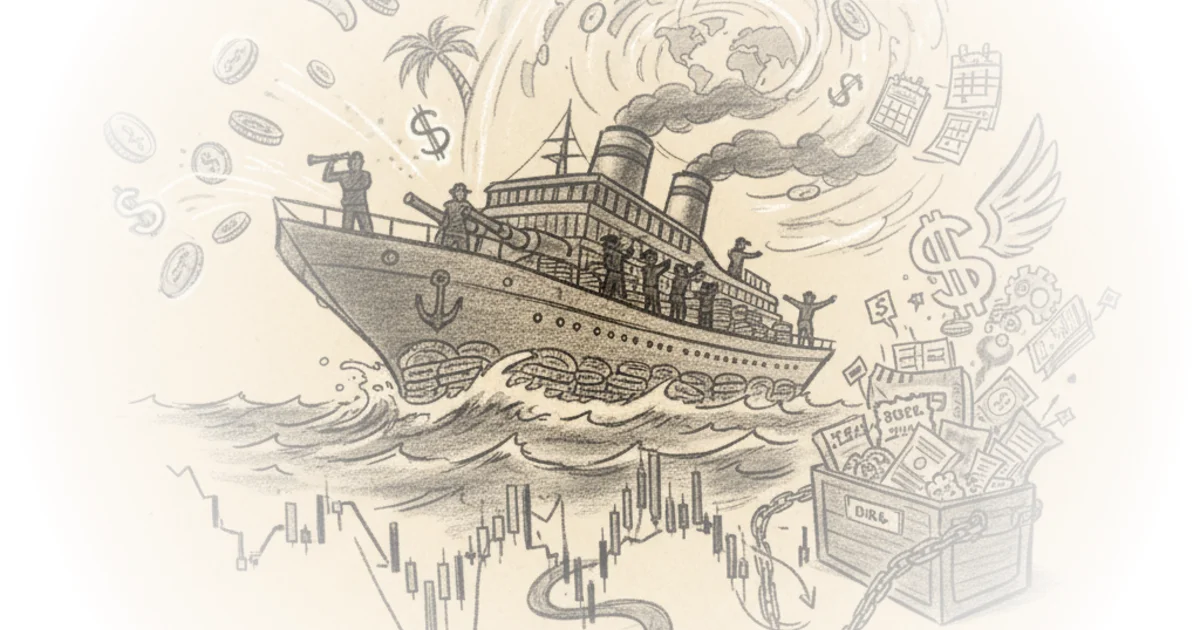
This maneuvering seems risky on the surface, but Denby's analysis suggests it was a calculated bet on the industry's unique value proposition. "For a majority American customer base, cruising was the cheapest, most hassle-free means of taking a vacation." The author effectively highlights how the industry had already mastered the art of simplifying travel, bundling airfare, meals, and entertainment into a single, predictable cost. This resilience during a downturn is impressive, but it also exposed a ceiling. The strategy of convenience had a limit; the brand had become associated with the "newlywed and nearly dead," lacking the cool factor needed to attract a new generation.
The boat itself was becoming the destination. The destinationification of the boat addressed another major challenge servicing the industry.
The Neighborhood Strategy
The core of Denby's argument centers on the launch of the Oasis of the Seas in 2009, a vessel that changed the trajectory of the entire industry. He describes how Royal Caribbean split the ship into seven distinct "neighborhoods," creating a microcosm of a city rather than just a floating hotel. "The ship by design had something for everyone, or more accurately, some things for everyone." This design philosophy allowed families with divergent interests to find their own spaces, solving the problem of boredom that had long plagued the demographic.
Denby points out a fascinating shift in marketing that accompanied this physical change. In press releases, the actual ports of call were relegated to the bottom, while the amenities took center stage. "While it mentions how one can book a trip on the boat, there's never any mention as to where the boat is actually bound to sail." This is a profound observation: the industry was no longer selling a trip to a place, but an experience on the ship itself. Critics might note that this approach risks alienating travelers who seek authentic cultural immersion, but Denby argues that the data proves the strategy worked, with passenger numbers surging despite the economic headwinds.
The author also connects this design shift to a practical economic necessity: fuel costs. With fuel accounting for nearly 10% of operating expenses, the industry needed to reduce its reliance on long, fuel-intensive itineraries. "It was down to Royal Caribbean not wanting to burn the fuel." By focusing on the Caribbean and utilizing private resorts, companies could shorten routes and slow speeds, saving money while keeping guests entertained on board. This created a self-reinforcing loop where the ship became the primary attraction, making the specific geography less relevant.
The New Luxury Frontier
As the piece moves into the present day, Denby identifies a new frontier: ultra-luxury competitors entering the space. He highlights the Ritz Carlton's entry into the market with the Ama, a ship that defies traditional cruise definitions. "In an industry where 1,000 guests qualifies a ship as small or boutique, the Ritz's first passenger ship, the Ama, holds only 298 guests." Denby argues that these new entrants are not competing with traditional cruise lines, but with land-based luxury hotels, leveraging the same brand loyalty and service standards.
The author details how the Ritz Carlton is transferring its terrestrial strengths to the water, from empowered staff who can spend up to $2,000 to resolve guest issues without management approval, to dining experiences designed by their top chefs. "All these aspects are easily transferable over to a super yacht." This shift suggests that the next phase of the industry's evolution will be driven by brand trust and hyper-personalization rather than sheer size. While the "big boat bonanza" of the 2010s focused on scale, the current trend is about intimacy and exclusivity.
The boat with its ample exposed wood grain looks like a Ritz, while the dining experience was designed by the head chef at the Ritz Carlton in Wolfsburg.
Bottom Line
Denby's most compelling insight is that the cruise industry's greatest innovation was realizing the destination was a liability, not an asset. By transforming ships into self-contained destinations, they insulated themselves from fuel volatility and port politics, creating a product that is both economically efficient and experientially rich. However, the argument leaves one question unanswered: as the industry pivots to ultra-luxury and smaller, more intimate vessels, will the mass-market appeal that fueled the last two decades of growth remain sustainable? The industry has successfully reinvented itself twice, but the next challenge may be maintaining its broad appeal while chasing the high-margin luxury niche.