Alan Horn crafts a narrative that feels less like a historical fiction and more like a psychological autopsy of spiritual isolation, revealing how the pursuit of absolute purity can curdle into performative madness. By dramatizing a single communal meal among 16 ascetics, Horn exposes the absurdity of a system where the body is starved to feed the ego of the soul. This is not a story about finding God; it is a story about the terrifying mechanics of a community that has forgotten how to be human.
The Theater of Asceticism
Horn's central thesis is that the monastery has become a stage where the brothers compete in a grotesque contest of suffering. The scene opens with Maurice, a novice, facing an assembly of men who look "skeletal" and "hollow," yet their hunger is secondary to their need for validation. Horn writes, "Maurice submitted to the scrutiny of this assembly of saints like a martyr to the flames. His salvation depended on his winning a place among them." This framing immediately shifts the focus from spiritual devotion to social survival. The stakes are not divine favor, but acceptance within a group that has weaponized its own deprivation.
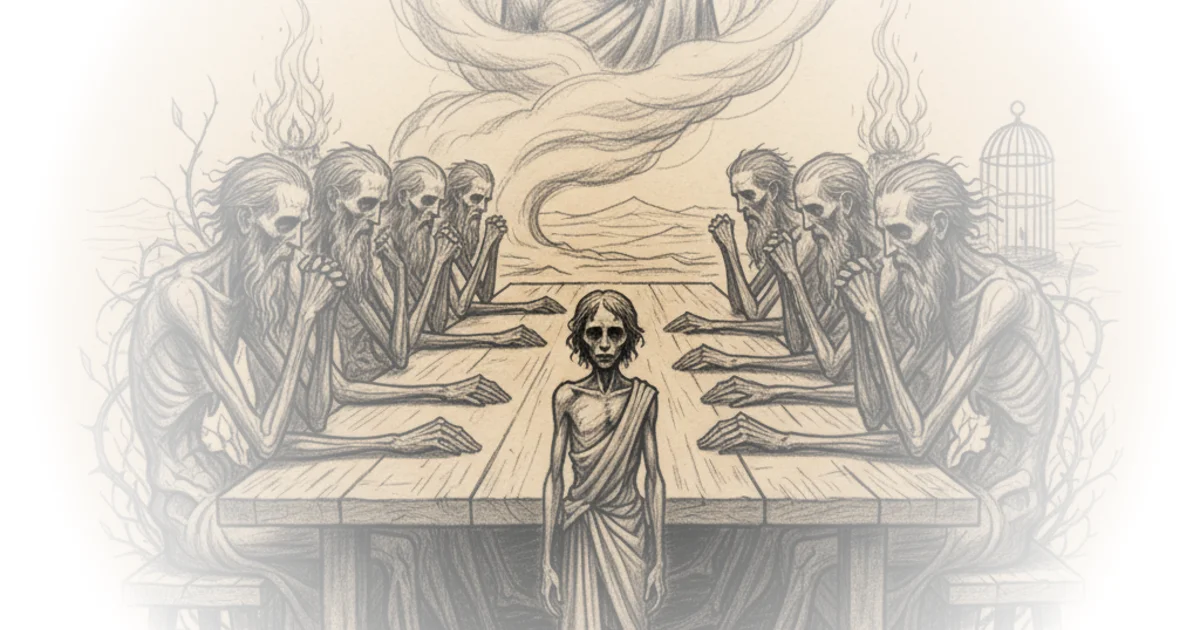
The author brilliantly illustrates how the rules of the community are twisted to serve vanity rather than humility. When Brother Moue struggles to ask a question because the food is too tempting, the group's reaction is not compassion but irritation. Horn notes the pettiness: "Shame, shame!" shouted a brother with a beak-like nose, followed by Moue sticking out his lips. This moment captures the fragility of their discipline; the slightest indulgence triggers a cascade of judgment. The narrative suggests that in this environment, the "Seven deadly sins" are not conquered but merely redistributed, with pride and envy becoming the primary currencies of the realm.
"How can I think with this savory food in front of me?" asked Moue, exposing the absurdity of a community where a spoonful of lentils is a battlefield for the soul.
Critics might argue that Horn romanticizes the brutality of the Desert Fathers, ignoring the genuine theological rigor that motivated such extreme asceticism. However, the text's strength lies in its refusal to offer a noble counter-narrative. The monks are not portrayed as martyrs in the traditional sense, but as broken men trapped in a cycle of self-flagellation that has lost its original meaning.
The Architecture of Delusion
As the meal progresses, the dialogue devolves into a series of one-upmanship contests regarding starvation and abstinence. The author uses the character of Saius to highlight the competitive nature of their piety. When Maurice mentions eating radish oil, Saius gleams with a dark intensity, declaring, "I haven't taken oil in seven years." Horn uses this exchange to show how the monks have turned the denial of basic needs into a scoreboard. The historical context of the Anchorite tradition, where individuals lived in total isolation to battle demons, is subverted here; these men are together, yet their isolation is more profound because they are constantly performing for one another.
The narrative takes a darker turn with Brother Phib, who describes demons in vivid, almost cartoonish detail—horns, forked tails, and smoke. When Phib asks if Maurice has seen such things, the novice hesitates, realizing the trap. "We never know what forms the demons may take," Phib exclaims, "They can even assume a pious appearance and feign the speech of holy men." This is the story's most chilling insight: the demons are not external monsters, but the brothers themselves, disguised in piety. The reference to the Desert Fathers' belief that demons could take the form of light or angels is twisted into a paranoid delusion where every brother is a potential threat.
The character of Isaiah provides the emotional climax of the meal, weeping over the act of eating itself. "Woe is me, woe is me, who shamelessly dares to satisfy my stomach with this food that appalls my God," he cries. Horn's choice to have Isaiah lament the very act of survival underscores the insanity of the situation. The community has created a theology where existence is a sin. This is not the quiet contemplation of the early hermits; it is a collective hysteria where the fear of judgment has replaced the love of God.
The Silence of the Leader
Throughout the chaos, the figure of Apa Zeno, the "holy father," remains detached. He scratches himself, looks off vacantly, and chews his bread without engaging. Horn writes, "The elder's eyes were not directed at anyone... and he did not seem to be following the conversation." This silence is deafening. In the tradition of the Desert Fathers, the abbot was meant to be a spiritual guide, a living example of wisdom. Here, Zeno is a hollow symbol, a figurehead who presides over a house of mirrors. His absence of leadership allows the petty squabbles and performative suffering to fester unchecked.
The story ends not with a resolution, but with a question about a dove, a symbol of the Holy Spirit, which one brother claims to have seen and another denies. The ambiguity of the ending mirrors the ambiguity of the monks' faith. Are they witnessing a miracle, or are they hallucinating from starvation? Horn leaves the reader with the unsettling feeling that the line between the divine and the delusional has completely dissolved.
"We never know what forms the demons may take. They can even assume a pious appearance and feign the speech of holy men."
Bottom Line
Alan Horn's "The Solitary" is a masterful critique of institutionalized spirituality, revealing how the pursuit of perfection can devolve into a theater of the absurd. The piece's greatest strength is its unflinching portrayal of the psychological toll of extreme asceticism, showing that the demons the monks fear are often the reflections of their own pride. The narrative's vulnerability lies in its lack of a redemptive arc, leaving the reader with a bleak view of human nature that may feel unrelenting, yet it remains a powerful reminder that without humility, even the holiest of endeavors can become a prison.