Andrew Henry dismantles a pervasive visual myth: that early Christians depicted Jesus as a magician wielding a magic wand. By excavating the specific social roles of ancient ritual experts and the distinct symbolic histories of mythological staffs, Henry proves that a modern viewer's assumption of "sorcery" is a category error. This is not just an art history lesson; it is a correction of how we read the visual language of the ancient world, revealing that the "wand" in the Catacomb of Domitilla was a symbol of authority, not a prop for a trick.
The Modern Projection of Magic
The piece begins by confronting the reader's own biases. Henry writes, "To us today, a wand is not a neutral object. We have been conditioned through centuries of folklore and decades of pop culture to view the wand as the quintessential tool of the magician." He argues that we are projecting a fantasy trope onto a historical reality where the concept of a "professional magician" barely existed. This framing is crucial because it forces the audience to suspend their pop-culture conditioning before engaging with the evidence.
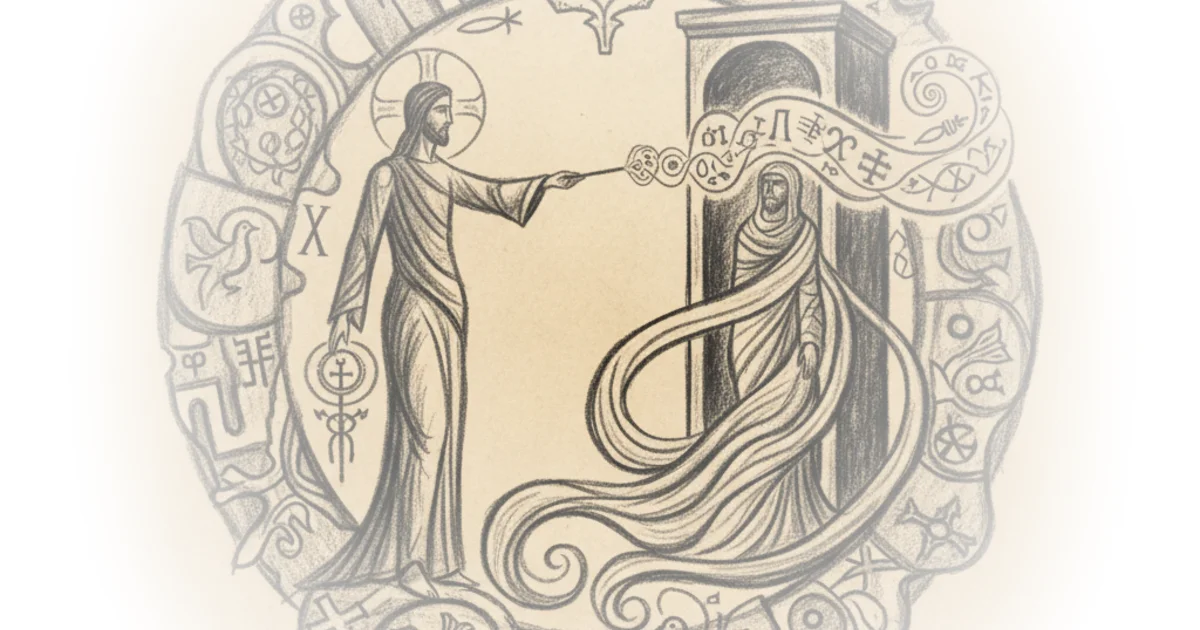
Henry meticulously separates the modern idea of a wizard from the ancient reality of ritual specialists. He notes that in antiquity, those performing rituals were often scribes, metalworkers, or religious functionaries. "Their tools were chisels, ink, and styluses, not wands," he observes. This distinction is the article's intellectual anchor. It suggests that if Jesus were being portrayed as a "magician" in the modern sense, the artist would have likely included amulets or curse tablets, not a simple stick. The argument holds up well because it relies on the absence of evidence where evidence should be if the "magician" theory were true.
Wands were not part of anyone's standard magical toolkit, nor would have instantly brought to mind magicians.
The Constellation of Ritual Sticks
Moving beyond the general, Henry dives into the specific symbolic weight of staffs in the Greco-Roman world. He details how different figures used rods for entirely different purposes: the lituus for Roman augurs, the kerykeion for Hermes, and the thyrsus for Dionysus. He explains that while these objects were ritualistic, they were not interchangeable. "Each ritual stick carried its own symbolic history tied to a specific divine or mythic context or figure," Henry writes. This nuance is the article's strongest asset. It prevents the reader from collapsing all ancient sticks into a single "magic wand" category.
The analysis of Circe is particularly sharp. Henry addresses the most famous literary example of a wand-wielding figure, acknowledging that in Homer and Ovid, Circe's rod is central to her transformations. However, he pushes back against the idea that this established a universal trope. He argues that even in Ovid's Metamorphoses, where Circe's wand is prominent, the author "never gives one to Medea, the other famous witch who he features prominently in that text." This specific counter-example effectively dismantles the idea of a standardized "witch's wand" in the ancient imagination. Critics might note that literary examples don't always reflect popular visual culture, but Henry's point remains robust: the staff was a specific attribute, not a generic tool.
The Verdict on the Catacomb Fresco
Finally, Henry returns to the fresco of Jesus raising Lazarus. He posits that an ancient viewer would not have seen a magician, but rather a figure of divine authority, perhaps echoing the staffs of prophets or kings. He writes, "An ancient Roman walking through the catacombs of Domitilla looking at a fresco of Jesus raising Lazarus while pointing a stick would not have instantly thought, 'Ah, a magician.'" This conclusion recontextualizes the entire image. The stick becomes a gesture of command, similar to a scepter, rather than a device for casting spells.
The article's strength lies in its refusal to let the modern viewer's intuition stand unchallenged. By showing that the "magic wand" is a modern invention projected onto the past, Henry restores the specific theological and cultural intent of the early Christian artists. The evidence is solid, the logic is tight, and the correction of a long-held misconception is delivered with clarity.
Bottom Line
Andrew Henry's argument is a masterclass in historical contextualization, successfully proving that the "magic wand" is a modern anachronism when applied to early Christian art. The piece's greatest vulnerability is its reliance on the silence of the archaeological record regarding "wands," but the sheer weight of the literary and social evidence makes this a minor gap. Readers should watch for how this distinction between "magical tool" and "symbol of authority" reshapes their understanding of other ancient religious icons.
The ancient world had no shortage of ritual staffs, rods, sticks, or branches of various shapes and sizes, each used in different ritual contexts, but none were the universal symbol of magic we imagine today.