Tim Mak delivers a haunting revelation that cuts through the noise of modern geopolitics: Russia's war in Ukraine is not just about territory, but a calculated campaign to erase a distinct culture that has survived empires for millennia. This piece moves beyond standard battle reports to expose how the administration leverages historical trauma and linguistic manipulation to fracture communities from within.
The Architecture of Erasure
Mak anchors the narrative in the personal journey of Iryna, a woman who spent decades unaware her identity was being systematically dismantled by state policy. He writes, "All my life I considered myself Greek... until the war broke out and my native village was occupied." This framing is crucial; it shifts the focus from abstract political disputes to the visceral loss of self experienced by civilians on the ground.
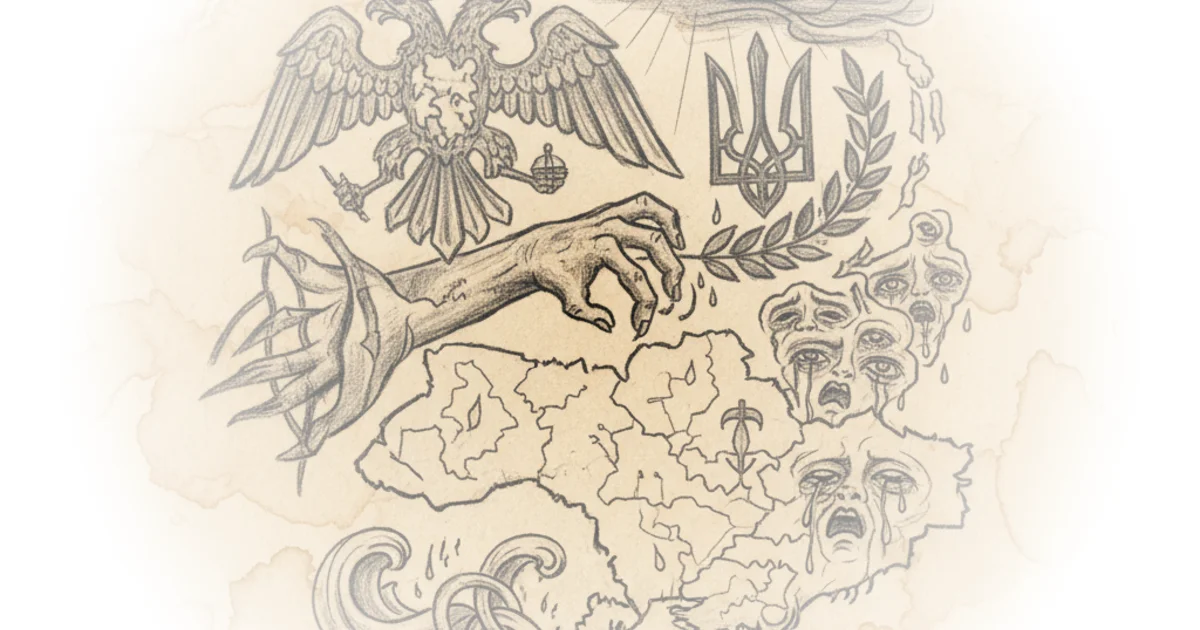
The author meticulously traces how Soviet-era policies laid the groundwork for current Russian aggression. He explains that while the Bolsheviks initially promoted "korenizatsiya" (nativization), they quickly pivoted to suppressing distinct identities to forge a monolithic "Soviet people." Mak notes, "On December 15, 1937, Communist Party understood that independence in the national republics was growing... That's why large-scale campaigns were launched against 'bourgeois nationalism.'" The evidence presented—that over 20,000 Greeks were persecuted and more than 5,000 killed in the Donetsk Azov region alone—underscores a long-standing pattern of state-sponsored violence that predates the current conflict.
Since then, being Greek meant being killed or tortured.
This historical context is vital. It reminds us that the North Azovian Greeks are not merely a demographic statistic but a people who have endured deportation from Crimea in 1778 and subsequent repressions under Stalin. Mak effectively argues that the current occupation is a continuation of this centuries-old effort to extinguish their distinctiveness.
The Weaponization of Language and Identity
A central pillar of Mak's argument is how language itself becomes a tool of control. He details how the Soviet regime artificially merged the Urum and Rumaiic languages into a simplified version of modern Greek, specifically designed to alienate the community from their own heritage and project propaganda back to Greece. As Mak puts it, "The USSR wanted to show Greece that ethnic Greeks lived well in the Soviet Union... if the North Azovian Greeks spoke the official language of Greece but praised Stalin and communism, their newspapers, books, and radio broadcasts could be exported back to Greece as propaganda."
This manipulation created a generational rift where speaking one's native tongue became dangerous. Mak recounts how Iryna's mother lived in fear: "No, no, no, God forbid you tell someone that she is Greek. God forbid." The psychological toll of this enforced silence is palpable. Even today, the administration continues to exploit these fractures. Mak observes, "Today Russia is trying to spread its narratives through loyal Greek media and organizations to strengthen its global influence," noting that fake news launched through local European outlets carries more weight than direct broadcasts from Moscow.
Critics might argue that focusing on linguistic nuances distracts from the broader military reality of the invasion. However, Mak convincingly demonstrates that for occupied populations, cultural survival is inextricably linked to physical survival. The loss of language and tradition is not a side effect; it is a primary objective of the occupation.
A Culture Stripped Away
The piece concludes with a sobering look at what remains when identity is stripped away. Mak describes unique traditions like "nosyty pluzhok" (carrying the plow) and the Panair festival, which distinguish North Azovian Greeks from mainland Greeks. Yet, under occupation, these practices are vanishing. Iryna reflects on her inability to return home: "It would hurt too much because it's no longer the same. It is no longer about the Rumaiic people, no longer about the Greeks, unfortunately."
Mak also highlights a disturbing irony in Russian policy: while claiming to protect indigenous peoples, the administration systematically denies them status if they are too large or refuse to adhere to a "traditional lifestyle." He points out that indigenous activists are now being locked up on fabricated terrorism charges, with sentences of up to 20 years. Furthermore, economic desperation is used as a recruitment tool: "To reduce the population of indigenous peoples, Russian authorities deliberately recruit them for the war against Ukraine... people are forced to sign military contracts just to survive."
This dual strategy—cultural erasure followed by physical conscription—reveals the depth of the administration's commitment to dismantling these communities. The human cost is measured not just in casualties, but in the extinction of a unique way of life that has persisted since the 7th century BC.
You begin to search for some kind of identity. To dig deep inside yourself. Who am I? What am I? I don't want to be Russian. I feel ashamed that I have those roots. But there is nothing I can do about it.
Bottom Line
Tim Mak's reporting succeeds by grounding a complex geopolitical strategy in the intimate, heartbreaking reality of one family's lost history. The strongest element of this argument is its demonstration that cultural genocide is not an accidental byproduct of war, but a deliberate, long-term policy of the Russian state. The biggest vulnerability for the West is ignoring these subtle, slow-burning erasures while focusing solely on front-line battles; if the world fails to recognize the value of these unique cultures, their destruction will be complete before the shooting stops.