Eric Salzman doesn't just analyze Robinhood's financial resurgence; he exposes the mechanics of a business model that treats retail investors as predictable prey for high-speed algorithms. While the headlines celebrate a 220% stock surge and a founder's billionaire status, Salzman argues this success is built on a "brilliantly evil" fusion of video game psychology and opaque market structures that have existed since the era of Flash Boys. For the busy professional, this piece cuts through the noise of market rallies to reveal why the "democratization" of finance might actually be the most sophisticated extraction machine in history.
The Dopamine Engine
Salzman opens with a scathing assessment of the user experience, framing the app not as a financial tool but as a behavioral trap. He writes, "Robinhood is a pusher in plain sight and dopamine is the drug it peddles." This is not hyperbole; it is a description of a product designed to trigger the same neural pathways as gambling. The author points out that founder Vlad Tenev recently appeared at a summit in a race-car driver's jumpsuit, telling the crowd that "a finely tuned machine can make all the difference." Salzman dismantles this analogy immediately, noting that while a race car is fast, "if you put 99.99% of us into a Formula One car, we're going to run that thing into the first wall we see."
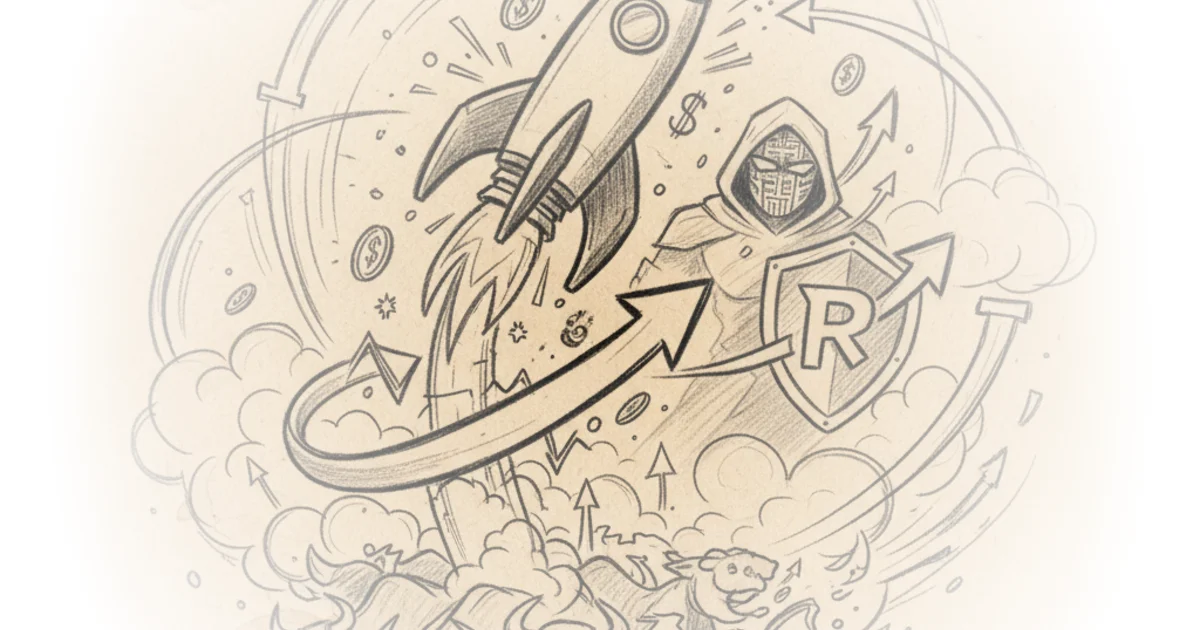
The core of Salzman's argument is that the company's leadership knows their demographic is not investing; they are being farmed. He draws a chilling parallel to drug cartels, admitting he felt a "sick sense of admiration" for how Tenev and co-founder Baiju Bhatt leveraged their high-frequency trading (HFT) backgrounds to create a "no-fee brokerage combined with a video game-like interface." This framing is effective because it shifts the blame from the individual trader's lack of discipline to the architectural design of the platform itself. Critics might argue that users are consenting adults who choose to trade, but Salzman counters that the consent is manufactured through features that lower barriers to entry while obscuring the risks.
Robinhood is a pusher in plain sight and dopamine is the drug it peddles.
The Hidden Cost of "Free"
The piece then pivots to the financial engine driving this operation: Payment for Order Flow (PFOF). Salzman explains that the "free" trades are a mirage, funded by selling customer data to market makers like Citadel and Susquehanna. He notes that these firms pay Robinhood to execute orders, creating a conflict of interest where the broker profits from the volume of trades rather than the customer's success. Salzman cites a damning SEC finding from 2018, where Robinhood was penalized for misleading customers about execution quality. The regulator found that despite claiming to offer the best prices, Robinhood's customers were "deprived... of $34.1 million" due to inferior trade execution.
Salzman argues that the real value of this data lies in the predictability of the retail crowd. He writes, "One theory that I subscribe to is that Robinhood's main client base — young men — is aggressive risk takers and relatively predictable." This connects directly to the "Meme Stock" craze of 2020-2021, where herds of retail traders moved in unison, allowing HFT algorithms to front-run their moves with terrifying efficiency. The author suggests that the founders knew this dynamic when they started the firm, turning a structural advantage into a revenue stream. While the market makers argue they provide liquidity, Salzman's analysis suggests they are simply betting against the retail flow with a mathematical certainty that the average user cannot match.
The Leverage Trap
Perhaps the most dangerous section of the commentary focuses on the aggressive promotion of options and zero-day expiration (0DTE) contracts. Salzman describes these as products where "probably 99% of Robinhood customers should not be playing." He illustrates the mechanics of leverage with a simple example: using $1,200 to control 1,000 shares of stock. While this can double a bet in a bull market, it wipes out the entire principal in a flat or slightly down market. He notes that in 2022, when Google shares dropped, "option bets got creamed as newbie traders learned the downside of leverage."
The author highlights a disturbing trend where the app allows users to unlock "advanced level of options strategies in minutes," a process that takes days at traditional firms like Charles Schwab. This ease of access is not a feature; it is a hazard. Salzman points out that 78% of Robinhood's transaction-based revenue now comes from crypto and options, products where the house always has the edge. He references the expansion into prediction markets, where users can bet on football games or election outcomes with leverage up to 7x. The author asks, "7x leverage on altcoins, what could possibly go wrong?" The rhetorical question underscores the recklessness of the business model. A counterargument worth considering is that sophisticated traders do exist on the platform and profit from these tools, but Salzman's data on revenue concentration suggests the platform is optimized for the losses of the many, not the gains of the few.
Bottom Line
Salzman's strongest asset is his refusal to treat Robinhood's success as a triumph of financial literacy, instead exposing it as a triumph of behavioral engineering. The piece's greatest vulnerability is its reliance on the assumption that all retail traders are incapable of understanding the risks they take, a generalization that ignores the minority of successful day traders. However, the evidence of systemic design—prioritizing high-risk products, obscuring PFOF, and gamifying the interface—makes a compelling case that the platform is fundamentally adversarial to the average user. The reader should watch for how regulators will respond to the explosion of zero-day options and prediction markets, as these are the next frontiers where the "casino in a pocket" model may finally hit a wall.