Heather Cox Richardson delivers a chilling chronicle of an administration unraveling under the weight of its own contradictions, painting a picture where foreign policy failures and domestic authoritarianism are not separate crises but intertwined symptoms of a collapsing institutional framework. The piece is notable for how it juxtaposes the administration's grandiose claims of "victory" in Iran with the absurdity of a militarized crackdown on a Washington D.C. reflecting pool, forcing the reader to confront the dissonance between official narratives and observable reality.
The Illusion of Diplomatic Victory
Richardson begins by dismantling the administration's narrative regarding its recent memorandum of understanding with Iran. She argues that the deal, far from being a triumph, is a "stopgap measure" designed solely to lower gas prices before midterms while handing billions to a hostile regime. As she writes, quoting right-wing hardliner Mark Dubowitz, "The actual MOU is deeply flawed. The administration needs to stop defending it beyond stating the truth: It's a stopgap measure to resupply energy markets, lower gas prices, and help Republicans in the midterms." This framing effectively strips away the propaganda, revealing the deal not as a strategic masterstroke but as a desperate political maneuver that sacrifices long-term security for short-term economic relief.
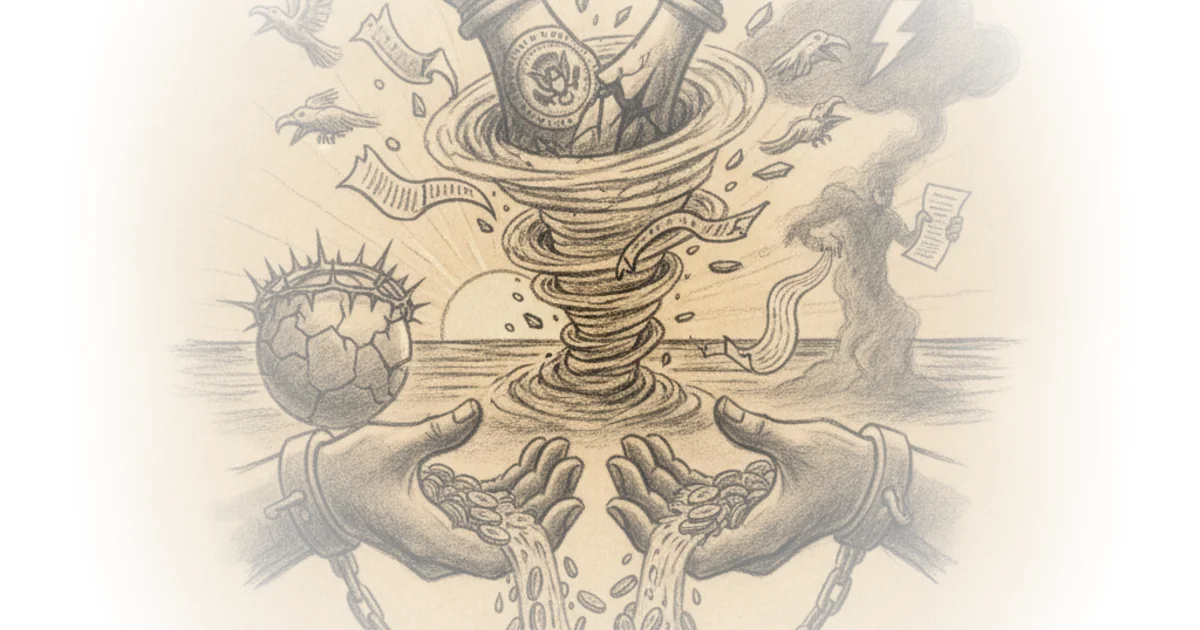
The author highlights the irony of Vice President J.D. Vance heralding the agreement as a "major milestone" for denuclearization. Richardson points out that these very inspections were standard under the 2015 Joint Comprehensive Plan of Action (JCPOA), an accord the administration itself dismantled in 2018 before ordering military strikes on Iranian nuclear facilities exactly one year prior to this writing. "Inspections are good, but they basically just get us back to where we were before Trump took over," she notes, underscoring the cyclical nature of this foreign policy blunder. The administration's claim of a new era is exposed as a return to a status quo that was already compromised by previous aggressive actions, including the bombing of sites that are now off-limits to inspectors.
"The way the Corrupt and Failing New York Times is covering stories on a very battered and beat up Iran, through FAKE & MADE UP 'FACTS' is, in my opinion, 'TREASONOUS.'"
Richardson does not shy away from the administration's violent reaction to scrutiny. She details how the executive branch has moved beyond mere criticism of the press to threatening legal action that appears to challenge the First Amendment itself. The quote above illustrates a rhetorical shift where dissent is equated with treason, a dangerous escalation that signals an intolerance for independent verification. Critics might argue that strong language from political leaders is common in polarized times, but Richardson's evidence suggests a systematic effort to silence opposition rather than engage in debate.
Weaponizing Intelligence and Intimidating Voters
The commentary shifts to the domestic front, where Richardson exposes the appointment of William Pulte as acting director of national intelligence. She describes Pulte not as a seasoned intelligence professional, but as a loyalist with "no experience" who is known for using federal power to harass political opponents. The author notes that Pulte's nickname in the administration is "Little Trump," and his immediate actions upon taking office included ordering the firing of 300 staff members at the National Counterterrorism Center, following earlier cuts by former DNI Tulsi Gabbard.
The piece also scrutinizes Gabbard herself, citing a Washington Post investigation into her ties with a religious leader described as a cult figure. Richardson writes that emails show an advisor telling "TG" to offer an alternative to candidates in the "dishonest Democratic party," suggesting her official acts were influenced by external ideological orders rather than national security concerns. This raises serious questions about the integrity of the nation's intelligence apparatus when leadership is driven by personal or cult-like allegiances.
The administration's strategy extends to voter suppression, Richardson argues, citing the raid on the Ohio Organizing Collaborative by 100 FBI agents in search of non-existent voter fraud. "As the Brennan Center... has established, a person is more likely to be struck by lightning than commit voter fraud," she reminds readers, highlighting the absurdity of using federal resources to intimidate legitimate voter registration groups. The piece connects this to Project 2025, noting that the plan explicitly called for using the Justice Department to target state election officials to "push the myth of voter fraud and make people afraid to vote."
"The federal government has knowingly trampled on the privacy rights of American citizens in a manner that threatens the sacred right to vote."
This quote from Judge Sparkle Sooknanan serves as a judicial rebuke to the administration's attempt to use the Systematic Alien Verification for Entitlements (SAVE) system to purge voter rolls. Richardson explains how the administration conflated this benefits verification tool with their own "Safeguard American Voter Eligibility Act," despite evidence showing the system has a 14% error rate that misidentifies legal voters as illegal. The court's intervention is presented not just as a legal victory, but as a necessary defense of democratic norms against executive overreach.
The Absurdity of Authoritarianism
Finally, Richardson turns to the surreal spectacle surrounding the Lincoln Memorial Reflecting Pool. She details how the administration has deployed National Guard personnel to hand out citations to individuals who touch the water, while the leader blames "SICK, DERANGED PEOPLE" for damage that social media and officials admit was likely self-inflicted or exaggerated. The author notes the absurdity of the situation: "If destruction of government property is a crime, I wonder what they'll do to the man who tore down the East Wing without a permit," quoting David Frum's sharp critique of the administration's selective enforcement.
The piece also touches on the bizarre social media reaction, including Trump posting an image of a person in an inflatable frog costume labeled "AMPHIFA" to mock activists. Richardson uses this to illustrate how the administration deflects from real policy failures by manufacturing cultural conflicts. The underlying message is clear: when an executive branch cannot defend its policies on merit, it resorts to distraction and intimidation.
Critics might suggest that focusing on these theatrical elements distracts from substantive policy debates, but Richardson argues that these behaviors are indicative of a leadership style that prioritizes ego over governance. The "Sealant Team 6" jokes and the militarization of a public park are not mere quirks; they are symptoms of an administration losing its grip on reality.
Bottom Line
Richardson's most compelling argument is that the administration's foreign policy failures and domestic authoritarianism are two sides of the same coin: a desperate attempt to maintain power through deception and force rather than competence and consensus. The piece's greatest strength lies in its ability to connect disparate events—from Iran negotiations to a cracked pool liner—into a coherent narrative of institutional decay, though it occasionally risks letting the absurdity of the administration's actions overshadow the grave human costs of its policies. Readers should watch for how the courts continue to check these overreaches and whether the public's outrage can translate into meaningful political accountability before the midterms.