Paul Cooper transforms a historical mystery into a visceral narrative of human resilience and catastrophic failure, arguing that the Maya collapse wasn't a sudden event but a slow-motion unraveling of a society pushed beyond its environmental limits. What distinguishes this coverage is its refusal to treat the Maya as a monolith or a footnote to Spanish conquest; instead, it centers the indigenous experience, the sophistication of their lost literature, and the sheer scale of their urban ambition before the forest reclaimed it.
The Ghosts in the Jungle
Cooper opens by grounding the listener in the desperation of 1695, describing a Spanish monk, Avendano, fleeing through the Central American wilderness. "Their faces had been torn by thorns and his feet cut open by pieces of Flint scattering the swampy ground," Cooper writes, immediately establishing the physical toll of the region. When Avendano finally stumbles upon the ruins, the description shifts from survival horror to awe: "it was an enormous pyramid of stone jutting out of the forest canopy tangled with roofs and vines." This framing is effective because it forces the audience to confront the sheer physical reality of the collapse; these weren't just abandoned villages, but metropolises of "size magnificence and grandeur" that rivaled the ancient capitals of the Old World.
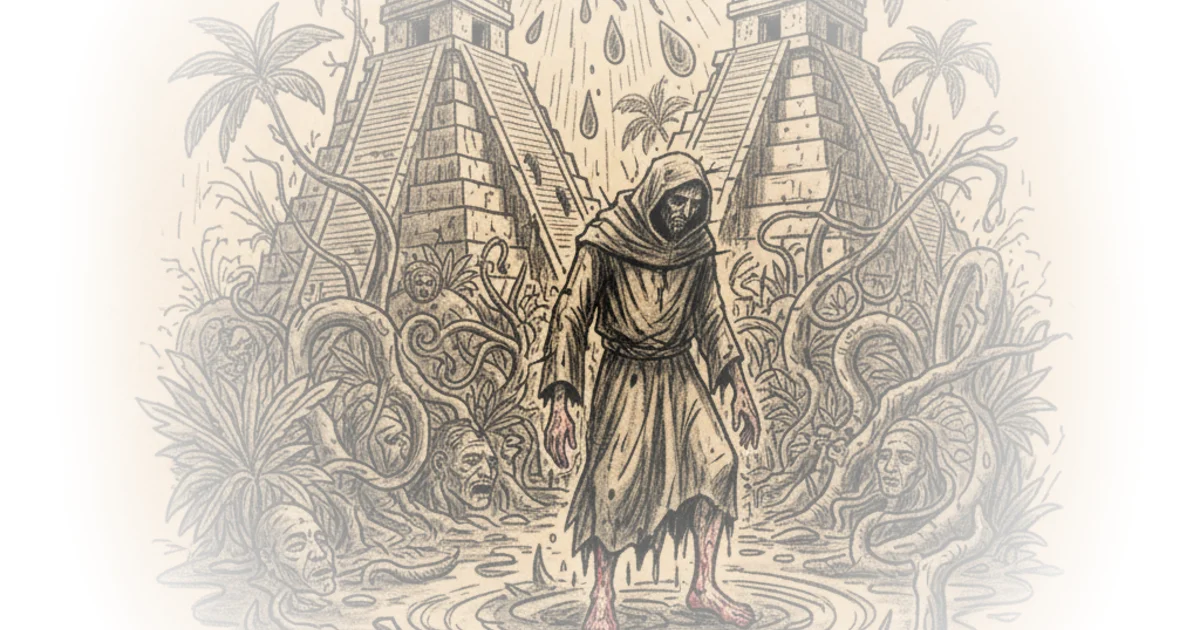
The narrative then pivots to the 19th-century rediscovery, crediting John Lloyd Stephens and Frederick Catherwood with shattering European prejudices. Cooper notes that before their work, the prevailing belief was that "only old-world civilizations like Egypt or Babylon had built cities of such magnitude." When Stephens insisted that "these vast ancient cities have been built up over centuries by an advanced society indigenous to the new world," he was fighting a cultural bias that refused to credit the Maya. This is a crucial point: the mystery of the collapse was compounded by the refusal of contemporaries to believe the people living there could have built it. Cooper highlights the romantic tragedy of the scene: "the spectacle of this once great and lovely City overturned desolate and lost discovered by accident overgrown with trees."
The story of exactly what happened is still one of humanity's greatest mysteries.
The Irony of Erasure
The piece takes a darker turn as it addresses the destruction of the Maya written record. Cooper identifies Bishop Diego de Landa not just as a conqueror, but as a specific agent of cultural genocide. He describes how de Landa, disgusted by the continued worship of old gods, "gathered together all of the ancient books he could find... and de Landa threw these into the fire and watched as they burned." Cooper quotes de Landa's own cold justification: "we found a great number of books containing these letters and as they contained but superstition and the lies of the devil we burned them all." This section is particularly powerful because it juxtaposes the brutality of the act with the accidental preservation of knowledge. Cooper points out the historical sarcasm that "much of what we know about their written language is down to the very man who tried his hardest to eradicate it," as de Landa's notes on the alphabet became the key to decoding the hieroglyphs.
Critics might argue that focusing so heavily on de Landa's role in the destruction of texts overshadows the earlier internal factors that led to the Classic collapse, which occurred centuries before the bishop's arrival. However, Cooper uses this to illustrate the fragility of the Maya legacy, noting that only three books survived the bonfire. The narrative emphasizes that the Maya were a "literate culture" with a "rich and complex system of hieroglyphics," and the loss of their history was a deliberate act of erasure that nearly succeeded.
A Civilization of Contradictions
Cooper concludes by painting a portrait of the Maya people themselves, stripping away the modern caricatures of bloodthirsty savages. He describes a society of "contradictions" who developed "a mathematics capable of calculating dates in the millions of years but who never invented the wheel to arch or the pulley." This specific detail serves to humanize the civilization, showing a people who prioritized different technological paths than Europe or Asia. The author reminds us that they were not a single empire but a "loose collection of city-states" that shared a culture of hot chocolate, jade earplugs, and a belief that "time was circular that history really did repeat itself."
The coverage effectively dismantles the idea that the Maya were simply victims of Spanish guns and steel. As Cooper notes, the Spanish conquest took 200 years because the Maya "fought guerrilla campaigns in the forests... ambushing Spanish soldiers with great effectiveness." The true collapse, he argues, happened 500 years prior to European contact, when the forest "crept back to cover its ruins forever." This distinction is vital for understanding the scale of the tragedy: it was a self-inflicted or environmentally driven catastrophe that wiped out millions before the colonizers ever arrived.
Bottom Line
Cooper's strongest achievement is reframing the Maya collapse not as a failure of intelligence, but as a complex interaction between environmental limits and societal rigidity, all while honoring the sophistication of a culture that was nearly erased. The piece's greatest vulnerability is its reliance on the romanticized narrative of the "lost city," which can sometimes obscure the harsh realities of daily life and the specific political fractures that may have accelerated the fall. Readers should watch for how future archaeological decoding of the remaining inscriptions continues to refine our understanding of why these cities were abandoned.