This piece challenges a deeply ingrained assumption: that American musical history is defined by rigid racial segregation and that the "folk" revival was merely a sentimental nostalgia trip. Justin E. H. Smith argues instead for a unified, cross-racial oral tradition that flourished in the American South long before it was fractured by commercial interests and political ideology. For listeners navigating a fragmented cultural landscape, this is not just music history; it is an argument for how collective identity can be rebuilt through shared, unrecorded human experience rather than curated algorithms.
The Real Deal on Stage
Smith opens with a vivid reconstruction of the 1966 Newport Folk Festival, focusing on a moment often dismissed as awkward: white autoharp player Kilby Snow performing alongside blues giants Bukka White and Howlin' Wolf. Many viewers might see Snow's exuberant gesticulation as out of place, but Smith insists we look closer at the substance rather than the surface. "The beauty of it might be thought... to be compromised by the presence of a white fellow on the stage," he writes, only to immediately dismantle that prejudice by revealing Snow as an authentic master of his craft.
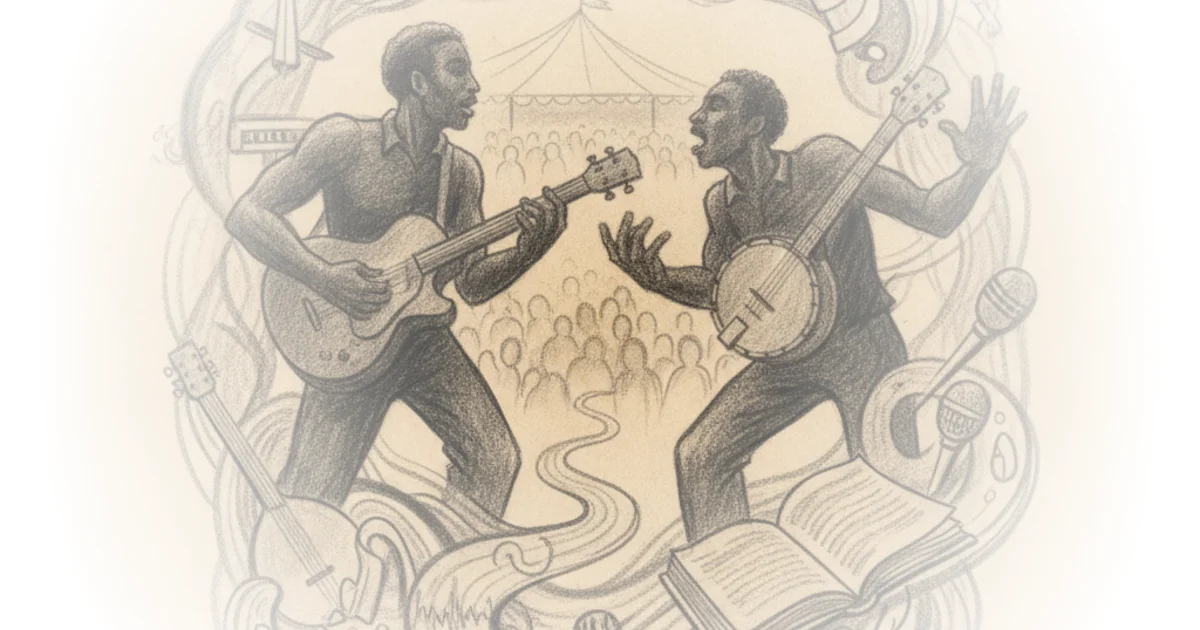
Smith connects this moment to broader historical threads, noting that Snow's instrument was purchased from Montgomery Ward, a detail that grounds high art in accessible, mass-market reality. This parallels the history of field recording efforts where everyday tools were used to capture profound cultural moments. Smith argues that Snow's presence wasn't an intrusion but a testament to a shared musical language: "He is experiencing the primary human emotion of joy, because he is in his element, doing his thing, as an American musician."
The author's framing here is powerful because it refuses to sanitize history or force a narrative of perfect harmony where none existed. Instead, Smith suggests that the "taxonomies" we use today to separate music by race are artificial constructs that obscure a deeper reality. As he puts it, "You can hear a different history in its music," one that predates and transcends the political boundaries drawn after the Civil War.
You can hear a different history in its music. I have come to believe that this other history is a more promising one for thinking about American collective identity and its possible futures.
However, critics might argue that emphasizing "joy" and "harmony" risks glossing over the very real systemic barriers that kept these traditions apart for centuries. While Smith acknowledges the political order sought to keep a "tidy garden of pure strains," some may feel his focus on musical cross-fertilization underestimates the violence required to maintain segregation in the first place. Yet, the piece remains compelling because it centers the agency of the musicians themselves over the politics that tried to contain them.
The Oral Default and the Neoliberal Break
Smith shifts from performance to theory, challenging the academic hierarchy that privileges text over speech. He invokes an insight from Gottfried Wilhelm Leibniz to argue that "literature... has always been oral by default," while written texts are merely secondary traces. This is a crucial pivot for understanding American culture, which Smith describes as a "transplantation of Anglo-Celtic and West African varietals into new soil."
The author identifies a catastrophic rupture in this tradition, linking the decline of authentic folk transmission to the rise of neoliberalism. "I have also come to believe that this history has been actively suppressed over the past half-century," Smith writes, tracing the line from New Deal documentation projects to the "Nixon Shock" and the subsequent dominance of corporate pop culture. He distinguishes between "popular" (rooted in people) and "popular*" (manufactured by corporations), a distinction that feels urgently relevant in an era of algorithmic music curation.
Smith notes that recording technology, while revolutionary for genres like jazz, paradoxically contributed to the effacement of vernacular traditions that relied on live, intergenerational transmission. He observes, "It was one and the same technology that both enabled me to hear these good conservationist bards at all and that ensured the eventual effacement from historical memory of what they were trying to conserve." This is a nuanced take on progress: the very tools used to preserve culture also accelerated its commodification and loss.
The argument gains depth when Smith contrasts the "popular" tradition's engagement with death and loss against the sanitized, profit-driven nature of modern pop. He cites the Carter Family and the Staple Singers as exemplars of a tradition that treats the full frame of human experience, including mortality, with equal weight to desire.
Theology in the Groove
Perhaps the most provocative section of Smith's commentary is his insistence on the fundamental Christian nature of American vernacular music. He argues that even the most secular-sounding rock and roll was driven by a "sustained alternation between sin and redemption." Smith points to early rock stars like Jerry Lee Lewis, whose art expressed what St. Thomas Aquinas called "disordered desire," yet remained inextricably linked to a theological framework they could never fully escape.
Smith highlights the Staple Singers' rendition of hymns as evidence that early rock was often Christian rock, distinct from the later, derivative attempts by bands like Petra or Stryper. "Listening to the Staples' recordings from the 1950s drives home a crucially important historical fact: that some of the earliest rock music was Christian rock," he asserts. He describes Pops Staples' guitar work as "dark, nasty, disconsoling" yet ultimately serving to drive home the necessity of salvation.
This theological lens offers a fresh perspective on why these songs resonate so deeply across racial lines. Smith suggests that the shared treasury of American songlines provided a common language for grappling with suffering and hope, regardless of the specific denomination or race of the performer. "The effect is something analogous to the contrast of black and bright gold in Byzantine icon painting," he writes, capturing the tension between earthly struggle and heavenly promise.
Critics might note that emphasizing Christianity could alienate readers who view American folk music through a strictly secular or humanist lens. However, Smith's argument is not about converting listeners but about accurately diagnosing the historical roots of the genre. By ignoring this dimension, we lose the "hidden force" that made the engagement with secular themes so compelling for artists like Little Richard and Mavis Staples.
The common tradition of American musical culture was... systematically broken down and replaced by the new contextless commercial culture that swept in along with a whole suite of other changes in the period of the Nixon Shock.
Bottom Line
Justin E. H. Smith delivers a masterful reclamation of American cultural history, arguing that our shared identity lies not in political divisions but in an oral tradition that has been systematically eroded by commercial interests. The piece's greatest strength is its refusal to separate "high" art from the vernacular, showing how joy and theology are woven into the very fabric of folk music. Its vulnerability lies in potentially romanticizing a past where racial harmony was more aspirational than real, yet the call to recover this lost continuity remains a vital, necessary project for understanding who we are.