Henry Oliver makes a provocative claim that cuts through the usual reverence for Jane Austen: she isn't just a beloved writer of courtship, but the architect of the modern novel because she invented the tools we use to navigate a commercial, individualistic world. While many treat her work as a quaint escape, Oliver argues that her narrative innovations—specifically free indirect speech—were a radical response to the seismic shifts of the Enlightenment and the Industrial Revolution, making her as urgent today as she was in 1800.
The Great Innovator
Oliver challenges the dismissive attitude that often greets Austen, noting that even literary giants have struggled to see her depth. He writes, "It is rare to talk to someone unliterary who loves Milton, Shakespeare, or Wordsworth. But Jane has leagues and leagues of admirers." This observation sets the stage for a deeper inquiry: why does she reach so many when others don't? The answer, Oliver suggests, lies not in her subject matter of drawing rooms and marriages, but in her narrative technique. He points out that Austen "invented the modern novel in order to answer fundamental questions about how to be good, happy, and flourishing in a commercial society."
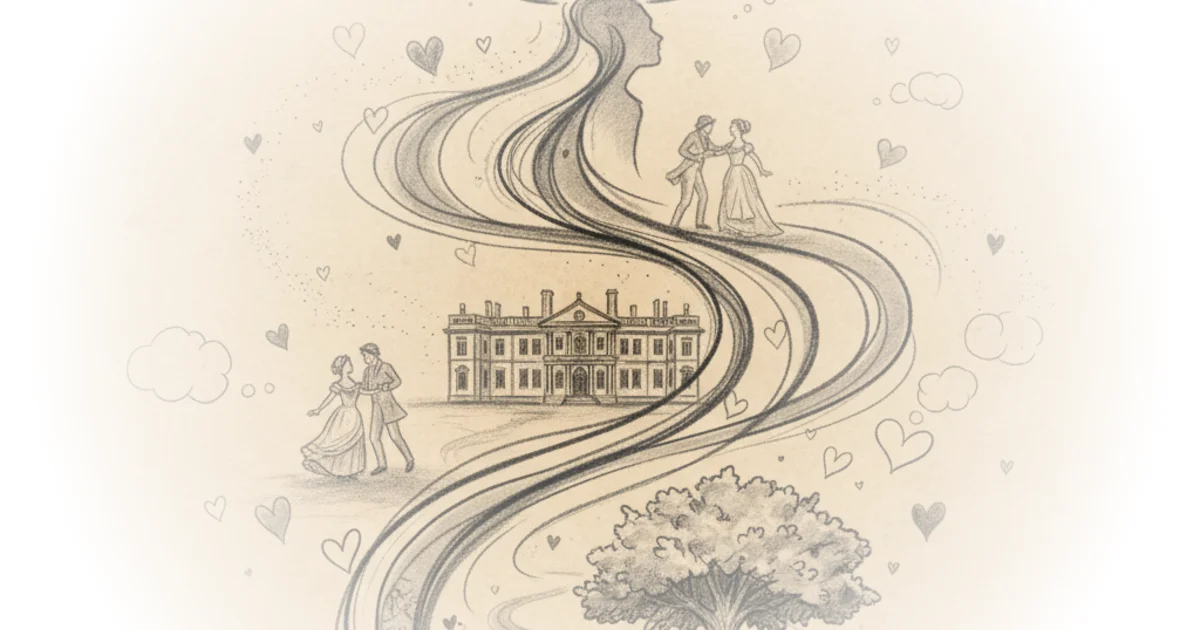
The author's framing is particularly effective when he dismantles the idea that Austen was a simple romance writer. He notes that critics like Charlotte Bronte found her "elegant but confined," yet Oliver counters that Austen "did unprecedented things with narrative." He cites Professor John Mullan, who called these inventions "as experimental as Ulysses." This comparison is striking; it forces the reader to reconsider Austen not as a precursor to modernism, but as its simultaneous pioneer. By weaving in the context of the Regency era—a time when the world was pivoting toward individualism and market forces—Oliver shows that Austen's focus on "personal experience" was a direct reflection of the new epoch.
Austen did no less than create what we now expect from a novel. No Jane Austen means no George Eliot, no Henry James, no Virginia Woolf; no Fitzgerald, no Orwell, no Nabokov, no Joyce.
This bold assertion holds up well when examining the lineage of fiction. Oliver argues that while earlier writers like Defoe and Fielding focused on external adventures or epistolary chaos, Austen shifted the focus inward. She gave us a form where characters must "overcome their inner problems—rather than having to overcome problems imposed upon them by the world." This is a crucial distinction for modern readers living in an age of self-optimization and internal conflict. Critics might argue that elevating Austen to the status of a philosophical innovator risks overshadowing the genuine social constraints her characters faced, but Oliver's point is that the form itself allowed those constraints to be explored with a new psychological depth.
A Mirror to the Modern World
The piece excels when it connects Austen's domestic details to the broader currents of history. Oliver refutes the notion that she was "blissfully unaware of the changing world," pointing out that her descriptions of bonnet trimmings and fabrics were actually reflections of "trade and industry, and the spur to fashion and changing morality." He writes, "Young women dressed in different styles from their mothers for the first time. Dresses were longer, shapelier, hung closer to the body." This detail is not merely aesthetic; it signals a liberation of the female form that parallels the rise of women's independence in choosing husbands.
Oliver draws a direct line from the philosophical debates of the time to Austen's fiction. He notes that "Competing philosophies of self-control and self-expression are the heart of Sense and Sensibility as they were the heart of contemporary ethical debate among philosophers." By grounding her work in the ideas of Adam Smith and The Theory of Moral Sentiments, Oliver reveals that Austen's novels are essentially moral laboratories. He explains that her central concern is "moral education—how to raise daughters who grow up to be Lizzie Bennet, not Lydia."
The argument that Austen's work is about "how to live a good life in a commercial society" resonates deeply with contemporary anxieties about money, status, and ethics. Oliver writes, "We are still living in the long 1800, in a world of technology, individualism, liberty, subjectivity, fashion, economic growth." This historical continuity is the piece's strongest asset. It suggests that the "long 1800" is not a closed chapter but the very air we breathe. However, one might note that this focus on the "long 1800" occasionally glosses over the darker realities of that era, such as the brutal expansion of colonialism and slavery, which Oliver mentions only briefly as a backdrop to the "moral reformation."
She didn't pander to their expectations—either about the genre or the moral of the story—but nor did she dismiss their interests as petty or unimportant.
This balance is what makes her work endure. Oliver emphasizes that Austen's genius lies in her ability to treat the "moral importance of everyday life" as paramount. She doesn't offer grand lectures but instead uses "Free Indirect Style" to let readers inhabit the minds of her characters. As Oliver puts it, "She does that by showing us the world from someone else's perspective." This technique, refined over a century and sitting at the heart of modernist masterpieces, remains the most powerful tool for empathy in literature.
Bottom Line
Henry Oliver's commentary successfully reframes Jane Austen from a nostalgic favorite into a vital intellectual resource for navigating modernity. The argument's greatest strength is its demonstration of how her narrative innovations were a necessary response to the birth of the commercial, individualistic world we still inhabit. The piece's only vulnerability is a slight tendency to romanticize the era's moral progress, potentially underplaying the systemic injustices that Austen's characters navigated. For the busy reader, the takeaway is clear: Austen is not a relic of the past, but the original guide to the complex, internal, and often awkward moral landscape of the present.