Three Viral Essays, Zero Reliable Narrators
In early 2026, three long-form essays about artificial intelligence went viral in quick succession. Matt Shumer's "Something Big Is Happening" racked up more than 80 million views on X. Citrini Research published "The 2028 Global Intelligence Crisis," a financial doomsday scenario centered on the mortgage market. And Sam Kriss wrote "Child's Play" for Harper's, a literary exploration of San Francisco's tech culture. Alberto Romero, who writes The Algorithmic Bridge on Substack, argues that all three are fiction -- and that this fact is the most important thing about them.
Romero's central claim is bold. He contends that the AI era has made it nearly impossible to write truthfully about the present, and that fiction has become the only genre capable of capturing what is actually happening.
AI is not just an earthquake to a truth-based society like ours, but an earthquake that itself produces deeper, more powerful earthquakes.
It is a striking metaphor. But Romero does not stop at metaphor. He builds a case that each of the three essays, despite presenting itself as nonfiction analysis, is actually a species of fiction -- and that readers swallowed them whole.
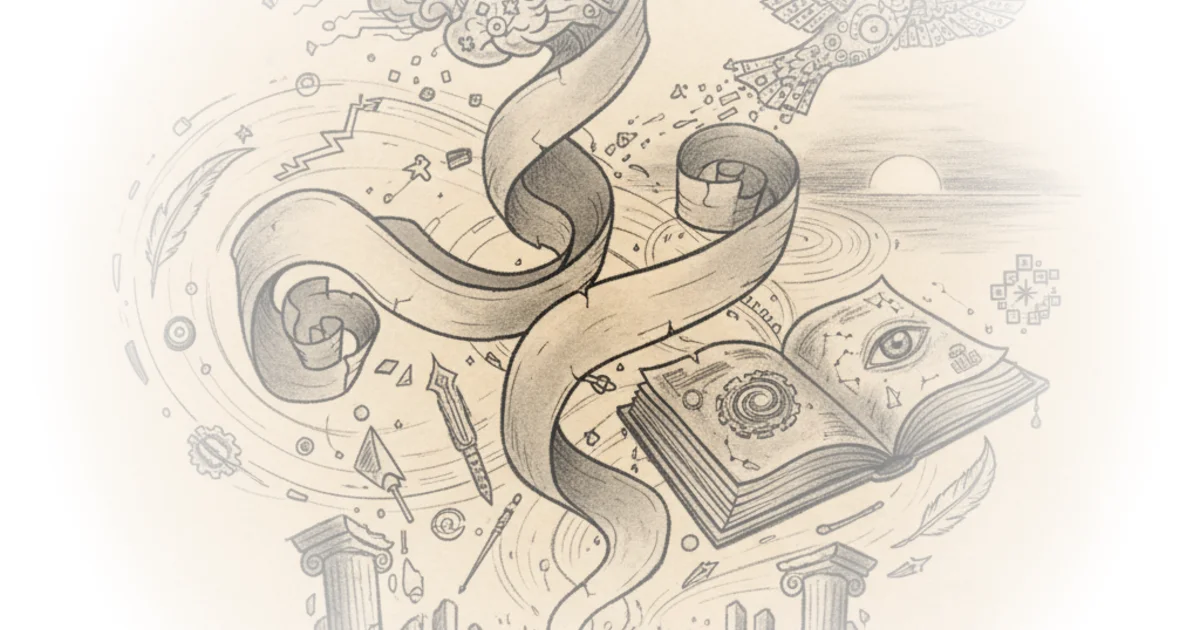
The Three Texts
Romero is sharpest on Shumer's piece, delivering a parenthetical that doubles as a full dismissal:
The godlike reach of Shumer's essay can be explained by the fact that the title allows every single person to project the biggest thing in their lives right now as the thing happening to everyone else: we all have main character syndrome, especially myself.
He is gentler with Citrini's financial analysis, but no less skeptical. Romero notes that when Citrini listed three SaaS companies that AI could disrupt -- Monday.com, Zapier, and Asana -- those were the same three examples Claude 4.6 Opus had given him two weeks earlier on the same topic.
It might be a coincidence, but stochastic parrots are usually more parrot than stochastic.
The implication is unsettling: that viral financial analysis may itself be AI-generated or at least AI-shaped, indistinguishable from the outputs of the models it purports to analyze.
Kriss gets the most admiring treatment. Romero calls "Child's Play" the best of the three in literary merit and arguably historical value, praising Kriss as a writer who blurs the line between fiction and nonfiction with genuine skill.
Kriss, unlike, I presume, Shumer and Citrini, is a veteran in the sport of disguising fiction as non-fiction -- worthy heir to the Borgesian style, although perhaps born at the worst time possible now that everyone seems to be shamelessly copycatting his schtick.
The Post-Truth Thesis
Romero's argument builds toward a philosophical claim about the nature of truth in 2026. The rules that once governed prediction and analysis, he says, change so rapidly that no coherent model of the world can hold together for more than a few months.
Making predictions was once child's play, to use Kriss's appropriate title, when the world had the decency to work under a coherent, self-perpetuating set of rules.
He pushes further still, arriving at what he calls his "most profound insight":
All of history until now recounts the past to the same degree of faithfulness that all of literature until now foretells the future.
This is the essay at its most ambitious. Romero is arguing that history and fiction have traded places -- that the literary imagination is now a better guide to reality than empirical reporting.
Where the Argument Frays
There is something self-undermining about an essay that warns readers not to trust viral AI writing while itself going viral as AI writing commentary. Romero acknowledges this tension only glancingly. He also confesses to having published his own fictional piece about Moltbook, an AI social network, disguised as a leaked document -- which makes his position as a reliable narrator of unreliable narrators somewhat precarious.
I am proud because they were partially tricked, but ashamed because the work was not fine enough to make them believe it at face value.
The essay also leans heavily on the assumption that all three pieces are fiction, but the evidence is uneven. The Citrini coincidence with Claude's output is suggestive, not conclusive. And calling Shumer's hype-driven AI enthusiasm "fiction" conflates exaggeration with fabrication -- a distinction that matters if the argument is about truth itself.
The Recursive Mirror
What makes the piece genuinely interesting is not any single argument but the way it performs its own thesis. Romero writes about fiction passing as truth while writing commentary that drifts into literary philosophy. He references Borges, Baudrillard, Hume, Chaucer, and Boccaccio -- not as decoration but as evidence that the collapse of stable meaning is an old problem with a new accelerant.
You are either delusional enough to take a chance at writing fiction or already falling behind.
That line captures Romero's worldview in miniature. He sees the AI era not as a technical revolution but as an epistemological one, where the capacity to write convincing fiction is more valuable than the capacity to report facts -- because facts themselves have become unstable.
Whether this is insight or surrender depends on what one expects from public discourse. Romero seems comfortable with the ambiguity. His readers may be less so.
Bottom Line
Romero has written a genuinely provocative essay about the way AI-era virality rewards fiction over analysis. His readings of Shumer, Citrini, and Kriss are entertaining and occasionally sharp. The deeper philosophical argument -- that truth and fiction have swapped roles -- is the kind of claim that sounds profound at first and slippery on closer inspection. But the core observation holds: three of the most widely read pieces of AI writing in 2026 are, at minimum, unreliable, and the reading public did not much care. That indifference, more than any particular essay, is the story worth paying attention to.