Albert Camus spent his career exploring what it means to be fully human — and in The Fall, he turned his attention to one of humanity's most uncomfortable truths: nobody is beyond judgment or making mistakes. In this episode of Philosophize This, Steven West examines how Camus uses the character Clamence to expose the elaborate rationalizations we build to avoid confronting our own moral limitations.
The Reverse Baptism
Clamence appears in The Fall as the picture of moral goodness — a lawyer who takes only cases helping the downtrodden, volunteers his time helping elderly people cross the street, and makes balloon animals for children at parties. On the surface, he embodies everything Camus laid out in The Rebel: solidarity with others through lucid rebellion.
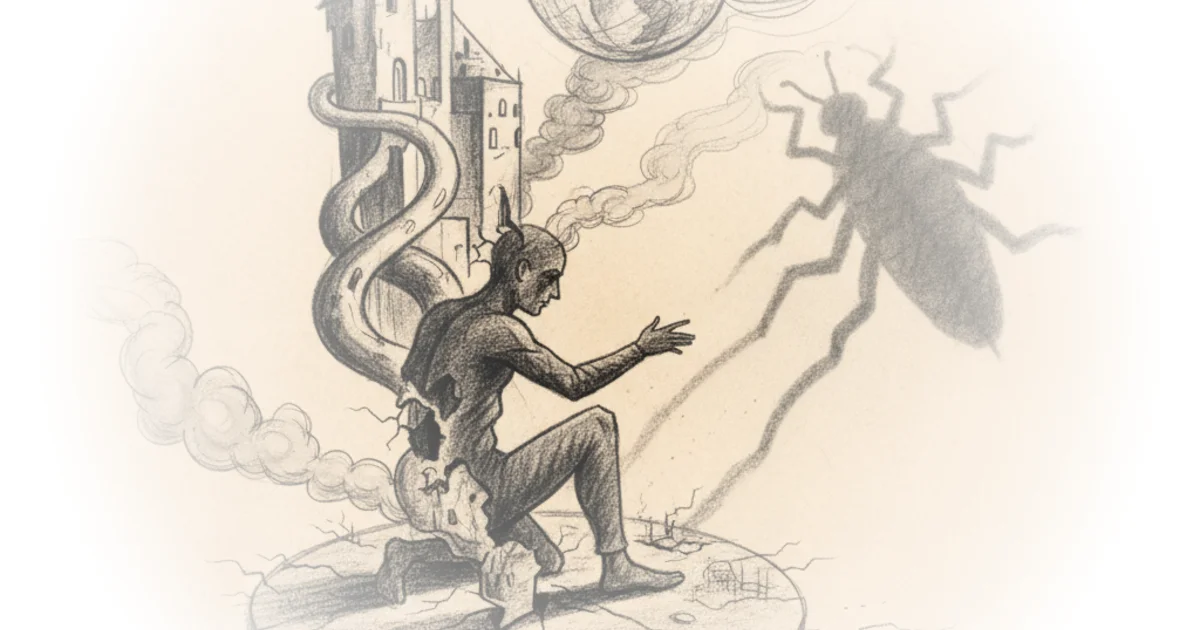
But Camus constructs what he calls a "reverse baptism." Instead of a purifying moment that elevates Clamence's morality, a series of revelations humble him profoundly. He witnesses a woman fall from a bridge into water and chooses not to jump in after her — continuing his night as if nothing happened. He encounters laughter behind him on a bridge at night. He's punched during a road rage incident.
These moments force Clamence to acknowledge how much of his morality is performative or half-hearted. The illusion of being a great person becomes exposed as what it truly is: an act. Rather than sitting in this uncomfortable exile, he creates elaborate rationalizations that allow him to keep living without confronting his full limitations.
The Judge-Penitent Strategy
The primary strategy Clamence uses in the book is what Camus calls "the judge penitent." He sits in a bar in Amsterdam's deepest circle of hell — symbolically — confessing to strangers at random about how bad of a person he is. By judging himself before anyone else can, he controls the narrative.
This is the same defense mechanism we see in countless modern situations: someone criticizes others while first insisting they're "the first to admit I'm a total piece of crap." The strategy serves multiple purposes. If I already judge myself as the lowest, scummiest person in the room, then every subsequent judgment I make about others officially "swings up" — meaning nobody can judge me for anything afterward.
Camus observed that people also avoid judgment by surrounding themselves only with people who enable each other's behavior, never challenging one another. They claim these are "the coolest people" because they never tell you things that would force confrontation with your limitations as a person.
The Modern Condition
What Camus recognized is that these strategies emerge from something specific about modern life itself. He wrote The Fall partly as an indictment of his own generation — the ways people construct elaborate systems to avoid guilt and admitting mistakes.
But crucially, he brought compassion to this critique. People don't use these strategies in a vacuum. There's something about modern existence that drives people toward these defenses. Camus believed compassion is often the only lucid response that makes sense in a world saturated with guilt and judgment.
Kafka as Philosophical Bridge
For insight into what it means to be modern, Camus turned to Franz Kafka — someone who bridges the work of Dostoevsky and Camus himself. Kafka wrote not philosophical systems but rather images designed to force readers to see their reality differently.
No other non-philosopher has inspired more philosophers than Kafka. His impact compares to Shakespeare or Dante during their eras. His writing creates dozens of completely different interpretations, each inspiring countless philosophers to examine what his paradoxes could mean.
The comparison to Zeno is instructive. Zeno's paradoxes — like the runner who can never reach the finish line by always traveling half the distance — weren't meant to create philosophical systems themselves. They simply created images that pointed at important truths about rationality's limitations, inspiring entire generations of philosophers afterward without ever building a formal system.
Kafka does the same thing. Any claim that someone knows exactly what Kafka was trying to say hasn't engaged deeply enough with his work to see how deep it truly goes.
The Trial as Example
One of Kafka's most famous works, The Trial, immediately dumps readers into classic Kafkaesque situations. Joseph K wakes up, wipes sleep from his eyes, and realizes he's under arrest — though the officials can't explain what he's arrested for. They simply sit drinking coffee while he paces around confused. When he asks why he's under arrest, they respond that it's not their job to explain.
This is Kafka's genius: each reading forces you to reread with an entirely new interpretation, creating fresh insights about your world each time. The deliberate combination of dense symbolism and reader confusion produces something profound about the nature of judgment, guilt, and modern existence — themes Camus would later explore in The Fall.
Counterpoints
Critics might argue that framing these avoidance strategies as primarily a modern phenomenon overlooks how humans across history have always constructed rationalization systems to protect themselves from uncomfortable truths. The psychological mechanisms Camus describes aren't unique to modernity — they're simply expressed differently in each era.
Some readers might also question whether the judge-penitent strategy is really as strategic and calculating as Camus presents it. Perhaps it's better understood as a genuine attempt at self-reflection, even if imperfect — not merely a defensive maneuver.
Bottom Line
This episode's strongest contribution is identifying how we construct elaborate systems to avoid judgment rather than simply admitting our mistakes. The judge-penitent strategy remains the most insightful observation about human nature in modern life — we constantly preemptively judge ourselves to control how others see us, then use that control to judge others from a position of false humility.
The vulnerability lies in where Camus draws these conclusions: his analysis feels accurate but underdeveloped. He gestures toward compassion as the solution without fully explaining why guilt and judgment have become so overwhelming in modern life that we need elaborate defenses against them. That tension — between diagnosing the problem and prescribing the cure — is exactly what makes this episode compelling.