Most people dismiss video games as mindless escapism, but Tom van der Linden argues that titles like The Witcher 3 are actually sophisticated laboratories for moral development. He suggests that the unique agency afforded to players transforms virtual choices into genuine ethical training, a claim that challenges our understanding of how empathy is cultivated in the digital age.
The Architecture of Empathy
Van der Linden begins by dismantling the idea that virtual violence is morally inert. He posits that "the actions undertaken by players in a videogame do not occur in a moral vacuum," noting that these digital behaviors interact directly with our real-world sense of right and wrong. This is a crucial distinction; unlike passive media where we watch a character make a choice, we are the ones pulling the trigger or sparing the life. The author argues that this active participation forces a level of emotional investment that film cannot replicate.
To achieve this, game designers must first build a world that feels alive. Van der Linden writes, "The immersion in the videogame depends to a significant degree on the players own capacity for empathy and is not solely determined by the quality of a game's design." He breaks this down into three pillars: external presentation (graphics, sound), world-building (history, culture), and characterization. It is the latter that truly hooks the player. By giving even minor NPCs rich backstories, the game humanizes them, making their suffering feel real. As van der Linden observes, "This creates the impression that virtual characters have their own individual lives and do not solely exist for the purpose of the player's advancement in the game."
This approach effectively bypasses our analytical defenses. When a character feels like a person rather than a quest objective, our moral reflexes kick in automatically. However, critics might note that this relies heavily on the player's pre-existing empathy; a sociopathic player might still view these characters as mere code, regardless of the design. Yet, for the vast majority, the emotional stakes are undeniably high.
The Illusion of Choice
The core of van der Linden's argument rests on the concept of "moral agency." He defines this as the freedom to influence a narrative in a way that is morally significant. Unfortunately, he points out that many games fail here, reducing morality to a simplistic binary. He critiques titles like Mass Effect, where "morality is presented as a spectrum between the heroic Paragon and the ruthless renegade," effectively encouraging players to pick a lane and stick to it for the sake of rewards rather than reflection.
"When the moral decisions you do make automatically lead to a rather extreme corruption of them the end result is more likely to feel cynical and may even encourage against moral reflection."
This is a sharp critique of the "good vs. evil" meter that plagues the genre. When choices are obvious or the consequences are predictable, the player stops thinking and starts optimizing. Van der Linden argues that true moral reflection requires ambiguity. He highlights how some games offer a choice between two flawed options, but even then, the design often feels limited. The problem, he suggests, is that when every choice backfires, the player feels disheartened rather than challenged.
The Witcher 3's Subtle Genius
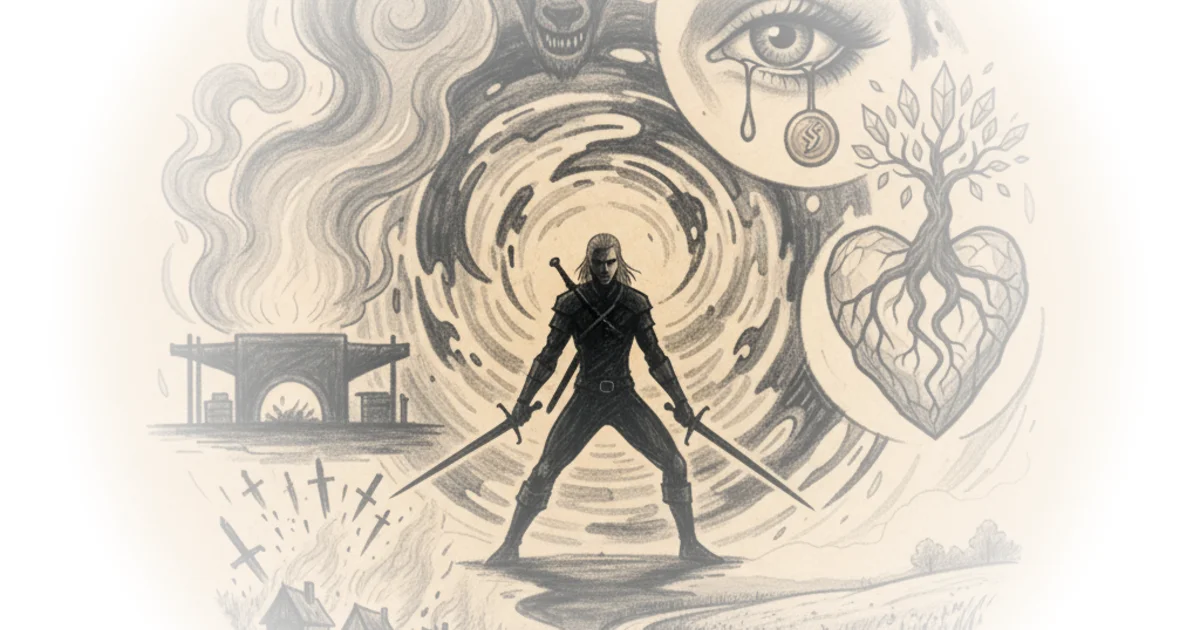
So, how does The Witcher 3 succeed where others fail? Van der Linden points to its refusal to use an honor system. Instead of a meter telling you if you are "good," the game leaves "Carol's nobility is mostly left up to the subjective judgment of the player." This freedom forces the player to rely on their own internal compass rather than chasing in-game points.
The game's quest design is where this philosophy shines. Rather than clear-cut moral forks, the player faces "tough decisions between equally undesirable options." Van der Linden describes moments where "your good intentions have unexpected negative outcomes," forcing a re-evaluation of one's actions. He recounts a specific instance where a lie told to protect someone leads to tragedy, creating a complex emotional response that lingers long after the screen goes dark.
Crucially, the game removes the safety net. Van der Linden notes, "These moments can be especially powerful when it's clear to the player that there's no going back no checkpoint from 20 hours ago to return to for a do-over." By eliminating the ability to reload and try again, the game forces the player to live with the consequences of their choices, mirroring the irreversible nature of real-world ethics. This design choice transforms the experience from a puzzle to be solved into a lesson to be learned.
"Aristotle wrote that moral behavior is not a given but something that must be practiced continuously something that one must get better at can videogames serve as a virtual training ground for real-world morality?"
Bottom Line
Van der Linden's thesis is compelling: video games can indeed serve as a training ground for morality, but only when they abandon simplistic reward systems in favor of genuine ambiguity and consequence. The strongest part of his argument is the focus on the "no do-over" mechanic, which forces a level of accountability rarely found in entertainment. However, the piece slightly underestimates the difficulty of translating these virtual lessons to complex, real-world political and social dynamics. Still, it offers a vital perspective on how interactive media can shape our ethical reflexes.