In an era where religious institutions are often pressured to either seize political power or march in lockstep with progressive social movements, Anarchierkegaard offers a startlingly different path: the church must stop trying to lead the world and start ignoring its trends. This piece challenges the very definition of the "avant-garde," arguing that the moment the church looks over its shoulder to ensure the world is following, it has already surrendered its spiritual freedom. For the busy thinker tired of the endless cycle of cultural capture, this is a necessary interruption of the noise.
The Trap of the Trendsetter
Anarchierkegaard begins by dismantling the romanticized notion of intellectual breakthroughs, suggesting that true innovation often looks less like a revolution and more like a quiet refusal to play by the established rules. The author writes, "Breakthroughs are rare by their very nature... the struggling presence of 'common sense' or 'received knowledge' starts to take on the characteristics of a demiurge that hangs over creation." This framing is effective because it shifts the focus from the grandiosity of change to the immense pressure of maintaining the status quo. The argument posits that the real struggle is not against a specific political enemy, but against the invisible weight of "received knowledge" that dictates what is thinkable.
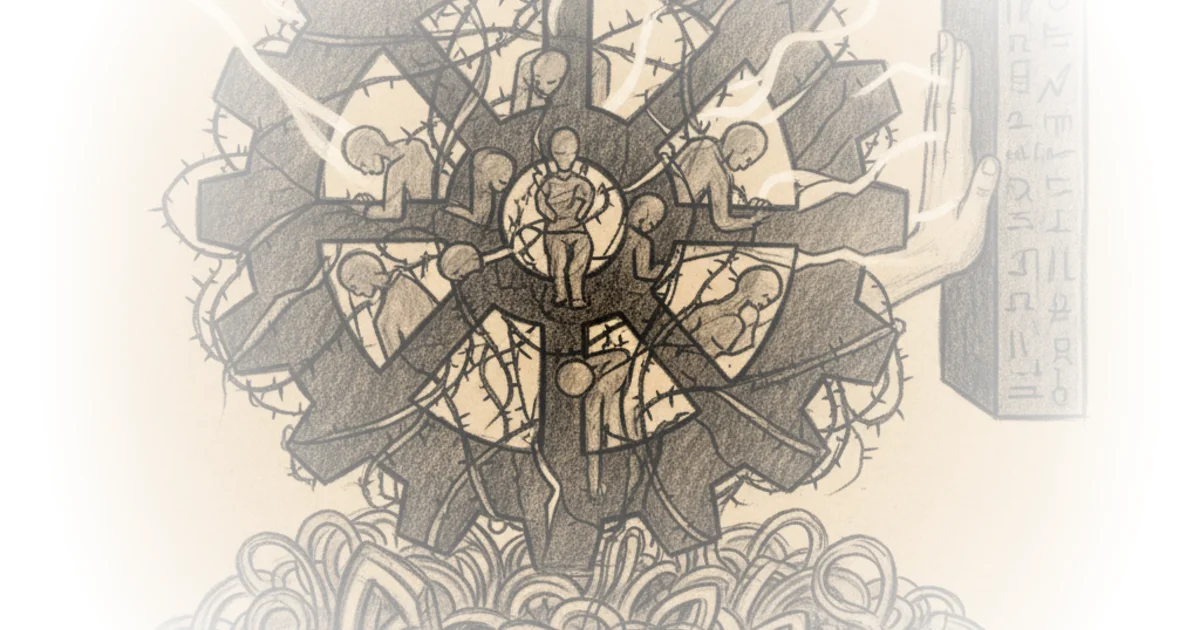
The piece then turns to Harvey Cox, a towering figure in 20th-century liberation theology who famously argued that the church should be the "avant-garde of God's kingdom" emerging "from below and the edge." Anarchierkegaard acknowledges the power of Cox's vision, noting that Cox sought to "uproot the fundamentalist tendencies which would want to turn 'Christian faith' into the excuse for an irresponsible reactionary turn against modernity." This historical context is vital; just as Karl Barth had to confront the church's complicity with the German state in the 1930s, Cox had to confront the church's desire to be relevant in the secular city. The author correctly identifies that Cox's goal was to place the church outside of official state structures, operating instead as a "holy invisible dictator" of praxis rather than policy.
"The church is the avant-garde of the new regime, but because the new regime breaks in at different points and in different ways, it is not possible to forecast in advance just what appearance the church will have."
However, Anarchierkegaard argues that Cox's solution contains a fatal flaw. By defining the church as the leader of the march, the church inevitably becomes a slave to the marchers. The author writes, "In order even to be avant-garde, attention must be paid to which way the world is going, so that one can stay in front." This is the piece's most incisive critique: the desire to be ahead of the curve requires a constant, anxious monitoring of the curve itself. The church, in its attempt to be sophisticated and relevant, ends up mirroring the very bourgeois authority it claims to oppose.
The Illusion of Progress
The commentary deepens as Anarchierkegaard contrasts the Coxan model with a theology of absolute indifference to worldly trends. Citing the work of Eller, the author suggests that true Christian freedom is not about teaching the world how to act, but about existing in opposition to the world's logic. "It appears, as far as Eller was concerned throughout his illustrious yet quiet career, that the Christian teaching is freedom from the world in toto," Anarchierkegaard writes. This distinction is crucial. It separates the concept of social justice as a "plus" or a "gift" from social justice as the primary motive of faith. The author argues that when the church makes the world's progress its goal, it loses its ability to offer a genuinely different reality.
A counterargument worth considering is that a church completely indifferent to the world's direction risks irrelevance, potentially abandoning the marginalized who need a voice in the public square. Yet, Anarchierkegaard presses on, suggesting that this "irrelevance" is actually the only way to maintain integrity. The author warns against the "tit-for-tat bludgeoning" where conservatives and progressives simply swap roles while both remain trapped in the same worldly axis. "Conservative churches tend to be very sensitive to the worldlinesses of the liberals, liberals tend to be very sensitive to the worldlinesses of the conservat," the text notes, highlighting how both sides are defined by their reaction to the other rather than their own internal truth.
"The avant-garde is very much of the world in the sense that its goals and values are determined totally by its relationship to the world—by trying to place itself where the world will want to be."
This observation strikes at the heart of modern institutional anxiety. Whether it is the executive branch pushing for rapid policy shifts or religious bodies rushing to adopt the latest cultural vocabulary, the drive to be "first" often leads to a loss of self. Anarchierkegaard suggests that the church, in its attempt to be the "discoverer" of God's liberatory work, ends up "appropriating the world's conception of goodness." This is a profound critique of the modern tendency to measure spiritual health by metrics of social influence or cultural alignment.
Bottom Line
Anarchierkegaard's strongest move is exposing the paradox that trying to lead the world inevitably binds the church to it; the most radical act may be to stop looking over one's shoulder entirely. The argument's greatest vulnerability lies in its potential to justify withdrawal from the very suffering that liberation theology sought to address, risking a quietism that ignores the material needs of the oppressed. Readers should watch for how this tension between radical indifference and active compassion plays out in future theological debates, as the pressure to be "relevant" only intensifies.