Benn Jordan peels back the curtain on a digital warfare strategy that has moved beyond simple election interference to a systematic dismantling of shared reality itself. This is not a standard political analysis; it is a forensic deep-dive into the mechanics of how state actors weaponize confusion, using a specific Russian playbook that has now been adopted globally to radicalize audiences through the very platforms they use to debate. The most startling revelation isn't just that bots exist, but that the goal is not to convince you of a specific lie, but to make you incapable of believing in any truth at all.
The Architecture of Confusion
Jordan begins by tracing the origins of this strategy to post-Soviet Russia, identifying a pivotal shift in how information is weaponized. He introduces Vladislav Surkov, a former adviser to Vladimir Putin, as the architect of a philosophy that rejects hiding the truth in favor of destroying the concept of truth entirely. "Instead of trying to hide truth from people you attack truth itself," Jordan writes, explaining how this creates a fog where citizens can no longer distinguish between real and fake events. The author argues that this confusion is not a bug in the system, but the primary feature designed to secure unchallenged power.
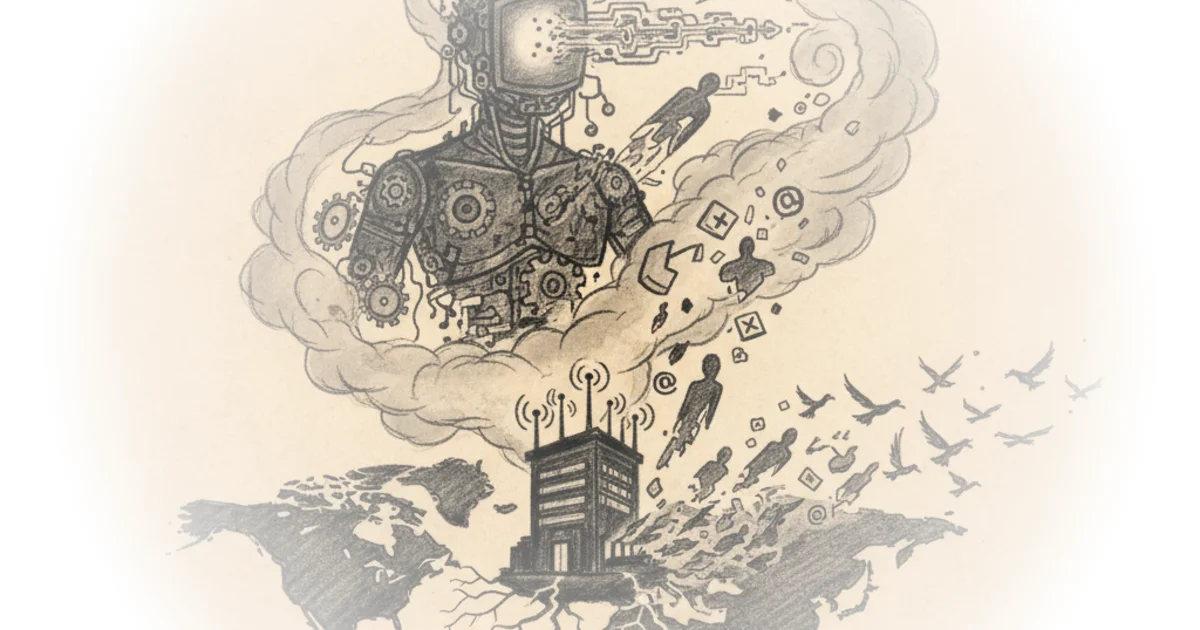
The piece details how the Kremlin moved from covert support of fringe groups to an open strategy of funding opposing factions simultaneously. Jordan notes that "the administration was completely open about it every group enjoying the financial and political support of the Kremlin now knew that their opponent were too." This deliberate chaos, he suggests, leaves voters paralyzed, unable to form a coherent political reality because every side appears equally manipulated. Critics might argue that attributing all political polarization to a single foreign architect oversimplifies complex domestic social fractures, yet the evidence of coordinated state funding for opposing movements remains a distinct and dangerous variable.
You cannot defeat what you cannot Define.
The Human Cost of Digital Trolling
Moving from theory to practice, Jordan exposes the gritty reality of the Internet Research Agency (IRA) in St. Petersburg. He reveals that the operation was not run by an army of elite hackers, but by low-paid employees performing agonizing, repetitive data entry. "Most of those who remained found the work agonizing so the average employee retention was only a few months," he notes, highlighting the human toll of manufacturing fake outrage. These workers were paid roughly $900 to $1,200 a month to create thousands of posts, often using repetitive association tactics to degrade political figures.
Jordan illustrates this with the concept of "repetitive Association," where a specific insult is linked to a politician until the insult becomes the only thing people remember. He writes, "months and years of this over and over might make you take this person a little less seriously as a leader." This tactic, he points out, has been mirrored in Western politics with nicknames like "crooked Hillary" or "sleepy Joe," suggesting a direct lineage from Russian troll farms to American political discourse. The argument is compelling because it reframes these catchy slogans not as organic political humor, but as calculated psychological operations designed to erode respect for institutions.
The Global Expansion and the Telegram Pipeline
The commentary takes a darker turn as Jordan connects the dots between political misinformation and the darker corners of the internet, specifically Telegram. He argues that the infrastructure used to spread disinformation is inextricably linked to illegal content, creating a trap for unsuspecting users. "Telegram is notoriously filled with child sexual abuse material," Jordan states, noting that the platform's refusal to moderate content allows it to become a hub for radicalization. He explains how troll farms use these channels to lure young, edgy audiences with illegal content before feeding them political propaganda.
This creates a dangerous feedback loop where users who stumble upon or are lured into these channels are then exposed to fabricated political narratives. Jordan points to a specific incident involving a fake video of Haitian migrants, which was flagged by the FBI and other agencies as disinformation but was still amplified by prominent political figures. "Her title legitimized the video but hey let's pause for a moment and acknowledge these X users freedom of speech," he writes, critiquing the platform's inability or unwillingness to intervene even when the content is clearly fabricated. The author suggests that the fingerprints left by users engaging with this content could open them up to blackmail, adding a layer of personal risk to the political manipulation.
Critics might note that focusing heavily on Telegram's illegal content risks distracting from the broader issue of algorithmic amplification on mainstream platforms like X and Facebook, which also drive polarization. However, Jordan's point stands that the most extreme radicalization often happens in the unmoderated spaces where the line between political discourse and criminal activity is intentionally blurred.
Your political reality and memories are partially manipulated by the Russian government.
Bottom Line
Benn Jordan's most powerful contribution is the demonstration that the goal of modern information warfare is not to win a debate, but to destroy the very possibility of a shared reality. While the focus on Russian tactics is well-documented, the piece's strongest insight is how these methods have been internalized by domestic actors who amplify the chaos for their own gain. The biggest vulnerability in the argument is the lack of a clear path forward for the average user to protect themselves from such sophisticated, multi-layered manipulation. The only defense, as Jordan implies, is a radical skepticism of the digital environment itself.