In a landscape of climate reporting often dominated by doomerism or dry policy charts, Wayfare offers a startlingly intimate framework for understanding ecological collapse: the concept of "looking into the entanglement of our inheritances." This piece does not merely catalog the shrinking of the Great Salt Lake; it forces a confrontation with the specific, messy history of human settlement that caused it, weaving together the spiritual, the agricultural, and the violent into a single, undeniable narrative. For the busy reader, this is not just an environmental update; it is a necessary reckoning with how our current survival depends on acknowledging the wounds of the past.
The Weight of Inheritance
Wayfare anchors its argument in the words of Dr. Mayra Rivera, noting that as climate disasters become routine, the meaning of "unprecedented" has eroded. The piece uses this observation to pivot immediately to a local crisis with global implications. "When I refer to the entanglement of our inheritances in this essay, I mean the interactions that have shaped and continue to shape our circumstances," the article explains. This reframing is crucial. It moves the conversation from abstract carbon metrics to the tangible, relational ties between people and place.
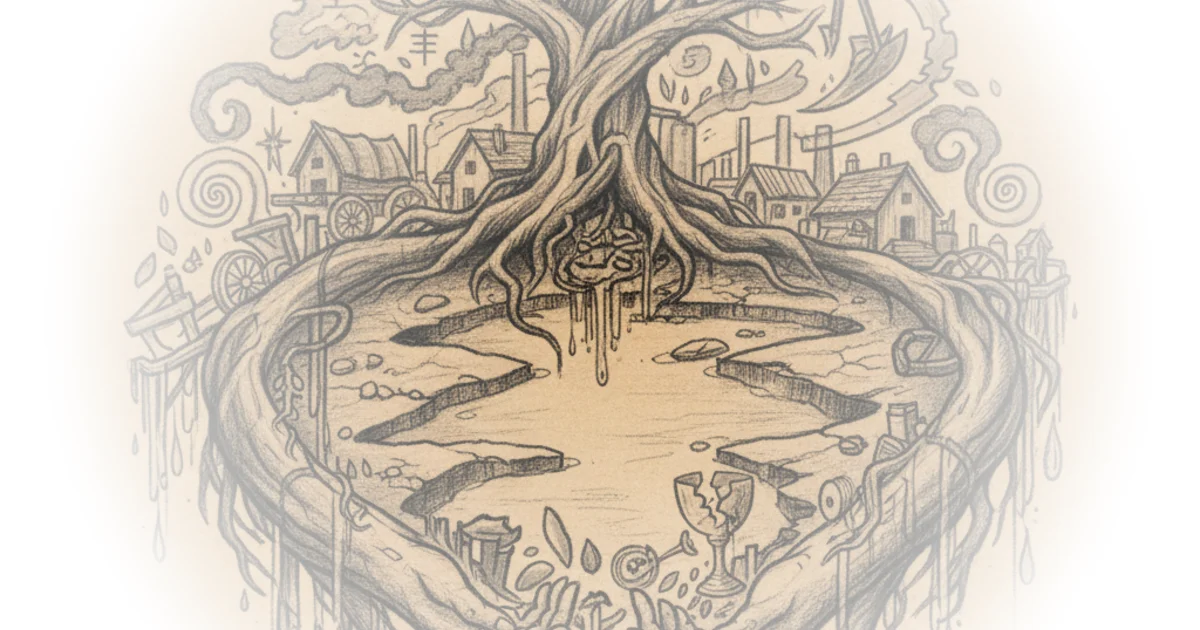
The coverage is particularly effective when it refuses to separate the "gifts" of settlement from the "damages." The text details how the arrival of Latter-day Saint ancestors in 1847 triggered a population boom that tripled in a decade, creating a modern Utah of over 3.5 million people. Yet, it insists that this growth is inextricably linked to the lake's decline. "These transformations are simultaneously glorious and disastrous," Wayfare argues. This dual perspective avoids the trap of simple villainy, instead presenting a complex web where the very systems that built the region's economy are now dismantling its foundation.
"Each number in these millions marks the arrival of a person into the world, one who— if you will— comes into being within a vast entanglement of inheritances of their own."
Critics might argue that focusing on historical settler actions distracts from the immediate, global drivers of climate change. However, the piece counters this by showing how local water diversion for crops like alfalfa directly reduced the lake's inflow to one-third of its natural streamflow. The argument holds up because it connects the specific agricultural choices of the 19th and 20th centuries to the current 70% loss in water volume, proving that local history is not separate from ecological reality.
The Cost of Prosperity
The article shines when it traces the "butterfly effect" of Utah's development, linking the Great Salt Lake to global food systems and recreational industries. It notes that the lake's natural engine for lake-effect snow supports a ski industry that draws millions, while brine shrimp harvesting now feeds nearly half the world's table shrimp. "Interactions creating world-famous recreational sites as well as global and national food systems between humans and the lake have, like a butterfly effect in motion, sent far-reaching gifts around the world," the editors note.
Yet, the piece does not let this prosperity obscure the human cost. It explicitly details the displacement of Indigenous communities, citing the Fort Utah Massacre of 1850 where up to 100 Timpanogos individuals were killed. The text includes a piercing observation from Darren Perry, Elder of the Northwestern Band of the Shoshone Nation: "It is not without irony that these Mormons who were pushed from their homelands as victims of hate, would soon do the same violence to others." This quote is the moral anchor of the piece, forcing the reader to confront the cycle of violence that accompanied the expansion of the valley.
The environmental consequences of this history are now coming due. The article warns that as the lake dries, dust laden with arsenic and other minerals rises, posing serious health threats. It draws a grim parallel to Owens Lake in California, where drying led to respiratory diseases and mitigation costs of 2.5 billion dollars. "Indeed, the lake's losses are human losses," Wayfare states plainly. This is a vital correction to the narrative that environmental damage is a distant, abstract problem; here, it is a direct threat to lung health and community safety.
Finding Sanctity in Tension
Where many environmental essays end in despair, this piece pivots to a theological and practical framework for healing. It introduces the idea that "it is often in the convergence of competing truths that sanctity is revealed," a sentiment shared by a professor quoted in the text. The argument suggests that holding the tension between the need for food and the need for water, or between the legacy of settlement and the rights of Indigenous peoples, is where new life begins.
Wayfare highlights concrete examples of this healing, such as the Wuda Ogwa Restoration project. Spearheaded by the Northwestern Band of the Shoshone Nation, this effort aims to restore wetlands along the Bear River—a site of historical massacre—while returning 13,000 acre-feet of water to the lake. "Volunteers, biologists, and engineers are supporting the effort; last November, hundreds of volunteers from Utah and Idaho helped plant 50,000 native trees and seedlings," the piece reports. This serves as a powerful counter-narrative to the idea that the damage is irreversible.
The article also reinterprets religious texts often used to justify domination over nature. It cites Doctrine and Covenants 59:18, which speaks of things made for human benefit, but then challenges the reader: "By presenting all things of the earth— including deep-sea creatures humans did not know existed for millennia— as made for human pleasure, the verse may incline us to forget that the earth, of which we are a part, has the power to destroy as well as to bless." This nuanced reading suggests that true stewardship requires humility and a recognition of our reliance on the earth, rather than a sense of superiority.
"When we recognize that the earth also stewards us, our role as stewards of the earth invites us to practice gratitude, humility, and joyful reciprocity."
Bottom Line
Wayfare's most compelling contribution is its refusal to separate the spiritual from the ecological, arguing that the healing of the Great Salt Lake requires a simultaneous healing of our historical and relational wounds. The piece's greatest strength lies in its ability to hold the "glorious" and "disastrous" aspects of settlement in the same gaze, offering a path forward that honors both the need for human flourishing and the rights of the land. The biggest vulnerability of this approach is its reliance on a specific faith-based framework, which may limit its resonance with secular audiences, though the practical policy recommendations regarding water conservation and crop transition remain universally applicable. For the reader seeking more than just data, this is a profound invitation to see the landscape not as a resource to be managed, but as a relationship to be repaired.