Michael Huemer delivers a stinging critique of the very machinery meant to restrain power, arguing that democracy may actually create the optimal conditions for state predation rather than preventing it. While high school civics teaches us that voting and constitutions are fail-safes against tyranny, Huemer suggests these mechanisms often fail because they rely on human behaviors—ignorance, irrationality, and self-interest—that work against them. For busy readers navigating a complex political landscape, this piece offers a sobering framework for understanding why government failures persist despite our best institutional designs.
The Anatomy of Predation
Huemer begins by dismantling the romanticized view of governance, reframing the state not as a protector but as a potential predator. He draws on the economist Mancur Olson's theory that governments often originate when "roving bandits decide to become stationary bandits," choosing to stay in one place and systematically extract resources rather than moving on after a single robbery. This historical lens challenges the standard social contract narrative, suggesting that the state's fundamental incentive structure is rooted in exploitation.
"Government creates the perfect conditions for predation. In most cases, people don't know what the government is doing and hence are unaware of its specific predatory acts."
The author argues that unlike individuals who might face retaliation if they harm others, the state operates with a monopoly on force where victims cannot effectively punish their abusers. This dynamic creates a vacuum of accountability. Huemer's analysis here is sharp: he posits that when one party holds vastly more power than another, self-interest dictates exploitation rather than cooperation. The implication is that without external checks, the mere existence of a powerful entity invites abuse, regardless of the leaders' personal morality.
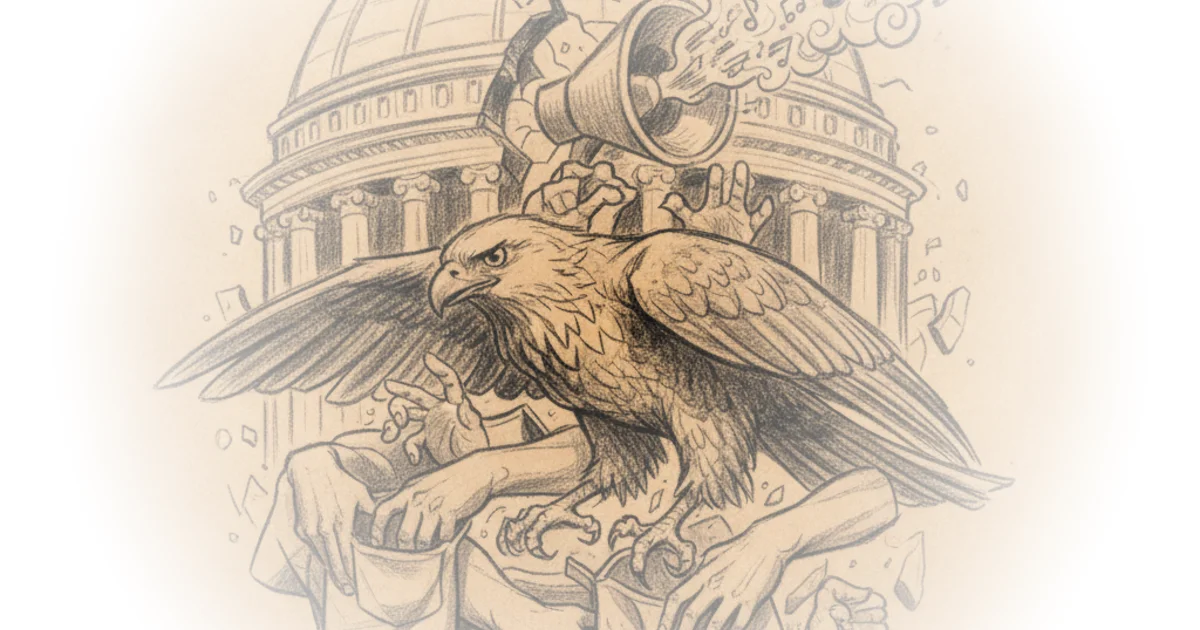
Critics might argue that this view ignores the genuine social goods provided by stable governance, such as public health and infrastructure, which often outweigh the costs of predation. However, Huemer's point stands as a warning: assuming benevolence in a system designed for coercion is a dangerous gamble.
The Illusion of Democratic Safeguards
The piece then systematically dismantles the five pillars of American democracy taught in civics classes. Huemer contends that these safeguards are theoretical rather than practical. He notes that while we are told leaders will be voted out if they abuse power, this assumes voters are informed and rational—conditions he argues rarely exist.
"Voters know perfectly well that their vote has almost no chance of making a difference to the outcome of any large election. It therefore makes no prudential sense for them to expend significant time or effort on choosing wisely."
This concept of "rational ignorance" suggests that it is actually logical for citizens to remain uninformed, as the cost of becoming educated about complex policies far outweighs the negligible impact a single vote has. Consequently, voters rely on superficial cues like appearance or identity rather than policy substance. Huemer extends this critique to the news media, describing it as a business model driven by "sensationalism, rage bait, and reports that confirm your audience's ideological assumptions" rather than truth-seeking.
"The way to capture attention is not to provide the most informative or socially beneficial reports about current social issues."
This framing is particularly potent because it explains why bad policy persists even when the public seems dissatisfied. If the information ecosystem rewards outrage over accuracy, and voters lack the incentive to dig deeper, the feedback loop required for democracy to correct itself is broken. A counterargument worth considering is that while individual votes may seem insignificant, collective action and social movements have historically driven change, as seen in the Civil Rights era. Yet, Huemer counters that such activism rarely addresses "routine inefficiency or miscellaneous corruption," which constitute the bulk of government activity.
Constitutional Failure and Incentive Structures
Perhaps the most damning section concerns the failure of checks and balances and the Constitution itself. Huemer points out that the system assumes each branch will restrain the others, but in reality, they often collude to expand their own power. He highlights how the appointment process for Supreme Court justices is frequently used not to ensure constitutional fidelity, but to secure judges who will "rubber stamp expansion of federal power."
"Almost no one cares or even thinks about it anymore, other than libertarians."
This refers to the widespread disregard for the Tenth Amendment, which reserves powers not delegated to the federal government to the states or the people. Huemer argues that nearly all federal activity is technically unconstitutional, yet this reality is ignored by the public and the courts alike. The historical context of Korematsu v. United States looms here as a stark reminder: even when the Constitution explicitly forbids certain actions, like placing citizens in concentration camps, the government has found ways to proceed when it deems necessary, with little effective pushback from the judiciary or electorate.
Furthermore, Huemer identifies a perverse incentive structure unique to the public sector. In the free market, failure leads to replacement; in government, failure often leads to increased funding and power.
"When they fail, we can't fire them and hire one of their competitors. So instead, we just give them more money and power."
This observation explains why agencies tasked with solving problems like crime or poverty often see those problems worsen while their budgets swell. The lack of a competitive mechanism removes the pressure to succeed, creating an environment where failure is not only tolerated but rewarded.
"Democracy works well at avoiding obvious, widespread, near-term disasters. It is not so good for problems that are subtle, or only affect a minority (especially an unpopular minority), or that will occur after the current politicians are no longer in office."
Huemer concludes by acknowledging that while democracy is flawed, it remains superior to dictatorship—a nod to Winston Churchill's famous assessment. However, he warns against complacency, noting that democracies are ill-equipped to handle long-term threats or the needs of non-voters, such as future generations and foreign nationals affected by domestic policy.
Bottom Line
Huemer's strongest contribution is his rigorous dissection of why democratic institutions fail to align with their stated goals, revealing a system where incentives favor expansion and opacity over efficiency and liberty. The argument's greatest vulnerability lies in its potential fatalism; while the diagnosis of institutional rot is compelling, it offers little roadmap for reform beyond a vague hope that humanity might "evolve beyond government." Readers should watch how this analysis applies to current debates on federal overreach and the growing disconnect between policy outcomes and public sentiment.