Paul Cooper's latest episode from Fall of Civilizations does something rare for historical podcasts: it treats geology not just as a backdrop, but as a primary character in the rise and fall of an empire. While most accounts of the Nabataeans focus on the romance of lost cities, Cooper argues that the very survival of Petra was a geological accident, and its collapse was an inevitable consequence of the shifting tectonic plates that birthed it. This is not merely a travelogue; it is a forensic examination of how human ambition interacts with deep time.
The Explorer and the Mask
The narrative begins not in antiquity, but in 1812, with the Swiss explorer Johann Ludwig Burkhart. Cooper frames Burkhart not as a heroic discoverer, but as a desperate man in a fragile disguise, navigating a landscape where his life hung on the success of a ruse. The tension here is palpable, driven by Cooper's use of Burkhart's own diary entries. "I was particularly desirous of visiting Moses's valley," Cooper quotes, highlighting the explorer's obsession. But the stakes were lethal. Cooper notes that Burkhart knew a close examination of these works would have been dangerous, writing that "a close examination of these works of the infidels... would have excited suspicions that I was a magician in search of treasures."
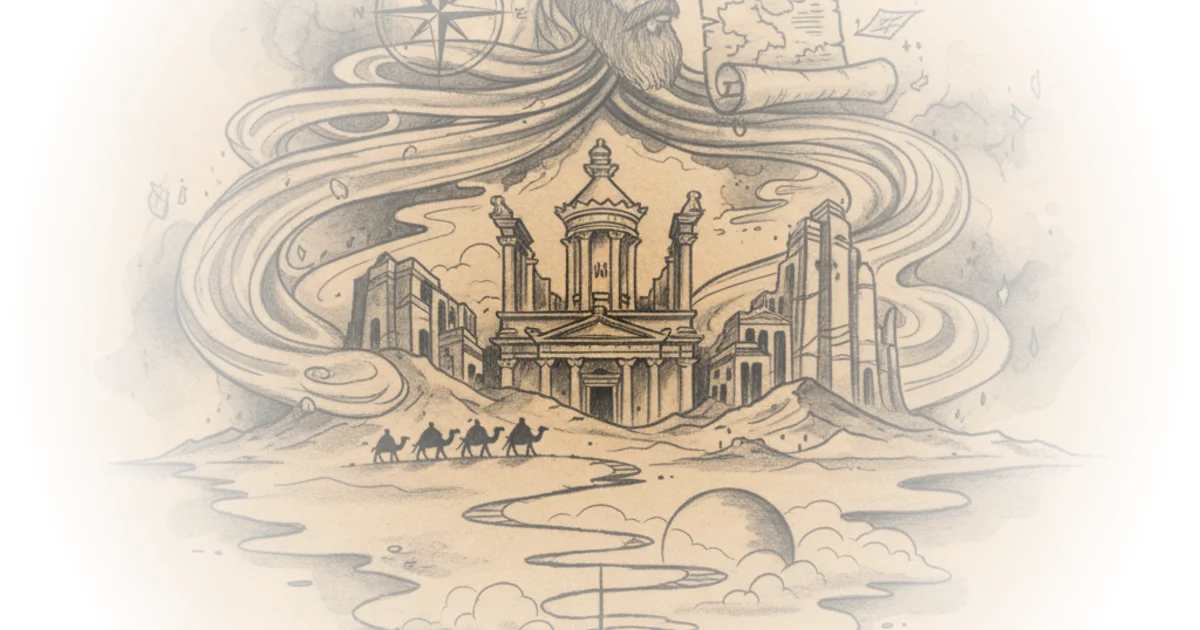
This framing is effective because it grounds the myth of Petra in the gritty reality of 19th-century exploration. It reminds us that the "discovery" was a moment of high-stakes performance. Cooper captures the claustrophobia of the approach, describing how the valley narrows until "the sky is not visible from below." The sheer physicality of the approach mirrors the psychological weight of the revelation. As Burkhart finally sees the structure, Cooper quotes his breathless reaction: "it is one of the most elegant remains of antiquity existing in syria... its state of preservation resembles that of a building recently finished." The contrast between the "gloomy and almost subterraneous passage" and the sudden emergence of the "enormous edifice" is a masterclass in narrative pacing.
The story of the Nabataeans is not just about how they built a city, but how they mastered a landscape that was actively trying to erase them.
The Geology of Power
Cooper shifts gears to explain why Petra exists where it does, diving into the specific stratigraphy of the region. He details the difference between the younger, grey DC sandstone and the older, iron-rich Um Ishrin sandstone. The argument here is that the Nabataeans did not choose a random spot; they chose a geological anomaly. The tectonic pressure from the African and Eurasian plates tilted the land, exposing the "rosy red" Um Ishrin layer that had been buried for 500 million years. "The winding interlaced patterns on these stones were formed by the shapes of riverbeds that ran across this landscape as much as 500 million years ago," Cooper explains, linking the aesthetic beauty of the city to ancient hydrological systems.
This geological deep-dive is the piece's strongest analytical move. It reframes the Nabataean success not as a miracle of engineering, but as a triumph of adaptation to a specific, fleeting window in Earth's history. The rock was soft enough to carve but hard enough to stand, a balance that would not last forever. Critics might note that this geological determinism risks downplaying the social and political ingenuity of the Nabataeans themselves. However, Cooper balances this by showing how they exploited this environment to control trade routes, turning a harsh desert into a corridor of wealth.
From Bandits to Kings
The narrative then traces the Nabataeans' evolution from nomadic tribes to a powerful trading empire. Cooper cites the 7th-century BC Assyrian king Sennacherib, who described the Nabataeans as unconquered nomads: "the nabatu who were not submissive at all." The transformation from "pirates and bandits" to protectors of trade caravans is presented as a rational economic shift. Cooper quotes the Roman writer Strabo, who noted that the Nabataeans "formally lived a peaceful life but later by means of rafts went to plundering the vessels of people sailing from egypt."
The core of Cooper's argument is that the Nabataeans understood the value of their location better than any empire that followed. They didn't just tax the trade; they became the trade. Cooper references the biblical account of King Solomon's wealth, noting the influx of gold from "the kings of arabia and of the governors of the country." This evidence suggests that the Nabataean economy was already a dominant force before they even built their great city. The transition to a settled life was a strategic move to secure their monopoly, not a surrender to civilization.
The Paradox of Settlement
Perhaps the most striking part of Cooper's analysis is his examination of the Nabataean cultural identity as described by the Greek historian Diodorus. Cooper highlights the paradox of a people who built a magnificent city while strictly forbidding the comforts of settled life. Diodorus wrote that for the Nabataeans, "it is their custom neither to plant grain set out any fruit-bearing tree use wine nor construct any house and if anyone is found acting contrary to this death is his penalty." Cooper interprets this not as primitivism, but as a deliberate political strategy: "they believe that those who possess these things are in order to retain the use of them easily come under the power of others."
This is a profound insight into the psychology of the desert. Cooper argues that the refusal to plant trees or build houses was a defense mechanism against conquest. If you have no roots, you cannot be pinned down. Yet, the very act of building Petra—a city of immense labor and permanence—undermined this philosophy. "The entire front from the base of the columns to the top of the ornaments may be 60 or 65 feet," Cooper notes, describing the sheer scale of the architecture. The city itself became a target, a fixed point for enemies to aim at, contradicting the nomadic ethos that had protected them for centuries.
Bottom Line
Paul Cooper's episode succeeds by weaving together geology, archaeology, and human psychology to tell a story of a civilization that was both timeless and fleeting. The strongest part of the argument is the connection between the specific geological conditions of the Um Ishrin sandstone and the unique cultural adaptations of the Nabataeans. The biggest vulnerability, however, is the reliance on second-hand accounts from Greek and Roman writers, which may romanticize the "noble savage" aspect of the nomadic lifestyle. Ultimately, this piece is a reminder that all civilizations are temporary tenants on a planet that is constantly shifting beneath their feet.