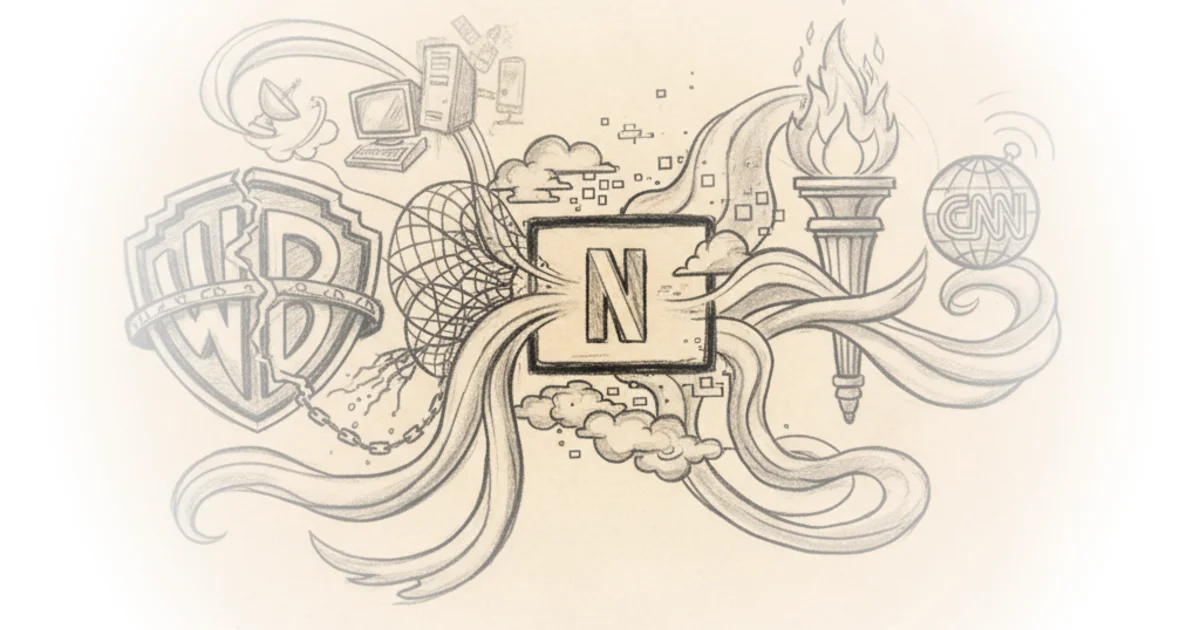
Matthew Yglesias performs a rare intellectual pivot: arguing that the most culturally destructive path for a historic film studio might be the one that looks best on a spreadsheet. In a landscape obsessed with antitrust crusades and geopolitical paranoia, he makes the surprising case that letting a streaming giant swallow a legacy media conglomerate could actually be the lesser of two evils for the future of cinema.
The Trap of Nostalgia and Antitrust
Yglesias begins by dismantling the romanticized view of independent studio ownership, reminding readers that the history of Hollywood is a graveyard of well-intentioned but disastrous corporate marriages. He notes that "there's a long tradition of American business leaders deciding it would be fun to be the CEO of a movie studio," citing how oil giant Gulf+Western once owned Paramount and Coca-Cola once owned Columbia Pictures. The lesson from these historical precedents, including the failed AT&T acquisition of Time Warner, is that non-media conglomerates often lack the patience and cultural intuition required to sustain a creative enterprise.
"AT&T's ownership of Warner ended badly, and they spun the entertainment conglomerate out via a new purchase that created a new larger conglomerate called Warner Bros. Discovery."
The author argues that while the current owner, Warner Bros. Discovery, has managed some hits, it has fundamentally failed its primary strategic goal: competing with Netflix. The core of Yglesias's analysis rests on redefining the market itself. He contends that the "subscription streaming video market" is a narrow construct that ignores the reality of modern attention economics. "Even though a Netflix-Warner combo would be a dominant player in the 'subscription streaming video market,' the actual market here — 'videos you can watch' — is extremely competitive," he writes. In this view, YouTube, Meta, and TikTok are the true rivals, making a monopoly impossible regardless of the merger.
Critics might note that this definition of the market conveniently sidesteps the specific power dynamics of content licensing and the ability of a dominant player to dictate terms to creators. However, Yglesias leans heavily on the idea that barriers to entry are low and that the threat of new competitors, perhaps even from AI-driven content generation like OpenAI's Sora, keeps the playing field level.
The Geopolitical Shadow
The most alarming aspect of the bidding war, according to Yglesias, is not the corporate strategy but the source of the capital. A hostile takeover bid from Paramount is backed by David Ellison, Jared Kushner, and sovereign wealth funds from Saudi Arabia, Abu Dhabi, and Qatar. "There's obviously something quite alarming on a political level about regime-aligned billionaires teaming up with Persian Gulf autocracies to gobble up American media properties," he observes. This framing shifts the debate from pure economics to national security and the integrity of the American information ecosystem.
"I would much rather see Netflix, whose executive chairman Reed Hastings is a great moderate Democrat and whose CEOs seem largely apolitical, grow than see this Ellison-Kushner behemoth expand."
Yglesias expresses deep concern that leftist antitrust enthusiasts, who often oppose consolidation on principle, might inadvertently become "useful idiots" for a political agenda that benefits the administration's allies by blocking a deal that would otherwise be approved. He suggests that the political optics of foreign state capital controlling American intellectual property are far worse than the potential reduction in competition that a Netflix merger might bring.
The Future of the Movie Theater
Perhaps the most poignant section of the commentary addresses the fate of the theatrical experience. Yglesias acknowledges the valid fears of labor unions, noting that "it is clearly better for creatives to have a larger rather than smaller number of outlets to pitch to." Yet, he argues that the prevailing legal doctrine prioritizes consumer welfare over producer welfare, and in a post-inflation world, asking consumers to accept higher prices to protect labor interests is politically untenable.
"We're instead in a world where if we don't get a few big hits per year out of the DC Universe, we're going to see more and more theaters close and there will be literally nowhere for movies of any kind to play."
Here, Yglesias makes a counterintuitive claim: Netflix, often vilified for killing the movie theater, might be the savior of the medium. He argues that the theater industry is in such a fragile state that it needs inventory more than it needs a specific type of owner. "Netflix says that if the deal goes through, they'll honor all existing agreements with regard to theatrical distribution," he points out, adding that the company has been increasingly willing to put original films on the big screen. The real danger, he suggests, is not consolidation, but the collapse of the distribution pipeline entirely.
"The thing that could squelch distribution would be consolidation of the movie theater industry — if Regal merged with Cinemark, for example. But that's also probably going to be unavoidable in the future because the business of operating a movie theater has fallen on very hard times."
He warns that if Netflix decides to treat second-tier intellectual property like the annual Christmas films, dumping them directly to the app, the cultural impact could be significant. "If Netflix decides to do a Dirty Harry remake, it would be a television show rather than a movie," he writes, noting that the corporate culture is oriented toward streaming. However, he balances this by praising Netflix's commitment to high-profile directors like Martin Scorsese and the Coen Brothers, arguing that the company is not hostile to art, even if its business model favors television.
Bottom Line
Yglesias's strongest move is reframing the debate from "consolidation is bad" to "who is the least bad owner for a dying industry?" His argument that a Netflix acquisition might prevent the total collapse of theatrical distribution is compelling, though it relies on the assumption that Netflix will continue to prioritize theatrical releases for prestige content. The piece's biggest vulnerability is its optimism about the long-term viability of the movie theater business in the face of technological disruption, a trend that may be more irreversible than the author admits.
"What really matters here is the art of film, not the business of movie theaters."
Readers should watch for how the administration handles the antitrust review of this deal, particularly whether the geopolitical concerns regarding foreign sovereign wealth funds will override the economic arguments for a merger. The outcome will likely define the next decade of American storytelling.