This piece cuts through the noise of geopolitical theater to reveal a startling truth: the most dangerous moment in US-China relations right now is not a loud trade war, but a deafening silence. Jordan Schneider, hosting former CIA analyst and National Security Council director Jon Czin, exposes how a "phony war" has evolved into a strategic stalemate where both superpowers are waiting for the other to blink. For the busy executive or policy watcher, the takeaway is counterintuitive: the absence of headlines does not mean the absence of conflict; it often signals a deeper, more calculated game of leverage is underway.
The Silence That Screams
Schneider and Czin open by diagnosing a "strange calm" in 2025 that defies expectations of immediate, chaotic escalation. Czin notes that while the world burns elsewhere, the US-China front is unnervingly placid. "It feels like the beginning of a Western movie where they say, 'It's quiet... too quiet,'" Czin observes, adding that as a parent, he "fears the silence more than the noise." This framing is crucial because it shifts the reader's anxiety from visible skirmishes to the invisible buildup of strategic positioning. The authors argue that this "fallow moment" is not a sign of peace, but a rare window where the underlying mechanics of the relationship are being recalibrated without the distraction of daily crises.
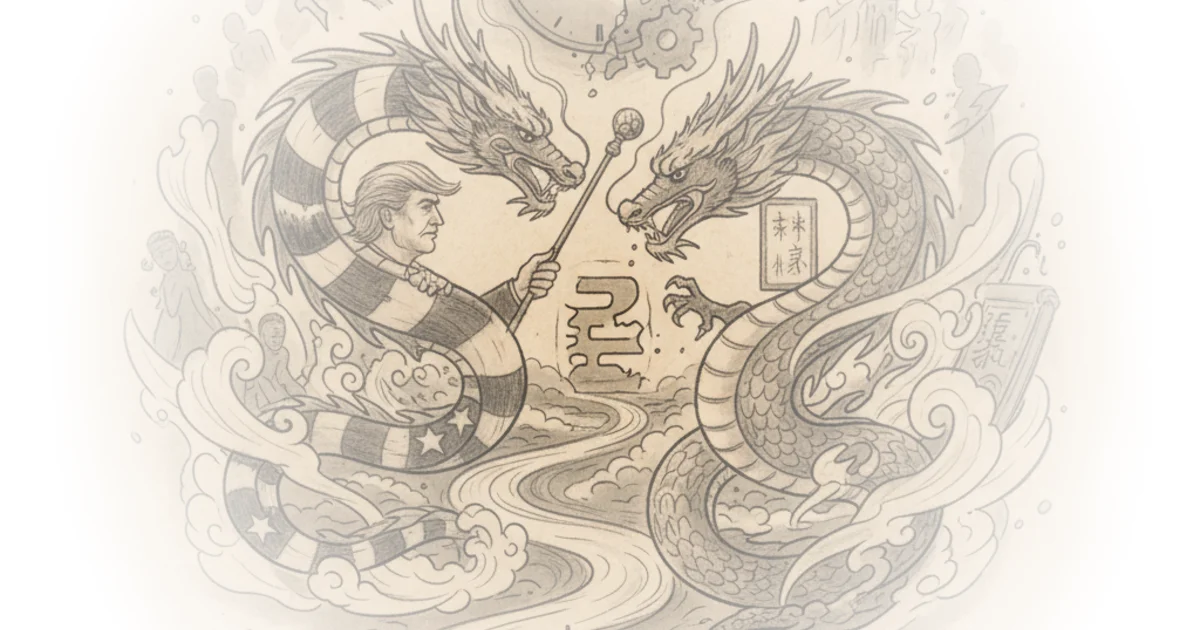
The commentary suggests that the administration's initial aggression has given way to a more complex reality. Czin describes the early months as a "Phony War," where tariffs were merely an opening act before the real confrontation. However, the dynamic shifted after a period of intense tit-for-tat escalation, leading to a walk-down that surprised many. "The trade war actually went much better for Beijing than they anticipated," Czin asserts, noting that China's rare earth leverage worked far better than Washington predicted. This assessment challenges the prevailing narrative that the US holds all the cards, suggesting instead that Beijing entered this round with a prepared toolkit and a psychological readiness that the US underestimated.
"Trump is his own China desk officer."
This single line from Czin, attributed to colleague Ryan Hass, encapsulates the chaotic internal dynamics of the executive branch. The authors argue that the lack of a sustained, coherent strategy is not a bug but a feature of an administration where personnel churn and the president's personal whims drive policy. The absence of a dedicated, professional China desk means that decisions are reactive rather than strategic. Czin points out that while the administration started with a desire to "clobber China," they quickly pivoted to "mollification" once they realized the depth of Beijing's leverage. This seesaw effect creates a policy environment where long-term goals are sacrificed for short-term political wins.
The Mosh Pit in the White House
The coverage delves into the internal friction within the administration, describing a "mosh pit" of competing factions where ideas break through by accident. Schneider highlights how personnel changes have diluted the influence of traditional hawks, allowing the president's personal inclinations to dominate. "There are fewer characters being defenestrated in this season of Game of Thrones so far," Czin jokes, but the underlying point is serious: the center of gravity has shifted away from a unified strategic front. The administration's approach is characterized by a "stir up some shit, declare victory, and move on" mentality, which is ill-suited for the complex, long-term competition with China.
Czin argues that the administration's misreading of China stems from a confluence of the "Peak China" narrative and a misunderstanding of the post-zero COVID economy. "You could only imagine him gravitating to [China's real estate problems] and saying, 'Yeah, I've really got these guys over a barrel,'" Czin speculates about the president's mindset. This psychological analysis is compelling because it explains why the administration might have overestimated its leverage. They assumed China would crumble under pressure, much like in the first trade war, but Beijing had learned from its mistakes. "Beijing had time to go back to the gym, pump themselves up," Czin says, noting that China's response in 2025 was far more alacrity and coordinated than in previous years.
Critics might note that attributing policy shifts solely to the president's personality risks underestimating the structural pressures facing the administration, such as economic constraints and congressional opposition. However, Czin's argument that "personnel is policy" remains a powerful lens through which to view the current volatility. The lack of a sustained strategy means that the US is often reacting to Chinese moves rather than setting the agenda.
Beijing's Long Game
On the Chinese side, the authors identify a clear, patient strategy: string the conflict along until the US midterm elections. "Their game plan is simply to string this along through the midterm elections," Czin explains, betting that the political pressure on the administration will force a deal. This is a sophisticated application of the "escalate to de-escalate" strategy, where Beijing uses targeted retaliation to create leverage without triggering a full-blown conflict. The conversation has shifted from grand strategic imbalances to specific, manageable issues like TikTok or soybean purchases. "China has effectively whittled down the conversation to a question of scoping," Czin notes, highlighting how Beijing has successfully narrowed the scope of the dispute to areas where they can make concessions without compromising core interests.
The authors suggest that this shift is a sign of Beijing's confidence. Unlike the first trade war, where China was caught flat-footed, they now have a playbook. "We know this is coming, and we will deal with it," is the sentiment Czin detected among Chinese officials and business leaders. This resolve, combined with the US administration's internal chaos, creates a favorable environment for Beijing to wait out the storm. The administration's expectation that the rare earth issue can be resolved in a year or two is dismissed by Czin as "very optimistic," suggesting that the leverage China holds is structural and long-term.
"The real issue with that is the timelines they've laid out. Expecting the rare earth issue to be resolved in a year or two seems very optimistic."
This observation underscores the disconnect between political rhetoric and economic reality. While the administration may declare victory on specific fronts, the underlying dependencies remain. Czin warns that even if tariffs are raised, "there's enough that routes in and around that — if China wanted to squeeze, they could do it." The leverage is not going anywhere, and the US cannot simply wish it away with executive orders.
Bottom Line
The strongest part of this analysis is its refusal to accept the surface-level calm as a sign of stability; instead, it reveals a high-stakes game of patience where the US is playing checkers while China plays chess. The biggest vulnerability lies in the assumption that the administration's internal chaos will persist indefinitely, potentially missing a window where a sudden, decisive shift in personnel or strategy could upend the current stalemate. Readers should watch for the approach of the midterm elections, as that is the clock Beijing is waiting for, and the moment when the "phony war" may finally give way to a real reckoning.