Scott Alexander tackles a pervasive modern anxiety: the feeling that our cities are collapsing, even as the data suggests otherwise. He proposes a provocative thesis—that when people scream about "crime," they are often using it as a polite proxy for "disorder," a category of annoyances that feels more urgent to the average citizen than the actual risk of violence. This is not a dry statistical exercise; it is a deep dive into why our collective mood feels so dark despite the absence of a statistical apocalypse.
The Proxy Problem
The core of Alexander's argument rests on a linguistic sleight of hand. He observes that while violent crime is historically low, the visceral experience of urban decay feels worse than ever. "When people complain about these things, they risk getting called a racist or a 'Karen'," he writes, "but when they complain about crime, there's still a 50-50 chance that listeners will let them finish the sentence without accusing them of racism." This reframing is crucial. It suggests that the "crime wave" narrative is a social shield, allowing people to express frustration with visible disorder without triggering immediate political defensiveness.
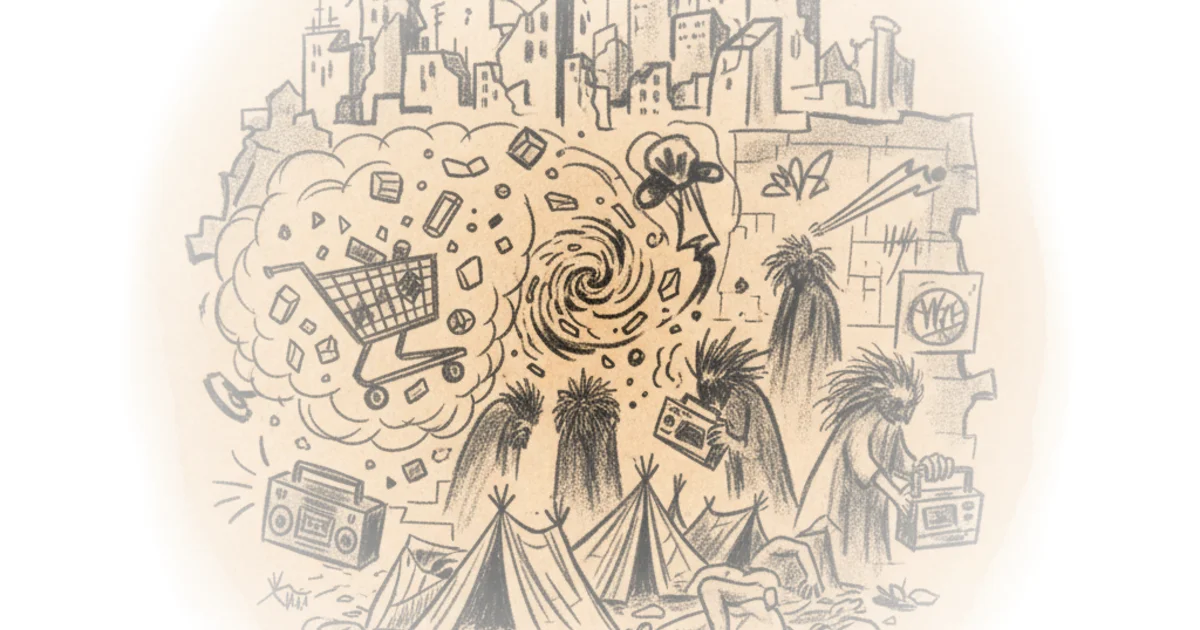
Alexander meticulously dissects the evidence for this rising disorder, and the results are surprisingly mixed. He notes that while littering has dropped 80% since 1969, and graffiti in New York has declined since the 1970s, the feeling of squalor persists. He points out that the data on shoplifting is a mess of conflicting reports, with some sources showing stability and others showing spikes. "The company replaced it with a survey of vibes among store owners, and dutifully reported that the vibes about shoplifting had never been worse," he notes with characteristic irony regarding a recent industry survey. This highlights a key vulnerability in the public discourse: we are increasingly relying on "vibes" rather than verified data to gauge societal health.
We look for our current problems in the past and cannot find them, then romanticize the problems the past really had.
The Historical Blind Spot
One of the piece's most compelling sections challenges our nostalgia. Alexander argues that we are comparing our current reality to a "local minimum" of crime and disorder that existed between the 1930s and 1960s, a period he suggests was an anomaly rather than the norm. He reminds us that the streets of turn-of-the-20th-century cities were "literally carpeted with horse feces and dead horses," a level of biological hazard that makes modern litter seem trivial. By invoking historical figures like Thomas Piper, the Belfry Butcher, and Sarah Jane Robinson, he illustrates that the past was not a golden age of safety, but a time where violence and squalor simply looked different.
This historical context is vital, yet it risks minimizing the very real suffering caused by modern homelessness. Alexander acknowledges this tension, noting that while tent encampments are hard to measure nationally, the rise in house prices post-pandemic offers a clear, non-ideological explanation for the increase in visible homelessness. "Having specific thoughts like 'house prices are up since the pandemic, so it's no surprise that there are more homeless people'... isn't just more grounded in the evidence," he argues. This is a powerful move: it replaces vague despair with specific, solvable policy failures.
Critics might argue that focusing on the type of disorder distracts from the severity of the current crisis. Just because horse manure was worse in 1900 doesn't mean a boom box playing at 200 decibels is acceptable, nor does it explain why a person living on the street feels more threatening today than a person living in a tenement did then. The psychological impact of disorder is real, regardless of the historical baseline.
The Vibes vs. The Data
Ultimately, Alexander refuses to choose between the statistical story and the emotional reality. He admits that even he feels the dread when walking through San Francisco. "I'm not a pragmatist who thinks you should be allowed to lie or do a biased survey of the evidence in order to live a normal life," he writes, "but I'm also not some kind of weird anti-pragmatist who makes a virtue out of ignoring evidence in order to keep despairing." This balanced approach is the piece's greatest strength. It validates the reader's frustration without surrendering to the narrative that civilization is ending.
He concludes that the perception of a "Revolt of the Public" is driven by a shift in who experiences these problems. As gentrification brings wealthier, more literate populations back into cities, they encounter disorder in ways their predecessors, who fled to the suburbs, did not. "As some areas gentrify and others worsen, there are shifts in who experiences these problems," he observes, suggesting that the national conversation is being hijacked by a specific demographic's sudden exposure to urban realities.
It's to push back against a sort of Revolt Of The Public -esque sense that everything is worse than it's ever been before and society is collapsing and maybe we should take the authoritarian bargain to stop it.
Bottom Line
Scott Alexander's analysis is a necessary corrective to the doom-scrolling narrative, successfully distinguishing between actual crime trends and the subjective experience of disorder. However, the piece's biggest vulnerability lies in its reliance on data that is often incomplete or lagging, particularly regarding homelessness and shoplifting in the post-2020 era. Readers should watch for new, granular data that can finally separate the "vibes" from the reality, rather than accepting the current stalemate between statistical decline and emotional escalation.