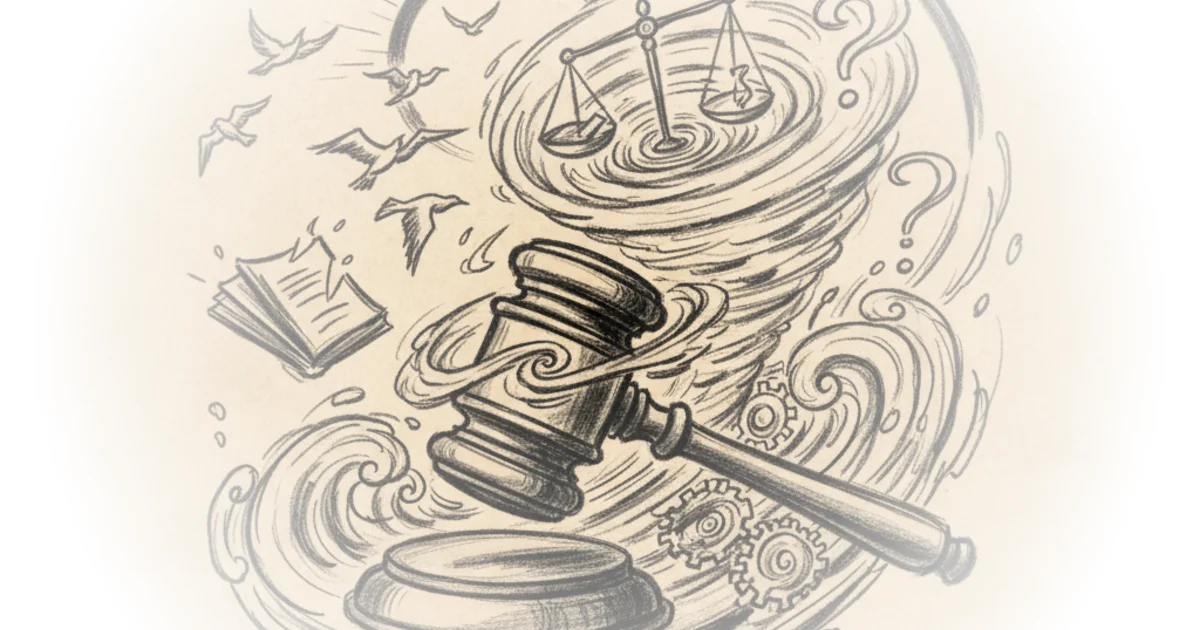
Steve Vladeck captures a Supreme Court operating at a fever pitch, where procedural maneuvers are reshaping the lives of millions faster than the news cycle can track. This isn't just a recap of legal filings; it is a stark warning that the Court's "shadow docket" has become the primary engine of policy, bypassing the deliberation we expect from the nation's highest tribunal. In a week defined by emergency stays and cryptic interventions, Vladeck argues that the real story isn't the final verdicts, but the frantic, opaque machinery deciding them before anyone has a chance to breathe.
The SNAP Crisis and Procedural Chess
The immediate human stakes are highest in the fight over the Supplemental Nutrition Assistance Program. Vladeck highlights how Justice Ketanji Brown Jackson's intervention was a calculated move to force the Court's hand. "Justice Jackson's intervention Friday seemed calculated to dramatically increase the odds of a ruling by the Supreme Court on a stay pending appeal by the end of this week," he writes. This wasn't just legal posturing; it was a race against hunger. By setting a strict 48-hour deadline for the First Circuit to rule on the administration's request for an indefinite stay, Jackson effectively removed the Court's ability to wait out the political storm.
The administration's refusal to use available funds to prevent a lapse in November payments has turned a budgetary dispute into a constitutional crisis. Vladeck notes the precarious timing: "Whether that comes with a whimper, rather than a bang, remains to be seen." If Congress passes a deal to end the government shutdown, the case could vanish, rendering the Court's decision moot. This creates a dangerous precedent where the judiciary is held hostage by legislative gridlock. Critics might argue that the Court should simply wait for Congress to act, but Vladeck's framing suggests that waiting is a luxury the administration cannot afford when it is actively withholding funds.
The Supreme Court's news cycle seems to be reaching peak 2025.
The Illusion of Certainty in Tariffs and Marriage
While SNAP demands immediate action, other cases reveal the Court's growing unpredictability. In the tariffs cases, oral arguments suggested a Court far more skeptical of executive power than the administration anticipated. Vladeck observes that Solicitor General D. John Sauer "received especially skeptical questions from Chief Justice Roberts, Justice Barrett, and, perhaps most intriguingly, Justice Gorsuch." Yet, he cautions against reading too much into these exchanges. "Between that and Justice Gorsuch's thoughtful, challenging questions to both sides... it's hard to be confident that what many, if not most, of us heard on Wednesday is going to translate into the final ruling in the case."
This unpredictability extends to the Court's handling of social issues. Vladeck dismisses the media frenzy around Kim Davis's petition to overturn same-sex marriage protections as largely performative. "I've written before about why I think the media obsession with this petition is not just unjustified, but affirmatively harmful," he argues. The core of his point is that the Court rarely grants review in such cases unless the vehicle is perfect, and Davis's case is not it. This analysis is crucial for busy readers who might otherwise panic over a procedural step that is likely just a formality. The real danger, Vladeck suggests, lies not in this specific petition, but in the Court's broader willingness to entertain challenges to established rights.
The Shadow Docket and National Guard Deployments
The most alarming trend Vladeck identifies is the erosion of the balance of power in emergency applications. The Court's recent decision to grant a stay in the passport sex-marker case sets a troubling tone for future rulings. "The passports ruling is almost certainly a harbinger (and, to my mind, an ominous one) of how the Court is going to rule later this term when it finally takes up on the merits a direct challenge to overt discrimination on the basis of transgender status," he writes. The Court's willingness to accept the administration's claim that listing biological sex at birth is "merely attesting to a historical fact" ignores the profound harm to transgender individuals.
This pattern repeats in the Illinois National Guard case, where the administration seeks to federalize troops in Chicago. Vladeck points out that the Court's unusual request for more briefing signals deep uncertainty, yet the stakes remain incredibly high. "Whatever the Supreme Court does in the Illinois case is going to have massive ramifications for the other litigation challenging National Guard deployments," he notes. The context here is vital: just days prior, a federal judge in Portland issued a permanent injunction against a similar deployment, calling the administration's factual claims "demonstrably false." This juxtaposition highlights a Court that is increasingly willing to grant relief to the executive branch even when lower courts have found the government's actions unlawful.
The Court has become increasingly difficult to predict in high-profile cases based upon the oral arguments alone.
The Bottom Line
Vladeck's analysis succeeds in cutting through the noise to reveal a Court that is prioritizing speed and executive deference over rigorous deliberation. His strongest argument is that the "shadow docket" is no longer a backwater but the main stage, where policy is made without the benefit of full briefs or oral arguments. The biggest vulnerability in this landscape is the public's inability to track these rapid-fire decisions, leaving millions of Americans vulnerable to rulings they never saw coming. As the Court moves toward a potential January or February decision on tariffs, and as the SNAP deadline looms, the true test will be whether the justices can reclaim the deliberative function that defines the judiciary, or if they will continue to act as a rapid-response arm of the executive branch.