For too long, the popular narrative of Black American Muslim history has been truncated, stopping abruptly at the mid-20th century with figures like Malcolm X and Muhammad Ali. Kahlil Greene's analysis of the new PBS documentary American Muslims: A History Revealed shatters this timeline, arguing that the faith was not a late arrival but a foundational thread woven into the very fabric of the American experiment from its inception. This is not merely a correction of dates; it is a reclamation of identity for a community often told they are perpetual outsiders in their own country.
The Founding Generation and the Enslaved Scholar
Greene immediately dismantles the assumption that Black Islam is a modern invention, pointing to the documentary's first episode which centers on Yarrow Mamout. This man, born into the Fula people of West Africa, was not a footnote but a central figure in early Georgetown who lived just blocks from the Capitol. Greene highlights how Mamout "spent four decades enslaved before a brickmaking bargain won him his freedom," only to become one of the first Black landowners in the District and a shareholder in the Columbia Bank.
The documentary's choice to focus on Mamout is strategic; it forces viewers to confront a reality where a free Black Muslim was navigating high finance and civic life while the nation was still drafting its constitution. As Greene notes, "Man is no good, he told Peale, unless his religion comes from the heart." This quote underscores that for these early figures, faith was an internal compass, not just a public performance. The fact that Mamout was painted twice by Charles Willson Peale—one of America's most celebrated portraitists—suggests a level of social integration and recognition that standard history curricula have long ignored.
Critics might argue that focusing on exceptional individuals like Mamout risks creating a "great man" theory of history that obscures the broader, silent majority who were enslaved and silenced. However, Greene counters this by noting that Mamout's existence is significant precisely because he was documented at all, proving that the community existed even when records are scarce.
The point is not that Yarrow was an exception. The point is that he was documented at all, while countless other Muslims of his generation were not.
Jefferson's Theory vs. Omar's Reality
The commentary shifts to a stark juxtaposition in episode two: the intellectual curiosity of Thomas Jefferson versus the brutal reality faced by Omar ibn Said. Greene draws a sharp line between how the founders treated Islam as an abstract concept for political debate and how they treated actual Muslims as property. Jefferson, who famously bought a translation of the Qur'an and once hosted an Iftar dinner for a Tunisian envoy, is shown to have "imagined Muslims as future citizens in the abstract while enslaving more than four hundred people whose own beliefs went unrecorded."
This contrast is the piece's most damning indictment of American hypocrisy. While Jefferson debated freedom of conscience in his library, Omar ibn Said was writing his autobiography in Arabic from a jail cell, covering the walls with scripture as an act of quiet resistance. Greene writes that the episode "lets those two artifacts sit in the same frame, the slaveholder's library and the captive's manuscript," forcing the audience to ask what religious liberty actually meant when one of its earliest writers was someone else's property.
The historical weight here is heavy. As Greene points out, Jefferson even "moved a White House dinner to sundown so a Tunisian envoy could break his Ramadan fast," yet he failed to act on behalf of enslaved Muslims who wrote to him seeking help. This selective application of liberty reveals that the founding generation's pluralism had hard limits defined by race and ownership.
The Great Migration and the Improvisation of Dignity
Moving into the 20th century, Greene examines episode five, which reconstructs the life of Florence Watts through a single, powerful photograph from 1922. This image captures four Black Muslim women in Chicago decades before the Nation of Islam gained national prominence. Greene emphasizes that these women were not waiting for a movement to define them; they were building one.
The documentary frames Florence's journey as part of the Great Migration, describing it as "a refugee story" where she fled the Jim Crow South only to face new forms of segregation in the North. Yet, in Chicago, Islam offered a radical alternative: "Islam offered Black families arriving from the Jim Crow South a sense of community and dignity in the modern industrial city." Greene notes that the women's head coverings were improvised from bedsheets, an act he interprets as "ingenuity," showing how they chose for themselves how to appear in a society that sought to erase their humanity.
This section effectively challenges the timeline of Black religious history. By situating Florence Watts and her contemporaries in 1920s Chicago, the documentary proves that the spiritual and communal structures often attributed solely to later movements were already thriving. The tragedy of Florence's life—her daughter's death due to medical negligence and her own passing shortly after—is not a failure of faith but a testament to its endurance against systemic violence.
A history that begins in 2001, or even in 1960, leaves more than three centuries of Black Muslim American life on the cutting room floor.
Reclaiming the Narrative
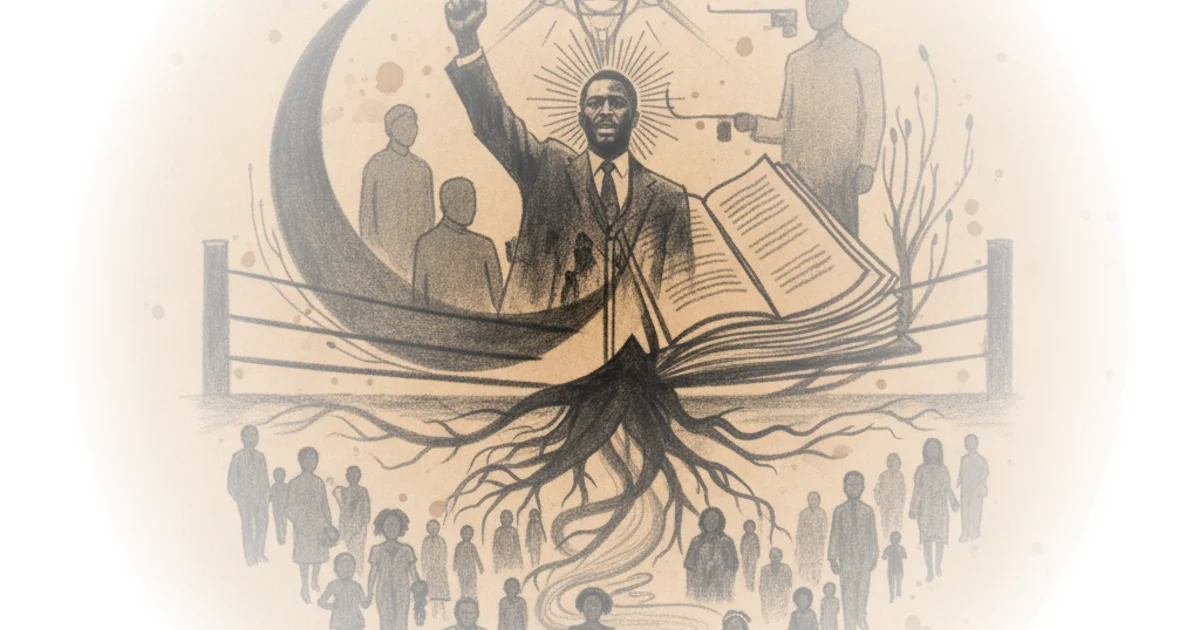
The throughline Greene identifies is clear: these stories are not prequels to Malcolm X; they are their own distinct chapters with their own theology and claims on America. The documentary's goal, as executive producer Zaheer Ali states, is to "challenge the idea that American and Muslim identities are somehow antithetical." This reframing is crucial in an era where political rhetoric often positions Islam as a foreign threat.
By tracing the lineage from Yarrow Mamout in 1800s Georgetown to Florence Watts in 1920s Chicago, the series exposes a continuous thread of Black Muslim presence that predates the nation's official birth certificate. Greene argues that this history matters now because it dismantles the "othering" narrative that has persisted for centuries. The evidence presented—portraits, ledgers, manuscripts, and photographs—is irrefutable proof that these communities were not visitors but architects of American society.
Bottom Line
Greene's commentary effectively uses the PBS documentary to expose a massive gap in American historical memory, proving that Black Muslim identity is as old as the nation itself. The strongest part of this argument is its refusal to treat figures like Yarrow Mamout and Omar ibn Said as anomalies; instead, it presents them as evidence of a systemic erasure that benefits from being corrected. The biggest vulnerability remains the scarcity of records for those who were not as fortunate or literate as these documented figures, but Greene wisely uses their stories as entry points to discuss the thousands whose names are lost. This is essential viewing for anyone seeking a complete understanding of American pluralism.