A Prime Minister's Fortune Meets a Toothless Ethics Regime
Mark Carney entered Canadian politics in 2025 carrying a financial portfolio unlike anything the country's ethics laws were built to handle. A decade at Goldman Sachs, two central bank governorships, and four years at Brookfield Asset Management left him wealthy, well-connected, and deeply entangled with the industries his government now oversees. Taylor C. Noakes, writing in The Walrus, traces how those entanglements expose the fragility of Canada's conflict-of-interest framework -- and why almost nobody in a position to fix it has any incentive to do so.
The scale of the problem is staggering. According to Duff Conacher, co-founder of the non-partisan watchdog Democracy Watch, Carney has interests in 554 companies subject to a blind trust and another 103 entries covered by an ethics screen. Ian Stedman, an associate professor at York University's School of Public Policy and Administration who has spent years advising officials on ethics rules, calls it unprecedented:
"The largest I've ever seen in Canada."
The Blind Trust That Can See
Upon becoming Liberal leader, Carney transferred his portfolio into a blind trust and established an ethics screen barring him from decisions affecting former employers. In theory, he can neither know nor direct how his assets are managed. In practice, the safeguards are riddled with gaps.
"He knows what stocks he put in it, including stock options he will definitely own for years."
That is Conacher's core objection. A blind trust does not erase memory. Carney held roughly 6.8 million dollars in unexercised Brookfield stock options as of late 2024, expiring sometime in the 2030s. Whether he cashed them in before the trust was established remains unclear. Meanwhile, the trustee is permitted to share updates on the trust's overall net worth, gains, and losses -- hardly the informational wall the word "blind" implies.
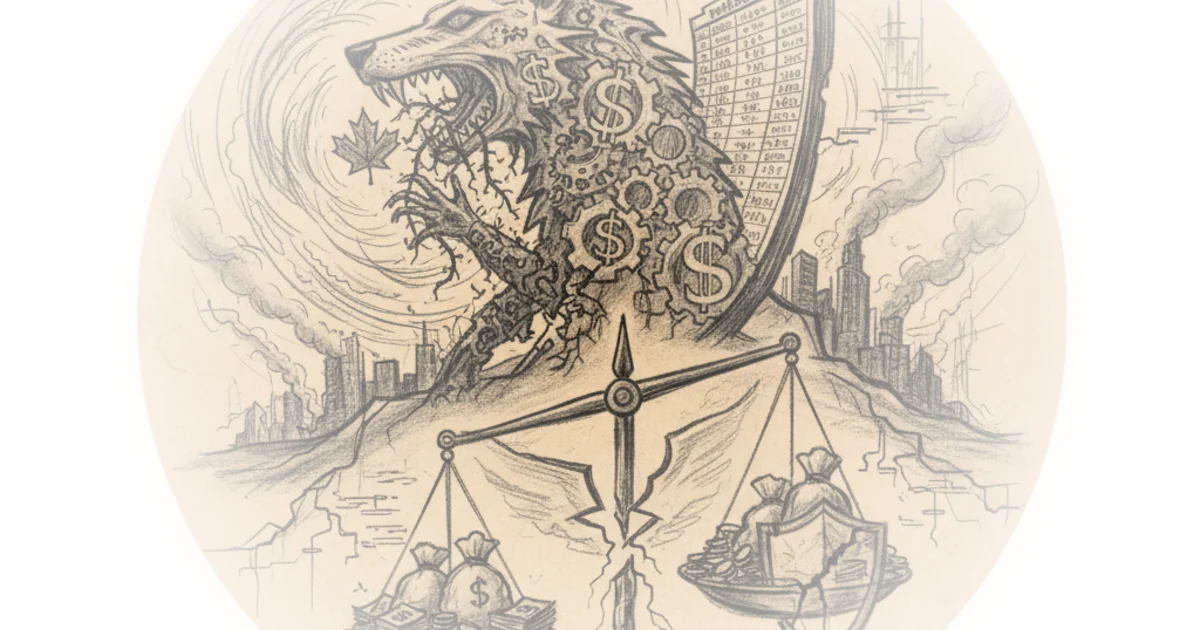
The day-to-day enforcement of the ethics screen falls not to the ethics commissioner but to an official appointed by the prime minister himself. Conacher finds this arrangement circular at best.
General Application, Specific Benefit
Canada's Conflict of Interest Act draws a line between decisions of "private interest" that benefit an identifiable person or firm and those of "general application" affecting an entire sector. The first is restricted. The second is not. Conacher argues this distinction creates an enormous loophole:
"If Carney makes a decision that helps twenty other companies alongside . . . Brookfield, then he's technically in compliance."
He goes further:
"Just because it helped other companies doesn't matter. If it helped Brookfield, where he has investments, then he's in conflict."
The scrapping of the carbon tax is a case in point. Carney framed the decision as cost-of-living relief, but Brookfield held more than 215 fossil-fuel assets producing over 159 million metric annual tonnes of carbon dioxide equivalent -- a figure revealed to be fourteen times higher than the company had publicly disclosed. Carney had served as Brookfield's head of transition investing, the executive nominally charged with the company's pivot to low-carbon business. The irony is thick.
It is worth noting, however, that the carbon tax had become a political liability for the Liberals well before Carney took the leadership. Polling consistently showed it was hurting the party. Attributing the reversal primarily to financial self-interest risks oversimplifying what was also a straightforward electoral calculation.
The Power of Doing Nothing
Conacher raises a subtler point that often gets lost in these debates: conflict of interest is not only about what a leader does. It is also about what a leader declines to do.
"What a lot of people forget is you can further your private interests, and help a company increase its profit, by not regulating them, by doing nothing."
Consumer protections not enacted, environmental rules not tightened, worker regulations not strengthened -- each instance of inaction can pad the bottom line of companies in a prime minister's portfolio just as effectively as a favourable policy decision. The Carney government's early record, Noakes notes, has repeatedly sided with corporate interests: backing Air Canada and Canada Post against striking employees, shelving the Digital Services Tax, and scaling back counter-tariffs.
A Pattern as Old as Confederation
Carney is not an aberration. He is the latest and largest manifestation of a problem that has persisted through Liberal and Conservative governments alike. Justin Trudeau placed his stock portfolio in a blind trust in 2013 but may have had foreknowledge of cannabis legalization that could have enriched it. Bill Morneau pushed pension reform legislation while holding over a million shares in his family's pension administration firm. In the 1980s, Sinclair Stevens approved federal funds for Magna International in exchange for a loan to his family's company, violated conflict-of-interest rules fourteen times by the Parker Commission's count, and was merely forced to resign from cabinet.
Justice W. D. Parker's recommendation was blunt: ban blind trusts entirely and require full divestment. Canada built an ethics framework in response but stopped short of adopting his most important proposals.
Trust Me, I Gave Up a Lot
When the CBC's Rosemary Barton pressed Carney on his financial conflicts during a March 2025 scrum, the prime minister turned defensive, telling her to "look inside herself" and suggesting her questions were ill-intentioned. His chief of staff, Marc-Andre Blanchard, described the ethics screen as meeting the "highest ethical standards." Conacher was unpersuaded:
"What he implied was, 'and therefore I'm a good person, and nobody should question my motives, and everyone should just trust me.'"
Subsequent ethics hearings undercut even that posture. Blanchard could not explain who screens the prime minister's texts and phone calls. The ethics commissioner, Konrad W. von Finckenstein, was unaware that a budget bill contained a tax credit benefiting a Brookfield-owned firm and acknowledged that Carney should not have met alone with a Brookfield executive.
Conacher's assessment of the law itself is blunt:
"It should be called the 'Almost Impossible to Be in a Conflict of Interest Act.' It is a truly Orwellian law. Everything Carney does is legal, but none of it is ethical."
Nobody Wants to Fix It
The Standing Committee on Access to Information, Privacy and Ethics is reviewing federal conflict-of-interest laws for the first time since 2012. But meaningful reform faces a structural obstacle: every party benefits from lax enforcement. The loopholes shielding Carney today could serve Pierre Poilievre tomorrow. Stedman puts it plainly:
"It's the ultimate conflict of interest in conflict-of-interest laws."
That said, a degree of caution is warranted before concluding the entire system is designed to fail. Ethics commissioners have found violations before. Public pressure has forced resignations. The machinery is weak, but it is not entirely decorative. The question is whether a portfolio of Carney's scale -- hundreds of companies across nearly every major Canadian industry -- has finally overwhelmed whatever enforcement capacity exists.
Bottom Line
Noakes makes a convincing case that Mark Carney's wealth does not merely test Canada's ethics laws -- it exposes them as structurally inadequate. A blind trust that the holder can mentally reconstruct, an ethics screen policed by the prime minister's own appointee, and a legal distinction between "private" and "general" decisions that lets sweeping conflicts sail through unchallenged -- these are not safeguards. They are theater. The deeper problem, as Conacher and Stedman both emphasize, is that the people who would need to fix the system are the same people who benefit from its weakness. Until that changes, Canadians are left relying on the personal integrity of leaders who, by definition, have every financial reason not to exercise it.