Tim Mak delivers a sobering reality check that cuts through the noise of diplomatic posturing: while world leaders debate meeting rooms, the war in Ukraine has entered a phase where Russia's economic fragility is colliding with its military overextension. This piece stands out because it refuses to treat battlefield statistics as abstract numbers, instead weaving them into a narrative of systemic collapse for the aggressor state. Mak argues that May 2026 may represent a turning point not just in territory gained or lost, but in the fundamental sustainability of Russia's war machine.
The Tactical Shift and Human Cost
Mak anchors his analysis in hard data from open-source aggregators like DeepState, revealing a stark contradiction in Russian operations. He notes that while Moscow launched a record-breaking 7,000 ground attacks in May, the actual territorial gain was negligible—a mere 14 square kilometers—resulting in a negative net gain for the first time since late 2023. This framing is crucial because it exposes the futility of Russia's current strategy: high-intensity attrition without strategic payoff.
"For the first time since October 2023, it endured a negative net gain."
The author contextualizes this by highlighting the devastation in key transport hubs like Kostiantynivka and Dobropillia, where Russian forces are razing cities to secure minor advances. This approach underscores a grim reality: the war is no longer about maneuver but about grinding destruction. Mak points out that despite these losses, Ukraine is regaining tactical initiative through innovation rather than just manpower.
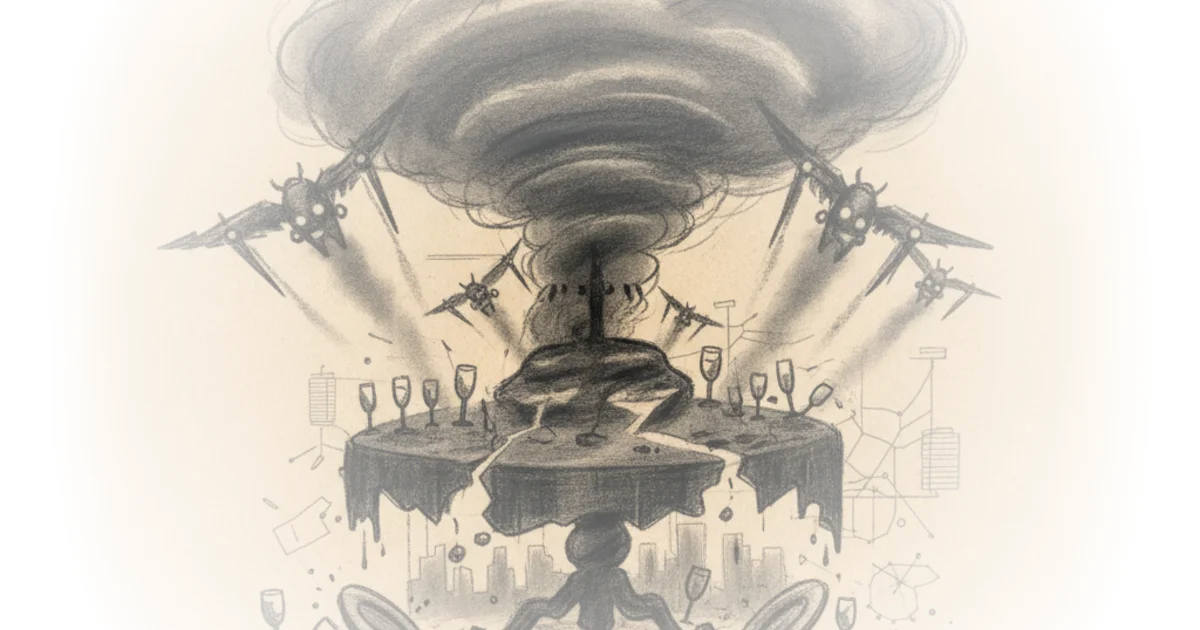
George Barros of the Institute for the Study of War (ISW) is cited by Mak to explain this shift. The Ukrainian armed forces are leveraging better intelligence and domestically produced weaponry to strike targets previously considered safe. Mak writes, "Ukraine is regaining tactical advantage at certain sections of the frontline," a claim supported by the deployment of the Vyrivniuvach, or 'leveller,' a guided bomb that offers parity against heavier Russian ordnance.
"It depends on whether this bomb is integrated into the weapon control system of the planes provided by our allies."
This observation highlights a critical dependency; while Ukraine has the ingenuity to build effective munitions, their full potential relies on Western integration. Critics might argue that focusing on technological parity overlooks the sheer volume of Russian artillery and manpower, but Mak's data suggests that quality is beginning to offset quantity. The human cost remains the central metric of this success, however. Citing President Zelenskyy's open letter, Mak reveals a casualty ratio where Russia loses six soldiers for every one Ukrainian.
"Again, this is more than 30,000 killed and severely injured Russians... We know that 63 percent of your frontline casualties are the dead."
This statistic is not just a number; it represents a demographic hemorrhage that no amount of propaganda can mask. The framing here is effective because it forces the reader to confront the scale of loss without sanitizing the violence.
The Illusion of Economic Strength
The second pillar of Mak's argument dismantles the image of Russian economic resilience projected at the St. Petersburg International Economic Forum (SPIEF). While the Kremlin staged a spectacle of wealth, Mak contrasts this with data showing a budget deficit that has already exceeded annual projections by 55 percent in the first quarter alone. The author relies on Serhii Fursa of Dragon Capital to describe the forum as "purely demonstrative," an attempt to convince both domestic and international audiences that the economy is stable.
"They are trying to make it as bright and expensive as possible to convince themselves and everyone around that everything is fine."
Mak's analysis goes deeper, explaining how Russia has burned through its National Welfare Fund, shrinking from $113.5 billion before the invasion to just over half that amount by 2026. The temporary boost in oil revenues due to Middle East conflicts is presented as a fleeting lifeline rather than a solution. Mak warns that Moscow's only remaining option may be printing money, a move that would trigger hyperinflation and further erode living standards.
"If they face a choice to either stop the war or fight, they can print money for a while. This will undermine the economic situation even more, but this is a decision that Putin can make."
This passage captures the desperation of the Kremlin's position. The argument holds up well against official Russian claims of prosperity, supported by tangible evidence of retail contraction and falling real incomes. However, one must consider that authoritarian regimes can endure significant economic pain for longer than democratic ones, potentially delaying any internal collapse despite these indicators.
"In the long term, if it becomes practically impossible for Russia to evade sanctions and Ukraine's strikes on oil infrastructure continue, the crisis can eventually push the war towards the end."
The Shadow of Escalation
Mak concludes by addressing the terrifying possibility of the conflict spilling beyond Ukraine's borders into NATO territory. He details recent Russian threats against the Baltic states and joint drills with Belarus, framing these as hybrid warfare tactics designed to intimidate rather than immediate invasion plans.
"What happens when Putin essentially threatens NATO and says, 'Hey, NATO is not prepared to deal with 600 drones entering the airspace in one night. So we can cause a crisis in the Baltic states and hit you with a bunch of drones, or you can basically just give up and give us Ukraine and let us just finish our war here?'"
This quote encapsulates the strategic gamble Moscow is taking: testing the resolve of the West while bleeding out in Ukraine. Mak notes that while Belarusian involvement remains limited to intelligence and logistics, the integration within the Union State poses a genuine risk. The recent drone incidents in Romania and Lithuania serve as stark reminders that the war's boundaries are already porous.
The author effectively balances the immediate battlefield reality with these broader geopolitical stakes, avoiding alarmism while refusing to downplay the danger. The argument suggests that Russia's aggression is driven by weakness, not strength, a paradox that defines this stage of the conflict.
Bottom Line
Tim Mak's piece succeeds in reframing the narrative from one of stalemate to one of Russian systemic failure, backed by rigorous data on battlefield attrition and economic decay. The strongest element is the synthesis of open-source intelligence with expert testimony, which strips away Kremlin propaganda to reveal a war that is becoming increasingly unsustainable for Moscow. Its primary vulnerability lies in the unpredictability of authoritarian decision-making; while the economy may be crumbling, the regime's willingness to absorb catastrophic losses before changing course remains an open question. Readers should watch closely how the integration of Western aircraft with Ukrainian munitions evolves, as this will likely determine whether Russia's economic fragility translates into a military breakthrough or merely a prolonged, bloody stalemate.